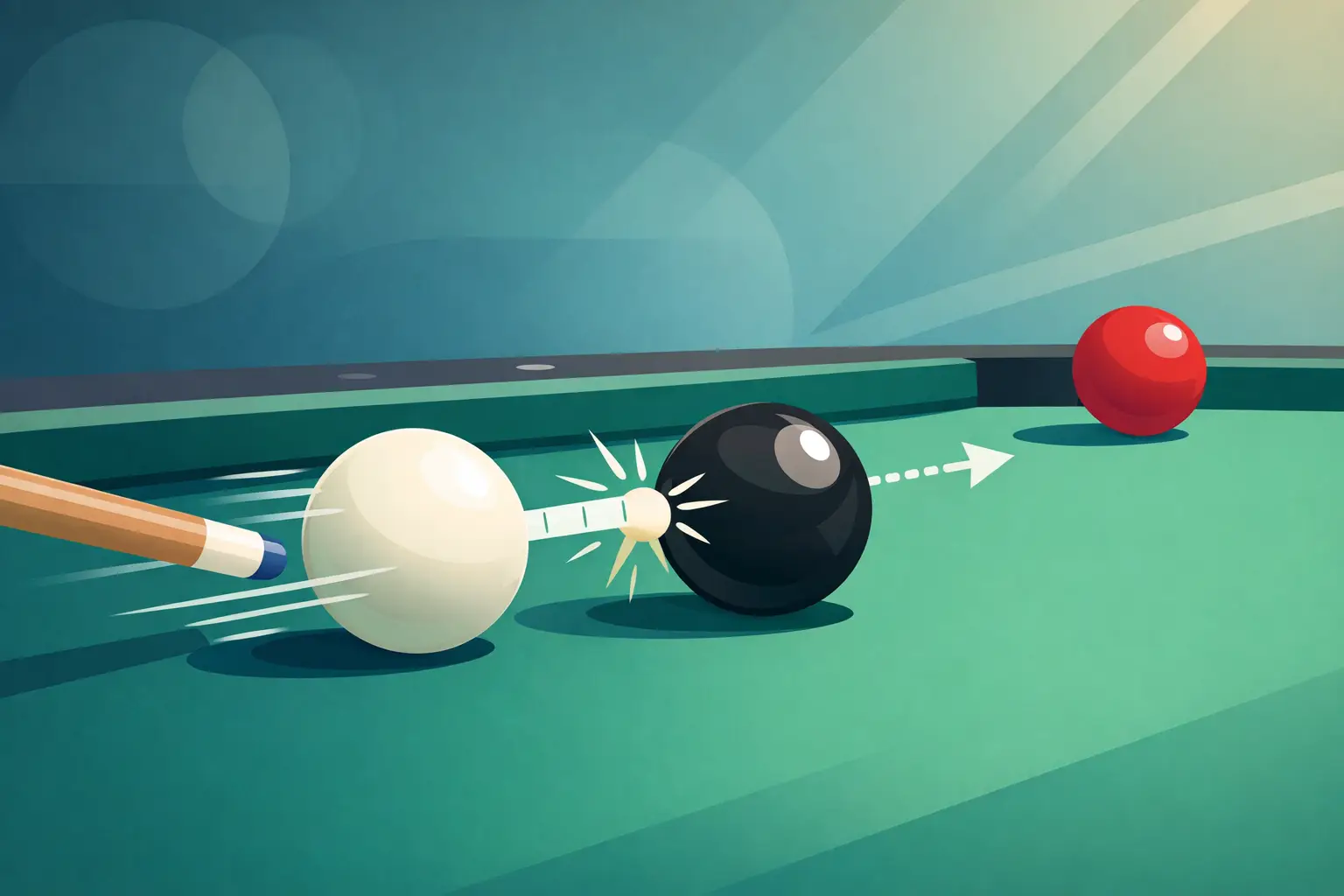
A stun shot is the difference between merely potting a red and leaving yourself the next red on the black. If you want to know how to play stun shots, start with this principle: strike the cue ball below centre, deliver the cue level, and let the backspin wear off just as the cue ball reaches the object ball.
At impact, the cue ball has no forward or backward roll. It is sliding. That is what produces the familiar stun reaction – the cue ball travels away from the object ball at a predictable angle rather than running through or drawing back. For players who want to build breaks with purpose, this is one of snooker’s essential control shots.
What a stun shot really does
A true stun shot is often confused with a screw shot because both begin with cue-ball contact below centre. The difference is timing. On a screw shot, the cue ball still has backspin when it reaches the object ball, so it returns towards you after contact. On a stun shot, the backspin has expired at the moment of contact, leaving the cue ball sliding.
That sliding cue ball departs on what players commonly call the tangent line – roughly at a right angle to the line of the object ball’s travel. The exact route can change with cut angle, pace, cloth conditions and any unwanted side, but the principle remains reliable enough to plan position around it.
A follow shot creates the opposite effect. Contact above centre gives the cue ball forward roll, so it continues beyond the object ball line after the pot. Each option has a place. Stun becomes invaluable when you need to hold the cue ball in the centre of the table, avoid a blocker, create a better angle on the colour, or take the cue ball across the table with measured certainty.
How to play stun shots: the essential technique
The shot begins before you get down. Decide where you want the cue ball to finish, not simply whether the ball will go in. Picture the object ball’s path to the pocket, then picture the tangent line that will send the cue ball into your chosen position area. This turns stun from a clever-looking shot into a repeatable tactical choice.
Strike below centre, but do not force it
For most medium-length stun shots, aim a small distance below the vertical centre of the cue ball. Think of a controlled low-centre strike rather than digging down towards the bottom edge. Going too low introduces excessive screw and makes the cue ball draw back. Going too high allows it to roll forward and destroys the intended angle.
How far below centre depends on the distance between cue ball and object ball. With a short distance, use less bottom because there is little time for backspin to fade. With a longer distance, you can strike slightly lower because the cloth will remove the backspin as the cue ball travels. There is no single chalk-mark position that works for every shot. Elite cue-ball control comes from recognising that the same contact point behaves differently over different distances.
Keep the cue as level as the shot allows
A level cue is the foundation of clean stun. Raise the butt of the cue too much and your tip action becomes steeper, increasing the risk of a miscue, unwanted swerve or a cue ball that bites into the cloth. The shot may still pot, but its route will be less dependable.
Set your bridge at a practical length, settle your head close enough to the cue to see the line clearly, and make sure the cue can travel through the ball without striking the cushion or your body. On shots close to a cushion, a perfectly level cue may be impossible. Accept the compromise, reduce the ambition of the positional route, and favour a simple pot if the margin is too tight.
Deliver through the cue ball
Stun needs a positive, decisive delivery. That does not mean hitting hard. It means accelerating smoothly through the cue ball with a still head and a straight cue action. A tentative jab often adds inconsistency, while an exaggerated punch can make the cue ball skid or send it too far along the tangent line.
Keep the grip relaxed in the final backswing, pause if that is part of your natural rhythm, then let the cue travel straight through. Stay down after contact. Many players lift their head because they are eager to watch the object ball, and the cue is pulled off line at the very moment accuracy matters most.
Match the pace to the position, not just the pot
The pace of a stun shot decides how far the cue ball travels after impact. A softer stun may hold the cue ball near the object-ball line. A firmer stun sends it further along the tangent line. Neither is automatically better.
If the next ball is nearby, remove pace from the shot and let the cue ball die into a manageable area. If you need to travel across open table, increase the pace while keeping the same clean low-centre contact. The key is to make the cue-ball journey deliberate. Hitting every stun shot firmly is one of the quickest ways to lose the white and end a promising break.
Read the tangent line before you address the cue ball
A useful practice habit is to stand behind the object ball and identify the potting line first. Once you know where the object ball is going, imagine a line perpendicular to it at the point of contact. That is your starting forecast for the cue ball’s route on a stun shot.
On a half-ball pot, the tangent line is especially visible: the object ball goes towards the pocket while the cue ball leaves across the table. On thinner cuts, the geometry becomes more deceptive, and even a trace of unwanted side can alter the outcome. Use middle-ball stun when learning the pattern. Adding side before you own the basic line is not advanced cue-ball control – it is unnecessary uncertainty.
The table itself also has a vote. New, fast cloth can preserve spin for longer; heavier or slower conditions can take it away sooner. A polished cue ball, a damp room, and balls that have not been cleaned can all affect throw and skid. Good players make these adjustments quietly. They do not blame the table after every positional error, but they respect its conditions before playing the shot.
Build stun into real break-building situations
The most valuable stun shots are rarely spectacular. They are the small positional shots that keep the cue ball below the blue, bring it off a red towards the black, or hold it in a narrow corridor between reds. In these moments, centre-table control is usually worth more than chasing the perfect angle.
Imagine a red near the right middle pocket with the black available. If a plain follow shot sends the white too high and a screw shot pulls it too low, a controlled stun can take the cue ball across into the black’s natural line. You are not trying to land on a pinhead. You are creating a larger, repeatable area from which the next shot feels simple.
This is where amateurs often overcomplicate position. They see one precise route and try to force it with side, power and a low-percentage pot. The stronger decision is often a straightforward stun that leaves a slightly longer colour but preserves the next red. Breaks are built by retaining options, not by demanding perfection from every cue-ball path.
Common mistakes that spoil a stun shot
The first is confusing low contact with a stun result. If the cue ball screws back, you did not play a bad stun shot – you played a screw shot. Move your contact point slightly nearer centre or allow more travel distance for the backspin to run off.
The second is striking too softly. With insufficient speed, the cue ball may begin to roll forward before it reaches the object ball. The result is an unintended follow shot. A stun shot needs enough initial backspin and enough pace for the timing to work.
The third is trying to stun with side spin too early. Side has its place, particularly when cushions are involved, but it magnifies errors in tip contact and can disguise the real cause of poor position. First make the cue ball leave on the expected tangent line with no side. Then introduce side only when it gives a clear advantage.
Finally, do not judge the shot only by whether the object ball drops. If the pot goes in but the cue ball repeatedly finishes on the wrong side of the next ball, your process needs attention. Position is the standard.
A practice routine that gives honest feedback
Place a red around the pink spot and the cue ball a comfortable distance away, with a natural pot to a corner. Choose a point on the table for the cue ball to reach after the pot. Play the same stun shot ten times, using no side, and assess the cue ball rather than the red.
Then change only one variable: move the cue ball further away, reduce the pace, or make the cut thinner. This teaches you how contact point, distance and pace combine. Randomly scattering balls may feel like practice, but it gives you little reliable feedback.
Once the basic action is settled, set up a red-colour-red sequence and use stun to bring the cue ball into a defined zone for each colour. Give yourself a realistic landing area, perhaps the size of a dinner plate, rather than expecting perfection. As control improves, make the zone smaller and introduce more demanding angles.
The Rocket Method teaches snooker as a connected game of technique, cue-ball knowledge and decision-making. A better stun shot is not just a mechanical gain. It gives you more routes, calmer choices and more chances to stay at the table.
The next time you practise, resist the urge to hit a ball hard simply because the shot looks impressive. Pick one red, one position area and one clean stun route. When you can send the cue ball there on command, the table starts to look very different.