BLOG
News, Tips & Updates

Is a Snooker Course With Lifetime Access Worth It?
A snooker course with lifetime access changes the way you can learn the game. Rather than trying to absorb every detail in a few weeks, you can return to the same elite instruction when a particular part of your game needs attention – whether that is your cue action, break-building decisions or composure under pressure.
That matters because meaningful improvement in snooker is rarely linear. A player may make an immediate gain in stance and alignment, then discover months later that the real value of those foundations is felt in long-potting consistency or more controlled cue-ball routes. The right course should still be there when that next question arrives.
Why lifetime access suits the way snooker is learned
Snooker rewards repetition, patience and precise self-correction. A good technical point is not always understood fully on first viewing, particularly when you are trying to take it to the table. You may know what a straight cue action should look like, yet still need several practice sessions before you can feel where your delivery changes under pressure.
Subscription-based training can create an unnecessary race against the clock. It encourages players to watch quickly, tick off lessons and hope the information sticks. That is not how the best players build dependable habits. They revisit key principles, test them in practice and refine their understanding as their game develops.
Lifetime access lets the course work at your pace. A beginner can spend time on grip, stance, sighting and a repeatable delivery. A more experienced club player can return directly to safety play, shot selection, positional routes and the mental demands of competition. The material does not become less useful as you improve. In many cases, you see more in a lesson once you have the experience to apply it.
What makes a snooker course with lifetime access valuable
Lifetime access alone is not a reason to buy a course. It is valuable only when the instruction deserves repeated viewing. If the content is shallow, dated or poorly organised, permanent access simply gives you permanent access to something you will not use.
The standard of the coaching comes first. Snooker is full of general advice that sounds convincing but lacks context: keep your head still, follow through, play the percentages. Each idea has value, but serious progress comes from understanding when it applies, why it works and how it connects to the next shot. Elite instruction should turn broad principles into decisions you can make at the table.
Production quality also has a practical role. Fine technical details are easy to miss in a dimly lit club or a short social-media clip. Clear camera angles, deliberate demonstrations and a logical lesson sequence help you study the details that influence consistency: hand position, body balance, cue delivery, timing and cue-ball contact.
Finally, a strong course needs to cover more than potting. Players do not lose frames only because they miss balls. They lose position, choose low-percentage routes, attack when safety is the better option and allow one error to affect the next visit. A complete course treats technique, tactics and mindset as parts of the same performance.
The advantage of returning at the right moment
There is a difference between watching a lesson and using it. Suppose you are struggling with the long red. You may initially return to a technical lesson looking for a single correction. After a few visits to the table, you may realise the issue is not simply cueing. Perhaps you are rushing your pre-shot routine, failing to commit to the line of aim or creating tension because you are thinking about the outcome.
That is where permanent access becomes more than a purchase feature. It gives you a reference point. You can revisit the relevant section before practice, focus on one change, then return afterwards to assess what you felt and what still needs work.
The same applies when your game plateaus. Most players have a period where they are potting reasonably well but cannot convert chances into meaningful breaks. At that stage, another hour of random practice rarely provides the answer. Returning to structured lessons on cue-ball control, route planning and risk management can show exactly where your break is ending unnecessarily.
For competitive players, lifetime access is particularly useful across a season. You may review your safety game before league matches, revisit tactical principles before a tournament or use mental-performance lessons when confidence is low. The course becomes an ongoing training resource rather than a one-off burst of motivation.
Learning from championship-level thinking
The greatest value in premium snooker education is access to the thought process behind excellence. Professional players see patterns and opportunities that many amateurs miss: the percentage route, the danger in a seemingly simple pot, the value of leaving a difficult safety rather than forcing a scoring chance.
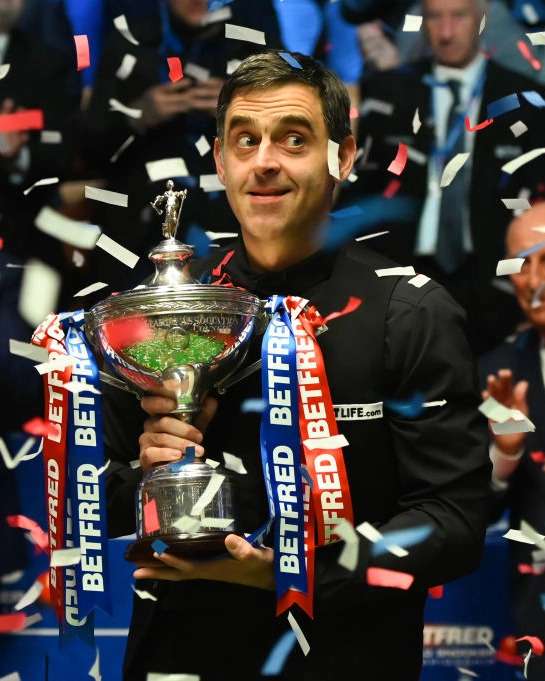
Ronnie O’Sullivan’s ability to combine extraordinary cue-ball control with rapid, intelligent decision-making has defined an era of the sport. Learning from a player of that calibre is not about copying every shot or trying to play at professional speed. It is about understanding the standards behind repeatable, attacking snooker – clear choices, disciplined basics and complete commitment to the shot.
The Rocket Method presents that knowledge in a 12-episode masterclass of nearly 12 hours, with Ronnie O’Sullivan supported by Alan McManus. That combination matters. It brings together exceptional playing insight and the measured analysis needed to explain the game clearly, from core mechanics through to the tactical situations that decide frames.
For a fan, there is also a deeper reward. You are not merely watching highlights or hearing broad commentary after a match. You are studying how an all-time great approaches the game, with the space to pause, replay and take the ideas into your own practice.
A one-off payment can be the smarter commitment
There is a clear financial appeal to paying once instead of maintaining another monthly subscription. But the bigger benefit is certainty. You know what you have bought, what you can access and that you can return whenever your game calls for it.
This is especially compelling for players whose table time varies. Work, family commitments, league fixtures and access to a local club can all affect how regularly you practise. A monthly model may feel wasteful during a busy spell, even though the next available practice session is exactly when you need guidance. Lifetime streaming removes that pressure.
It also makes sense for clubs and groups. A structured body of high-level instruction can support players with different needs, from newcomers learning the basics to established members sharpening their match play. The right group membership arrangement can give an organisation a premium learning asset without turning every season into another renewal decision.
There is a trade-off, of course. A one-off purchase requires more considered commitment at the outset. It is worth assessing whether the course is comprehensive enough for your ambitions, whether the instructor has genuine authority and whether you will make time to put the lessons into practice. Lifetime access rewards players who treat it as a long-term part of their development, not as something to watch once from the sofa.
How to get full value from permanent access
The best approach is not to consume every lesson in a weekend. Start with an honest assessment of your game. If your cue action feels unreliable, build your work around the technical foundations first. If your potting is solid but your breaks stall, focus on position and planning. If matches are undermining your confidence, give attention to routine, patience and decision-making.
Keep each practice session narrow. Watch the relevant section, choose one clear intention and spend enough time noticing the result. Filming your cue action occasionally or keeping brief notes after a match can make recurring patterns easier to spot. Then use the course to address those patterns with purpose.
Over time, your viewing habits should change. Early on, you may revisit demonstrations of stance and delivery. Later, you may spend more time studying why a particular safety choice is stronger, how to protect a lead or when to take on a difficult pot. That progression is exactly why lasting access has genuine sporting value.
The best snooker education does not promise instant perfection. It gives you the standards, knowledge and confidence to improve with every return to the table. Choose instruction worthy of revisiting, then let your practice turn elite insight into a game that holds up when the frame matters.
How to Plan Snooker Runouts With Real Control
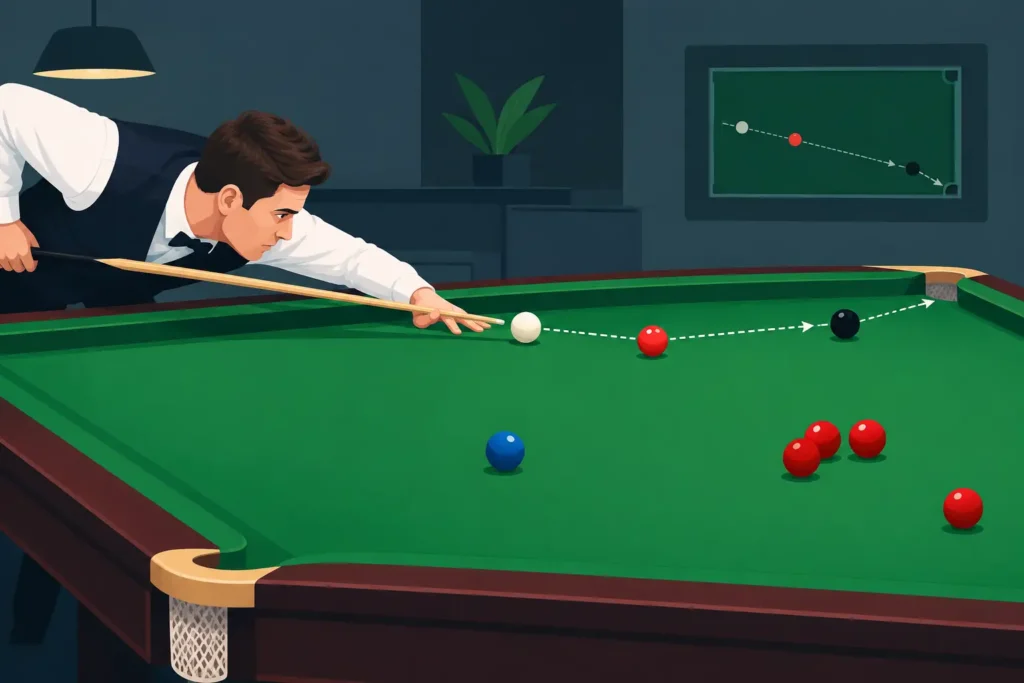
A runout is rarely won by the shot that gets applause. It is won two or three balls earlier, when you choose the right colour, leave the right angle and refuse the tempting pot that would leave you stranded. Learning how to plan snooker runouts means seeing the table as a sequence of decisions, not a collection of individual shots.
For club players, this is often the dividing line between a promising break and a score that genuinely changes a frame. Potting ability matters, of course. But once you can make routine balls, your progress depends on whether you can make the next shot easier than the last.
Start at the finish, not the first red
Before you play a scoring shot, identify the realistic finish. On a reds-and-colours break, that usually means locating the final workable red, the colour that takes you back into the pack or open reds, and the colour you want to use once the table begins to clear.
This does not mean trying to calculate a 70 break in perfect detail before your first stroke. Snooker is too variable for that. A cannon may open more than expected; a red may block a route; the cue ball may run six inches further than planned. The aim is to build a route with options.
Ask yourself three questions before committing: where is the next red, which colour offers the largest positional area, and what happens if I finish slightly short or long? If the answer to the last question is “nothing good”, the shot may be too precise for the stage of the break.
The best runout plans have breathing room. Professionals make difficult patterns look simple partly because they keep finding big landing zones. They do not demand perfect cue-ball speed unless the table gives them no alternative.
Separate the table into phases
A useful way to read a break is to divide it into three phases. First, establish scoring rhythm with accessible reds and colours. Next, develop the table by opening clusters, clearing awkward reds or improving the cue-ball route. Finally, simplify the finish by moving towards the colours and leaving the cue ball on the right side of the table.
Many amateur breaks end because the player tries to develop the table before earning control of it. If there are two open reds available, there is no urgent need to crash into a pack. Secure position first. Then choose the moment when a controlled cannon gives you a clear reward.
How to plan snooker runouts around position zones
Position is not a single point on the cloth. It is an area from which you can pot the next ball with confidence. The size and shape of that area should govern your shot choice.
For example, when coming off the blue to a red near the black end, you may have a generous zone across several feet of the table. When coming off the pink to a red tight to a cushion, you might have only a narrow line. The first route is more forgiving, even if it leaves a slightly longer pot.
This is where players often confuse ambition with quality. The route that creates a close-range pot is not automatically the best route. A slightly longer red, played from a stable angle with natural cue-ball travel to the black, can be a far better scoring proposition.
Use the colours for what they are designed to give you. The black is the highest-value scoring colour, but it is not always the best positional colour. The blue can offer a wider route through the middle of the table. The pink may keep the cue ball in the scoring zone when the black is blocked. The brown and green can be intelligent choices when they preserve a simple line rather than forcing side spin.
A strong break builder treats colour selection as a positional decision first and a points decision second. Over a long session, that discipline produces more chances to use the black anyway.
Choose routes that work at your current standard
There is a difference between the ideal professional route and the percentage route for your game. If a plan requires a thin cut, three rails and delicate left-hand side to land on a narrow red, it may be technically possible. That does not make it wise.
Build your runouts around the shots you can repeat under match pressure. Favour natural angles, simple stun, controlled screw and cue-ball paths that do not depend on excessive side. Side has its place, particularly when the natural route is unavailable, but it increases variables: contact, throw, pace and the reaction off cushions.
The same applies to opening the pack. Do not enter a cluster simply because you have seen elite players do it. Go in with a purpose. Know which red you are trying to release, where the cue ball is likely to finish, and which safety exists if the balls do not separate cleanly.
Sometimes the correct decision is to leave the pack alone and make a smaller break. That can feel conservative, but a mature player understands that a 28 followed by a good safety may win more frames than an ambitious 45 attempt that hands over an open table.
Plan your key shots before you are forced to play them
Every break contains a few shots that determine whether it continues. These might be the cannon into the reds, the recovery pot after imperfect position, or the transition from the final red to the colours. Spot them early.
When you see a key shot ahead, start preparing for it immediately. If you need to be above the blue to access a particular red, do not casually leave yourself below the blue one shot earlier. If clearing a red near the black spot will open the table, make sure you approach it from an angle that lets the cue ball escape rather than stop in traffic.
This forward thinking is especially valuable on the colours. As the reds disappear, each positional mistake becomes more expensive because there are fewer recovery options. Before potting the final red, decide which colour gives you the best route to yellow. Before taking the blue, know whether you want the cue ball on the left or right side of the table for pink.
The colours are not a formality. They are a separate runout with tighter margins. Treat them with the same planning discipline you used on the reds.
Use a decision routine, not guesswork
Good runout planning becomes faster when your thinking follows a reliable order. As you approach the table, assess the open reds, identify the available colours, notice clusters and blockers, then choose the shot that offers the best combination of potting certainty, position and table development.
Once the decision is made, stop reopening it. Indecision creates poor cueing. Commit to the line, visualise the cue-ball path and play the shot with a clear intention.
After every shot, reassess. Do not cling to the original plan when the cue ball has finished somewhere unexpected. The strongest players adapt without panic because their plan was never a rigid script. It was a framework built around priorities: stay on a red, keep the cue ball clear, preserve easy routes and avoid giving away the frame.
That is also why watching high-level snooker properly matters. Do not only admire the final pot. Watch where the player leaves the cue ball, which colour they reject, and how often they choose a larger positional area over a more spectacular route. The quiet decisions reveal the standard.
Practise runouts with a clear purpose
Random solo practice can improve your potting, but it does not always improve your break construction. Create situations that force planning. Place six reds in different scoring areas, nominate a target colour for each red, and judge the visit by whether you stayed in position rather than by the final score alone.
You can also practise one transition repeatedly: final red to a chosen colour, blue to pink, or pink to black. Start with generous angles, then narrow the positional zones as control improves. This develops the pace judgement that separates a planned route from a hopeful one.
For serious players, structured tuition can shorten the process considerably. The Rocket Method presents the game through the standards and decision-making of Ronnie O’Sullivan, helping players connect cue-ball technique with the tactical choices that make bigger breaks possible.
The next time you see an inviting red, resist the urge to ask only, “Can I pot it?” Ask what the pot gives you afterwards. That single habit turns a break from a series of chances into a runout built with intent.
Online Snooker Course vs Coaching: Choose Well
A missed black in the final frame rarely comes down to one bad stroke. More often, it is the result of a grip that changes under pressure, a cue action that loses its line, or a decision made without a clear plan. That is why the online snooker course vs coaching choice matters. Both can improve your game, but they solve different problems – and choosing the wrong one can leave you spending time and money without fixing the reasons you are stuck.
For many players, the strongest answer is not blind loyalty to one format. It is understanding what your game needs now: elite technical foundations, personal correction, a repeatable practice plan, tactical clarity, or accountability to put it all into action.
Online snooker course vs coaching: the real difference
An online snooker course gives you a structured body of knowledge that you can return to whenever you need it. The best courses do more than show attractive pots. They explain the detail behind a reliable stance, cueing action, sighting routine, positional routes, safety choices and match temperament. You are learning a system rather than collecting isolated tips.
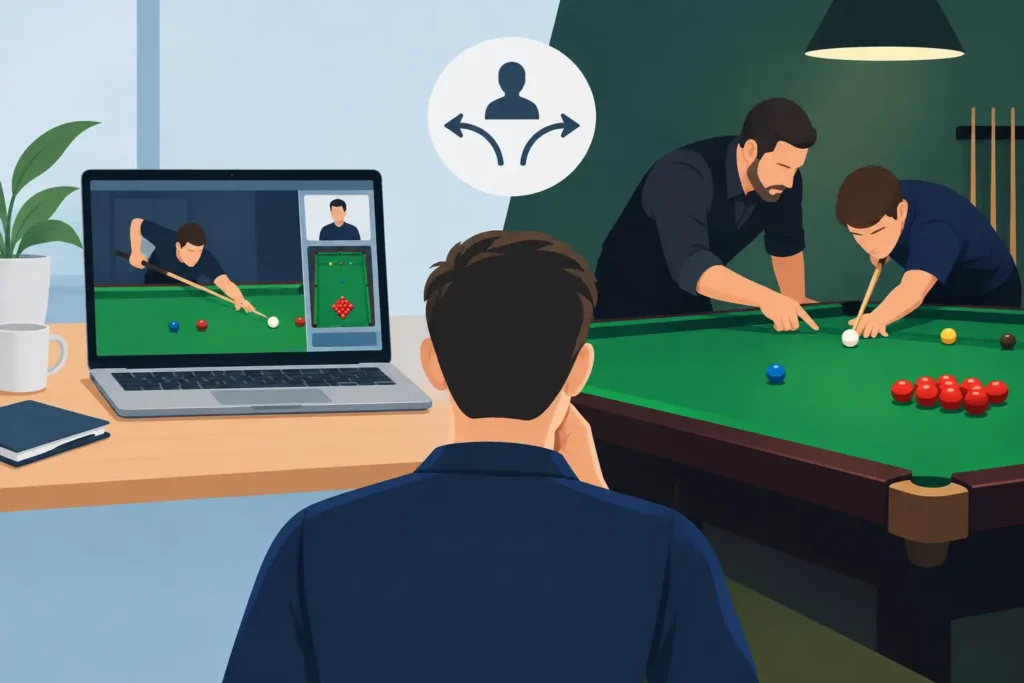
One-to-one coaching is different. A coach watches your individual movement, identifies the specific fault in front of them and responds in the moment. If your head rises through the cue ball or your bridge hand is unstable, immediate observation can be exceptionally valuable. Good coaching is personal diagnosis.
The trade-off is straightforward. Coaching offers direct feedback but is limited by appointments, travel, table time and the quality of the individual coach. A premium course offers depth, consistency and permanent access, but it cannot stand beside the table and stop you mid-routine. Neither format is automatically better. The right choice depends on how you learn, where you play and how clearly you can assess your own game.
When an online course is the stronger choice
A course is particularly powerful when your problem is not a single technical flaw but a lack of complete structure. Plenty of club players can pot well enough on their day. What lets them down is uncertainty: they change their cue action after a poor session, practise without a purpose, play safety by instinct, then wonder why improvement arrives in short bursts rather than lasting progress.
A well-built digital programme replaces that uncertainty with a sequence. You can work from fundamentals into cue-ball control, break-building, tactical thinking and the mental standards required when the balls matter. That order counts. Trying to improve advanced positional play while your address position varies from shot to shot is inefficient. The foundations must hold first.
The practical advantage is repetition. In a coaching session, you may hear an excellent explanation once and attempt to remember it next week. With a course, you can replay a demonstration before every practice session, slow down the detail, compare it with your own routine and revisit the lesson after a difficult match. This is especially useful for adult players balancing work, family and limited club time.
The Rocket Method is designed around that standard of access: nearly 12 hours of instruction across 12 episodes, led by Ronnie O’Sullivan and supported by Alan McManus. It gives players more than a glimpse of professional ability. It sets out the principles, decisions and standards behind it in a format available whenever the table is available.
The value of learning from elite examples
There is a meaningful difference between advice that merely sounds plausible and instruction shaped by championship performance. Snooker is full of well-meant club wisdom, much of it contradictory. Keep your elbow still. Do not think about your elbow. Hit through the ball. Do not force the cue through. Without context, players can become more confused, not more consistent.
Elite instruction does not remove the need for practice, but it gives that practice a higher standard. You see how great players approach the shot before, during and after contact. You learn that cue-ball control is not just a collection of side-spin shots, and that tactical strength is not simply playing safe whenever a pot looks awkward. The decisions connect.
Cost, access and pace
For players who live far from a specialist coach, the cost of regular tuition includes more than the hourly fee. There may be travel, table hire and the challenge of arranging a session around work. A one-off purchase with lifetime streaming access can provide better long-term value, particularly for a player committed to steady improvement over months and years.
It also lets you set the pace. A beginner may need several sessions on stance and cue delivery before moving on. An experienced player may go directly to break-building, safety exchanges or match management. The course remains available for both stages of the journey rather than expiring when a block of lessons ends.
When personal coaching earns its place
There are moments when nothing replaces a capable coach in the room. If you have practised the right concepts but cannot tell why your cue is still deviating, a trained eye can shorten the process. Small adjustments to alignment, bridge length, grip pressure or timing are often difficult to diagnose from feel alone.
Coaching can also create useful accountability. Knowing that someone will review your progress next Thursday may make you practise with more intent on Tuesday. For a player preparing for league competition, a coach can watch match play, expose poor shot selection and challenge habits that feel comfortable but cost frames.
The caution is that coaching quality varies considerably. A strong player is not always a strong teacher. The best coach explains cause and effect, gives you a manageable priority, and makes sure the change survives beyond the lesson. If you leave with six technical thoughts and no practice plan, you may have received information without direction.
Personal coaching is most effective when it builds on a clear framework. Use it to test your understanding, correct an entrenched issue or address a specific competitive goal. Do not rely on occasional sessions alone to supply every part of your development.
A practical way to decide
Ask yourself what happens when you miss. If you cannot explain whether the failure came from alignment, cue delivery, pace, spin, positional planning or decision-making, start with structured education. You need a complete language for your game before you can efficiently fix it.
If you know the fault but cannot remove it, coaching may be the next intelligent investment. For example, you may understand the principles of a straight cue action yet consistently pull the cue across the line. Videoing your practice and taking that evidence to a coach can make the session far more productive.
Your environment matters too. Players with reliable access to a table and the discipline to practise benefit greatly from an online course. Players who struggle to create a routine may gain more initially from booked sessions. Neither is a verdict on ambition. It is simply an honest assessment of what will lead to table time with purpose.
The strongest route is often both, in the right order
The online snooker course vs coaching debate becomes less useful when you see each option as part of a training plan. Build your knowledge first. Learn what high-level technique and decision-making actually look like. Practise one priority at a time until it is becoming dependable. Then use a coach selectively when you need individual feedback that no recording or replay can provide.
This approach protects your investment in coaching. Instead of using paid time to cover basic concepts you could study independently, you arrive with focused questions, a clearer feel for your own patterns and a better ability to apply the answer. The coach can spend more time refining your game and less time introducing it.
For clubs and group environments, the same principle applies. A shared course creates a common standard for members before practical sessions begin. Players can discuss the same routines, tactical ideas and technical language, making table-side feedback more specific and more useful.
Choose the format that keeps you improving
The best learning route is the one you will use consistently when the novelty has worn off. If you want a complete, repeatable education from the highest level of the game, an online course gives you the structure to build with. If a persistent technical issue needs eyes on it, personal coaching can provide the correction.
Do not chase improvement through scattered advice or another quick fix after a poor result. Give your practice a standard, measure what changes, and let every hour at the table move your game in a deliberate direction.
Ronnie O’Sullivan Table Philosophy Explained
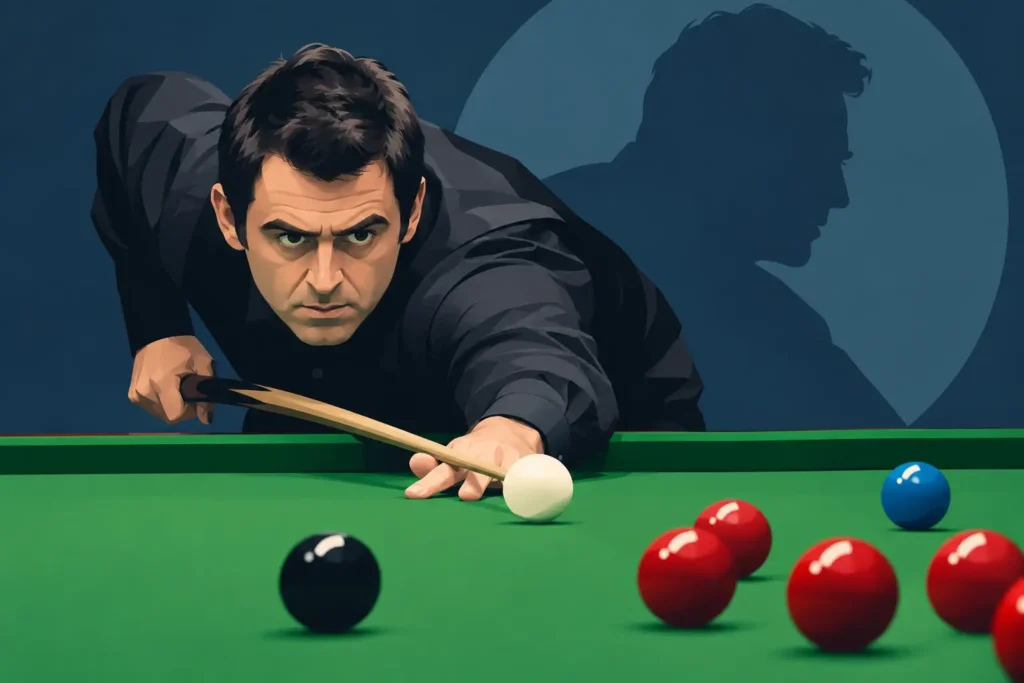
The best breaks rarely begin with a spectacular pot. They begin with a player standing behind the cue ball, seeing the whole table clearly and refusing to make the next shot harder than it needs to be. Ronnie O’Sullivan table philosophy is built around that standard: make the game flow, protect position, and let sound decisions create scoring opportunities.
For club players, this matters because most missed chances are not caused by a lack of ambition. They are caused by poor routes, awkward cue-ball placement and rushed shot selection. The great lesson in watching Ronnie is not simply that he pots balls at extraordinary speed. It is that his speed is usually the outcome of exceptional clarity.
The table is a map, not a collection of pots
A developing player often sees the most obvious red, then the most obvious colour, one shot at a time. That can produce a useful break, but it rarely produces control. A top player reads the table as a connected pattern. Every pot has a purpose beyond reaching the score.
Before addressing the shot, consider the colour that keeps the break alive, the likely red after it, and the area of the table the cue ball must reach. This does not mean planning twenty shots ahead with false certainty. Snooker changes quickly. It means recognising the high-value routes before committing to the first stroke.
Ronnie O’Sullivan’s table philosophy favours freedom through preparation. When the cue ball arrives in the right zone, the next shot looks natural. When it finishes on the wrong side of the black or drifts too close to a cushion, the player has to manufacture a solution. That is where rhythm disappears.
Position zones beat perfect spots
Amateurs can become obsessed with leaving the cue ball on one precise point. That is an admirable standard, but it can create tension and encourage over-hit or under-hit positional shots. A better objective is often a useful zone.
If the cue ball can finish in a broad area that offers two reds, or two routes back to a colour, the break has options. Options reduce pressure. They also make recovery possible when contact is not quite perfect.
This is not permission to be careless. It is a more professional way to think. The table seldom gives exact positions throughout a long break. Good scoring depends on repeatedly leaving workable angles, particularly around the black and pink, rather than demanding perfection from every stroke.
Cue-ball control is the real scoring weapon
Potting is visible. Cue-ball control is what separates a single red from a frame-winning visit. Ronnie’s approach makes this look uncomplicated because the cue ball is usually sent only as far as necessary.
That principle has practical value at every standard. Players often add side unnecessarily, force the cue ball around multiple cushions, or hit through a shot because they are thinking about the object ball alone. More speed and more spin create more variables. On a tight table, those variables can quickly become errors.
Start by asking a stricter question: what is the simplest route to the next ball? Sometimes it is a soft stun. Sometimes it is a controlled screw shot to hold the line. Sometimes the right answer is to roll through a short distance and accept a slightly thinner angle. The choice depends on the layout, but simplicity should be the default.
A useful practice discipline is to judge every positional shot on two outcomes: did the ball go in, and did the cue ball finish in a zone that made the next shot straightforward? If the pot drops but the next red is awkward, do not call it a complete success. This changes practice from potting drills into break-building training.
Pace is part of position
Cue-ball control is not only about spin. Pace decides whether a cue ball holds its line, reaches the desired side of a colour, or runs too far and loses the angle. It also changes how confidently a player can deliver the cue.
The best pace is usually the pace that leaves margin for error. A delicate shot played at exactly the minimum speed may be technically impressive, but if a slightly firmer delivery gives a wider positional area, it may be the better percentage choice. Championship snooker is full of subtle decisions like this.
For recreational players, the immediate gain comes from practising three distinct deliveries: a dead-weight roll, a controlled stun and a firm screw shot. Learn what each does on your home table before adding side. A player who knows pace well can make simple routes look effortless.
Attack with purpose, not impatience
Ronnie O’Sullivan is celebrated for attacking snooker, yet attacking does not mean attempting every difficult pot. The real aggression is often in the quality of the decision: taking a chance when the reward justifies it, then committing fully to the shot.
There is a major difference between a positive choice and a hopeful one. A positive choice has a clear line, a reliable cueing action and a sensible cue-ball destination if the pot is made. A hopeful choice is played because the player does not want to play safe, has not assessed the leave, or is chasing the feeling of a spectacular finish.
The table should decide the shot, not ego. If an attacking pot opens the reds and offers a natural route to the black, it may be the correct moment to score. If the same pot leaves the cue ball loose among reds with no colour available, the percentage can change completely.
This is where stronger tactical play begins. A safety is not an admission of defeat when the table does not offer a controlled attack. It is a way to regain the initiative. The highest standard of snooker combines ruthless scoring with the discipline to wait when the chance is not properly there.
Keep the mind clear between shots
The most valuable part of elite table philosophy may be psychological. Great players do not have perfect contact on every shot. They do not always get ideal splits or kind cannons. What separates them is their response when the table changes.
After an imperfect positional shot, avoid the emotional reaction that leads to rushed recovery. Pause, reassess the available balls and choose the best next option. There may be a thin pot, a containing safety, or a simple colour that keeps the break alive. The previous shot has already happened; it does not deserve another mistake.
A repeatable routine helps create this calm. Step back, select the shot and cue-ball destination, commit to the line, then deliver without changing your mind halfway through. The routine should be personal, but it must be reliable enough to remain in place when a frame becomes tense.
Speed can be an advantage only after the decision is made. Ronnie’s famous fluency is not a licence to rush. It is evidence of a mind that has processed the table, trusted the choice and stayed present in the shot.
Bring the philosophy into your next frame
Do not try to copy an elite player by playing faster or forcing ambitious shots. Copy the standard behind the performance. Look for routes that give you a choice of next ball. Send the cue ball the shortest sensible distance. Treat awkward position as a problem to solve rather than a reason to panic.
In practice, set up small scoring exercises and give yourself a clear brief: stay below the blue, return to the black side of the table, or make a five-red break without using side. Constraints expose where your positional control breaks down. They also teach you to see patterns rather than isolated pots.
The Rocket Method brings this level of thinking into structured, premium snooker instruction, led by the player whose game has made fluency look possible under the greatest pressure. But the principle belongs on every table: the next shot becomes easier when the current one has been chosen with purpose.
Next time you are in among the balls, resist the urge to prove how much you can force. Read the table, trust the simple route and give yourself a chance to keep playing.
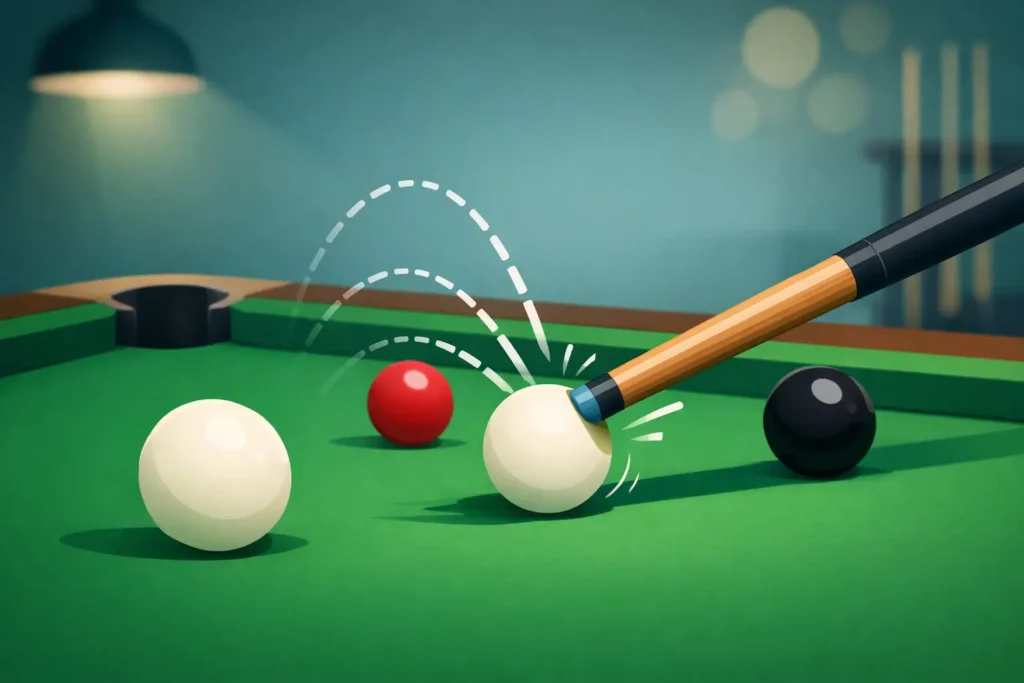
Why Does Snooker Cue Bounce? Causes and Fixes
A cue that pops upwards just as you strike the white can make even a simple blue feel uncertain. If you are asking, why does snooker cue bounce, the answer is rarely the cue itself. More often, it is a small breakdown in how your body delivers it: tension enters the grip, the bridge changes shape, the elbow drops too soon, or the cue is forced through the ball instead of allowed to travel.
At a snooker table, tiny vertical movements have consequences. The cue tip can strike the cue ball above or below its intended point, unwanted side can creep in, and your accuracy disappears under pressure. The good news is that cue bounce is usually a highly trainable issue. Once you understand what creates it, you can replace it with a quieter, more dependable action.
What does a bouncing snooker cue look like?
Players use the phrase in slightly different ways. Most commonly, it means the cue butt lifts or the shaft jumps upwards at contact. You may feel the cue come off the bridge hand, see the tip rise after impact, or notice that your follow-through finishes above the line of the shot.
Sometimes the visible problem is the cue ball hopping rather than the cue bouncing. That is different, although the causes often overlap. A cue ball that leaves the cloth has usually been struck with an elevated cue, a downward force, or an unintended low contact point. In either case, the key principle is the same: the cue needs to arrive level, free and straight.
Do not confuse a slight natural rise after the cue has travelled through the ball with a fault at impact. No player can hold a cue perfectly still forever. What matters is the delivery through the cue ball. If the tip is stable, the cue ball reacts as intended and you can reproduce the shot, there is no need to chase mechanical perfection.
Why does snooker cue bounce during the strike?
A tight grip creates an abrupt release
The most frequent cause is gripping too hard. When the hand squeezes the butt at the moment of contact, the wrist and forearm cannot swing freely. The player then makes a sharp, stabbing movement rather than a smooth pendulum action. The cue can kick upwards, especially when power is added.
Your grip should be secure enough that the cue does not slip, but relaxed enough that it can swing. Think of the fingers supporting the cue rather than crushing it. This is not about holding it loosely for the sake of it. It is about removing the tension that interrupts a straight delivery.
A useful test is to play a series of gentle centre-ball shots while consciously keeping the last two fingers soft. If the bounce reduces immediately, your grip pressure is part of the problem. Build the new feeling at low speed first. Trying to fix tension while hammering long pots is rarely productive.
The bridge is moving or too high
A stable bridge hand gives the cue a fixed channel. If your fingers are lifting, your hand is rocking, or the cue groove is too shallow, the shaft has room to climb at impact. This can be particularly noticeable on power shots, when the cue carries more momentum.
Set the bridge hand firmly on the cloth and spread the fingers enough to create a broad base. The cue should run through a consistent groove with no need for the hand to chase it. On an open bridge, make sure the thumb is pressed comfortably against the side of the forefinger. On a closed bridge, avoid clamping the shaft so tightly that it cannot move freely.
Bridge height matters as well. An unnecessarily high bridge raises the cue and makes a downward hit more likely. Unless the ball position demands otherwise, keep the cue as level as the table allows.
You are forcing the follow-through
A good follow-through is the result of a clean swing, not an extra shove after contact. Players who try to manufacture it often tense their shoulder, punch from the hand or drive the cue down into the cloth. The result can look like bounce because the cue is no longer travelling on one calm line.
For a normal pot, let the cue accelerate smoothly into the cue ball and continue naturally. There is no need to steer it towards the target after it has left the tip. The object ball has already received the information it needs.
This is especially relevant when you need more pace. Power should come from a longer, freer backswing and controlled acceleration, not from a violent final jab. A player with a composed action can generate substantial pace without making the cue jump.
The elbow or shoulder is changing the cue line
Your cue arm should provide a pendulum-like swing around the elbow through the strike. If the shoulder lifts, the elbow drops early, or the wrist flicks, the cue butt is pulled out of its level path. The tip may then rise, dip or cut across the cue ball.
This does not mean every player must look identical. Elite players have individual set-ups and rhythms. But the cue must still travel straight through impact. Use your mobile phone to film from directly behind the cue line and from the side. Look for the moment before contact, not only the finish. Does the cue stay level? Does the bridge remain still? Does your elbow begin dropping before the cue ball has been struck?
A premature elbow drop is common when players are trying to add force or when they are anxious about missing. Slow practice strokes can expose it quickly. If the cue lifts during the final backswing or delivery, reduce the pace and rebuild the motion without the pressure of potting.
Your stance is making level cueing difficult
Cue bounce can begin before you have even feathered the shot. If you are too upright, too cramped, or standing too far from the cue ball, you may have to lift the cue butt to see over the shot or make room for your body. That leaves you attacking downwards into the white.
Settle your head close enough to the cue to see the line clearly, while keeping your chest and cue arm free to swing. Your eyes should feel settled over the shot, not strained. A balanced stance makes it easier to keep the bridge still and the cue level for the full length of the delivery.
There are exceptions. When the cue ball is near a cushion, obstructed by another ball or positioned awkwardly, some elevation is unavoidable. The aim then is not a perfectly level cue, but the smallest amount of elevation that allows a clean strike.
How cue bounce affects cue-ball control
The visible jump is only one problem. A cue that bounces changes the contact point on the cue ball. A shot intended with a trace of stun can become unwanted top or backspin. A centre-ball pot may take accidental side. On tight positional shots, that difference is enough to turn a planned route into a difficult recovery.
It also damages trust. Once you have seen the cue ball react unexpectedly, you may begin to steer the next shot. That creates more tension, and tension produces more bounce. Breaking that cycle is one of the most valuable technical gains an improving player can make.
The longer the shot, the clearer the evidence becomes. On a straight long red, a cue that rises or twists will magnify any tiny error by the time the ball reaches the pocket. That is why long, gentle centre-ball practice is such an honest teacher. It shows whether your cue action is genuinely stable.
A simple practice routine to stop the cue bouncing
Start with the cue ball on the blue spot area and place a red or a coloured ball on its spot for a straight pot. Choose a short distance at first. Your task is not to prove you can pot it with pace. It is to deliver ten quiet centre-ball shots in which the cue finishes on the original line.
Pause at the end of your backswing for a moment. This removes the rushed transition that often causes a jab. Then let the cue move forward with a smooth acceleration. Hold your finish briefly, not as a pose, but to observe whether the cue stayed low and straight.
Next, repeat the exercise over a longer distance. If the cue starts bouncing again, do not simply try harder. Reduce the shot pace and identify what changed. Was the grip tighter? Did your bridge move? Did you lift your head to watch the result? Training becomes faster when you treat the miss as information rather than frustration.
For players who have plateaued after years of club play, structured technical work is often more effective than collecting another isolated tip. The Rocket Method focuses on the details that connect a sound cue action to scoring, safety and match confidence, taught through the perspective of Ronnie O’Sullivan and championship-level coaching.
A quieter cue action is not merely prettier to watch. It gives you a repeatable strike when the frame is close, the table is demanding and you need the cue ball to do exactly what you planned. Begin with one calm, level delivery at a time, and let consistency become the standard you expect from your game.

How to Develop Snooker Rhythm That Holds Up
A cue action can look sound in isolation and still collapse when the frame matters. The difference is often rhythm. If you are learning how to develop snooker rhythm, the aim is not to play faster or copy somebody else’s tempo. It is to build a repeatable pace that keeps your body quiet, your mind clear and your cue travelling through the ball with conviction.
Rhythm is what makes a good technique available under pressure. It connects the moment you assess the table to the moment the cue tip strikes the white. Without it, players rush simple balls, linger too long over difficult ones and make a different stroke for every shot. With it, the game feels calmer, even when the situation is not.
What snooker rhythm really means
Snooker rhythm is the consistent sequence of thought, movement and timing behind each shot. It begins before you approach the table and continues through your recovery after contact. Your walk into the shot, your stance, your feathering, the final pause and the delivery should have a familiar order and pace.
This does not mean every shot takes exactly the same number of seconds. A delicate safety, a long red and a powerful screw shot ask different questions of your technique. But the underlying routine should remain recognisable. The best players adjust to the shot without abandoning their process.
A player with poor rhythm often mistakes tension for concentration. They add extra feathers, re-address the cue ball repeatedly or hesitate at the point of delivery. Usually, the problem is not a lack of desire. It is a process that has not been trained deeply enough to survive doubt.
How to develop snooker rhythm through a fixed routine
The quickest route to better rhythm is to remove unnecessary decisions. Create a pre-shot routine you can use on virtually every ball, then practise it until it feels natural rather than forced.
Start standing behind the line of the shot. Choose the potting line, cue-ball path and intended pace before you step in. Be decisive here. Once you are down on the shot, your task is to deliver what you have already chosen, not reopen the tactical discussion.
Walk in along the line, place your feet, settle the bridge hand and lower your chin to the cue in the same sequence. Take a controlled number of feathers that allows you to sense the line and speed. Many players find that three to five purposeful feathers are enough. The exact number matters less than avoiding random, anxious movement.
Then include a clear final pause. Let the cue come back smoothly, stop for a fraction of a second, and deliver through the cue ball. That pause is not theatrical. It gives your body a stable moment from which to strike, preventing the snatched final stroke that costs so many routine pots.
After the shot, stay down long enough to see the object ball on its way. Rising early is often a sign that the mind has already moved to the next shot. Hold your finish, then assess the result without drama.
Let the shot determine the pace, not nerves
A natural rhythm has flexibility. For a straightforward black off the spot, you may move through the routine with more flow. For a thin cut to a corner or a demanding positional shot, you may need a little more time while standing behind the ball. That is sensible preparation.
What you must avoid is slowing down after you are already on the shot because fear has appeared. If uncertainty arrives, stand up. Reset fully. Trying to solve the problem while frozen over the cue creates mixed messages between mind and body.
Train rhythm before you train difficulty
Players often try to find rhythm by playing harder shots. In reality, rhythm is built on shots simple enough for you to notice your process. Start with a straight blue or black from a comfortable distance, played repeatedly with centre-ball cueing. Your score is not the only measure. Notice whether every repetition has the same preparation, stillness and finish.
Set a target of 20 successful pots, but restart the count if you rush the approach or abandon the final pause. This may sound demanding, but it teaches an essential principle: quality of process comes before quantity of balls made.
Next, use a line-up or a simple red-and-colour exercise. Do not turn it into a frantic scoring challenge immediately. Focus on arriving at each shot in balance and keeping the pace between shots composed. Walk around the table with purpose. A slow, uncertain approach drains confidence; a rushed one destroys accuracy. Find the measured tempo between those extremes.
Video is particularly valuable here. Film your routine from the side and from behind the shot line. Look for changes in your head position, feathering length, pause and follow-through. Players are frequently surprised by how different their rushed shots look from the repetitions that felt composed.
Build a rhythm that survives pressure
Practice-room rhythm is only the start. In a match, the score, your opponent and a difficult table can all interfere with your tempo. You need pressure practice that makes the routine your refuge rather than an optional extra.
Try setting yourself consequence-based challenges. For example, pot ten blacks from a chosen position, with a restart after any miss. Or play a short race against a friend and commit to using the complete routine on every scoring chance, including the obvious ones. The goal is not to manufacture nerves for their own sake. It is to prove that your sequence remains dependable when the outcome begins to matter.
Breathing can help, provided it stays simple. As you stand behind the shot, take one slow breath and make the decision. As you settle into the stance, allow the exhale to soften your grip and shoulders. Do not turn breathing into another complicated checklist. Its role is to lower tension, not occupy your attention.
Between visits, reset your rhythm rather than carrying the previous shot with you. A missed red, an unlucky kiss or a bad run of the balls does not require a new cue action. Return to the same preparation. Championship composure is rarely about never feeling frustration. It is about refusing to let frustration dictate the next delivery.
Common rhythm mistakes that hold players back
The first is copying a professional’s outward tempo. Ronnie O’Sullivan’s speed around the table is admired for good reason, but it rests on extraordinary clarity, balance and years of repetition. Trying to play quickly before your own routine is secure usually creates rushed cueing. Learn from elite principles, but build a pace you can repeat.
The second is adding more movement when confidence drops. Extra feathers and prolonged aiming can feel like care, yet they often dilute your commitment. If you have assessed the line properly while standing, trust that work when you are down.
The third is practising only when you feel fluent. Rhythm improves when you learn to restore it after disruption. Deliberately step away, walk around the table, then return and rebuild your routine. This teaches you that rhythm is not a lucky mood. It is a skill you can recreate.
Finally, do not confuse a smooth cue action with a soft one. A controlled, rhythmic delivery can still produce decisive screw, stun and pace. The cue should accelerate naturally through the ball, not be guided timidly towards it.
Make rhythm part of your long-term game
The strongest routines are personal, but their foundations are universal: clear decisions before the stance, stable set-up, purposeful feathers, a calm final pause and a committed finish. Keep those foundations fixed while allowing your style to develop.
At The Rocket Method, the standard is not simply to make more balls in practice. It is to understand the habits that make high-level snooker repeatable. Rhythm sits at the centre of that standard because it turns technique into performance.
Give your routine enough repetitions that it becomes familiar on a quiet practice table, then demand it when the frame tightens. The next time you feel yourself rushing, do not search for a magical correction. Step back, see the shot clearly and return to your rhythm.
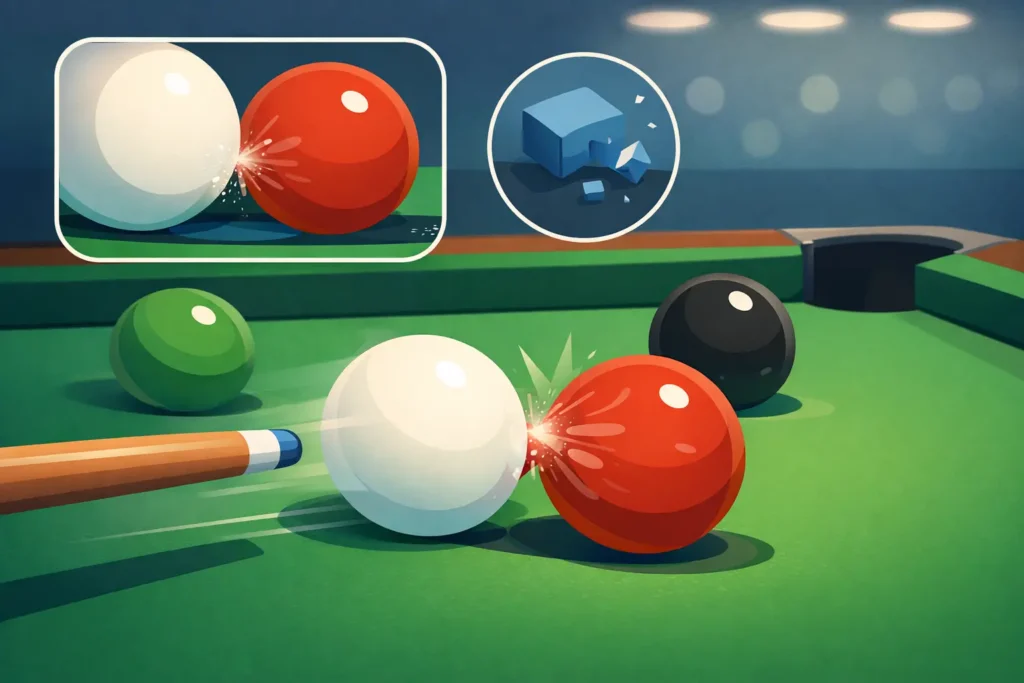
What Causes Snooker Kick Shots? The Real Reasons
A cleanly struck red that shoots off line can feel like a personal insult. You have read the angle, committed to the cue action and sent the cue ball exactly where it should go – then the object ball takes an unexpected path. Understanding what causes snooker kick shots helps remove some of the mystery, but it also brings an uncomfortable truth: even the best players cannot eliminate them entirely.
A kick is not usually a sign that you have suddenly lost your technique. It is most often a tiny interruption at the precise point where two balls meet. At professional level, where margins are brutally fine, that interruption can turn a routine pot into a miss, a match into a swing, and a well-built break into frustration.
What causes snooker kick shots?
In simple terms, a kick happens when something interferes with the smooth, predictable contact between the cue ball and object ball. Instead of the balls meeting on clean polished surfaces, a minute particle, trace of moisture or static attraction affects the collision. The resulting deflection may be slight, but slight is all it takes on a tight pocket.
The usual culprit is chalk dust. Chalk is essential on the cue tip, yet loose chalk on the cue ball, object ball or cloth is a constant threat. When it becomes trapped between the balls at impact, it can alter the line of contact and create a small, sharp deviation. You may see the object ball appear to jump sideways, undercut the pocket or take far more throw than the shot demands.
Moisture is another major factor. In a busy club, balls are handled repeatedly and conditions change through the day. Natural oils from hands, perspiration and humidity can leave a film on a ball. That film attracts dust and chalk, creating the imperfect contact point that causes a kick. A table can look immaculate while the balls carry enough residue to affect an important shot.
Static electricity also has a part to play, particularly in dry environments. Static can draw fibres and dust towards the balls, even after they have been wiped. It is one reason a kick can occur just after a ball has been cleaned and why no amount of pre-shot discipline can offer a complete guarantee.
Ball condition and cloth fibres
Balls should be smooth, clean and consistent. As balls age, however, fine marks and surface imperfections can develop. Small imperfections do not automatically make a table unplayable, but they give chalk and dirt more places to settle. A poorly maintained set of balls raises the chance of unpredictable contact.
The cloth matters too. Loose fibres, dust and residue on the bed of the table can attach themselves to a moving ball. This is more likely on heavily used club tables or tables that have not been brushed, ironed and covered with proper care. A ball that has picked up a tiny fibre on its journey may arrive at the object ball with an invisible problem already attached.
That is why experienced players often clean the cue ball after a close-range exchange, a safety battle or a shot involving the rest. It is not superstition. It is an attempt to control the few variables that can be controlled.
Why side can make a kick look worse
A genuine kick is only one explanation for a ball taking an unexpected line. Side spin naturally creates throw – the object ball is pushed fractionally across its intended line by friction during contact. On some shots, especially slower cuts with generous side, that throw can be substantial enough to resemble a kick.
This distinction matters. If you blame every miss on a kick, you deprive yourself of useful feedback. A shot played with right-hand side may have needed more allowance for throw. A cue ball that swerves before impact may have changed the contact point. A decelerating cue action may have delivered more or less side than you intended.
The best approach is honest assessment. If the object ball changed direction abruptly at impact, particularly on a straightforward, centre-ball shot, a kick is plausible. If it drifted consistently to one side on a slow shot with side, first consider throw, swerve and your chosen contact point.
The role of pace
Pace changes the picture. A firmer shot generally gives friction less time to influence the collision, so throw is reduced. But simply hitting everything harder is not a solution. Excessive pace shrinks positional margins, makes pockets play smaller and can make cue-ball control more demanding.
On a key pot, choose the speed that gives the cue ball a clear positional route while allowing the object ball to enter the pocket confidently. If you are using side, understand that softer pace tends to exaggerate throw. That is a tactical decision, not bad luck.
Reduce kicks with professional habits
You cannot make the table clinically perfect, but you can build a routine that reduces avoidable risk. The objective is not to become fussy or slow. It is to treat the balls, cloth and cue tip with the same respect you give alignment and cue action.
Keep your hands clean and dry before you play. Avoid repeatedly touching the cue ball unless the rules and situation require it. If you are entitled to have the cue ball cleaned, use the opportunity when there is visible chalk, a mark or a genuine concern about residue. Do not turn ball cleaning into a distraction, but do not ignore obvious contamination either.
Apply chalk carefully. A light, even coating on the tip is enough. Grinding chalk into the tip creates unnecessary loose dust, which then finds its way onto the cloth and balls. Good chalking is controlled, brief and purposeful.
In a home or club setting, proper table maintenance makes a real difference. Brushing debris towards the pockets, using the correct ball-cleaning method and keeping the table covered when it is not in use all protect playing conditions. Over-cleaning with unsuitable products can leave residue, so care should be taken to use products and procedures intended for snooker equipment.
Most importantly, retain your composure when a kick happens. The ball has gone where it has gone. There is no value in replaying the injustice while your opponent is at the table or while you still have a tactical shot to play. Champions are not defined by never receiving a bad bounce. They are defined by how quickly they return to clear decision-making.
When it probably was not a kick
There are moments when the explanation is technical rather than environmental. A player may cue across the ball, lift the cue slightly, misjudge a thin contact or fail to allow for cut-induced throw. On a long pot, even a tiny alignment error looks dramatic by the time the object ball reaches the pocket.
Before calling it a kick, ask three questions. Was there side on the cue ball? Was the object ball struck at slow pace? Did the cue ball visibly swerve or did the cue action feel rushed? A yes to any of these does not rule out a kick, but it makes a technical explanation more likely.
This is where structured practice pays off. Spend time hitting straight, centre-ball pots at varying speeds, then introduce controlled side and observe the difference in object-ball path. When you know what ordinary throw feels like, a real kick becomes easier to recognise without emotion or guesswork.
The finest players build their games on repeatable fundamentals, then accept the rare variable that no player can command. A kick may cost you a frame, but it should never be allowed to cost you your focus. Keep the equipment clean, cue with conviction, understand the effect of side and pace, and trust the quality of your preparation on the next ball.

How to Learn Snooker From Professionals Online
A missed black is rarely just a missed black. It may begin with a rushed approach, a cue action that changes under tension, poor shot selection two balls earlier, or a safety choice that gave your opponent the table. To learn snooker from professionals is to understand those connections – and to replace guesswork with a standard you can repeat.
For committed club players and ambitious beginners alike, that is the real value of elite instruction. Professional players do not simply pot more difficult balls. They prepare better, see the table more clearly and stay composed when the frame asks a question. Their knowledge turns technique, tactics and temperament into one coherent game.
Why professional instruction changes the way you play
Informal advice can be useful, but it is often fragmented. One player tells you to keep your head still. Another urges a longer backswing. A video shows a spectacular clearance but never explains how the player earned the opening red. You may collect plenty of tips while remaining uncertain about what to practise first or how to tell whether a change is working.
Professional coaching gives every part of your game a place. Your stance supports your cue action. Your cue action supports accurate delivery. Accurate delivery creates better positional control. Position creates choices, and choices decide frames. When one link is weak, the rest of the chain is exposed.
That structure matters even more once you have played for years. A long-time hobbyist can make good breaks and still plateau because familiar habits feel reliable until pressure arrives. The professional standard is not a pretty cue action on the practice table. It is being able to deliver the cue, choose the percentage shot and respond intelligently after an error in a close frame.
Learn snooker from professionals, not isolated tips
The best players have an unusually clear relationship with the table. They assess angles early, recognise when a pot is not worth the risk and understand that a well-weighted safety can be as decisive as a long red. Learning from them means studying decisions as closely as mechanics.
Start with the fundamentals, but do not treat them as a checklist to complete once. Grip pressure, bridge hand, alignment, cue delivery and staying down on the shot need regular attention. Small compensations are common: a player may steer the cue to correct poor alignment, lift their head to watch the object ball, or tighten their grip as the shot becomes important. Each one may produce the occasional pot. Over a session, it produces inconsistency.
Professional instruction helps you identify the cause rather than chasing the symptom. If the cue ball repeatedly finishes on the wrong side of the next red, the issue may be speed control, not aim. If long pots disappear in matches, the issue may be your pre-shot routine, not talent. This is where detailed demonstration is worth far more than a vague instruction to “concentrate”.
There is a trade-off. Copying a professional’s exact mannerisms is not the goal. Players have different heights, builds, natural rhythms and sight lines. What should be copied are the principles: sound alignment, a stable base, a cue delivered freely, deliberate shot selection and complete commitment once a decision has been made.
Build a routine that survives pressure
A dependable routine removes unnecessary decisions from the moment before impact. Assess the shot while standing back. Choose the line, speed and intended cue-ball path. Step into the shot with purpose, settle your bridge hand and deliver without changing your mind halfway through.
This does not make snooker mechanical. It makes your best play more available when nerves rise. Under pressure, players tend to return to their habits. A strong routine gives them something solid to return to.
The professional priorities most amateurs overlook
Many players judge a practice session by the number of balls potted. Professionals also judge the quality of their cue-ball routes, their willingness to take the correct safety and their ability to recover from imperfect position. Potting is essential, but snooker rewards the player who controls what comes next.
Position play is about margins, not perfection
You will not land perfectly on every colour. The stronger target is to leave a useful angle, retain options and avoid turning a routine visit into a difficult rescue shot. That means learning when to use a little less side, when to accept a longer pot, and when playing for the centre of the next-ball zone is smarter than chasing a precise spot.
Break building follows the same logic. Early in a break, keep reds and colours available. Avoid blocking your own routes. Before playing a shot, look beyond the next pot and ask what will remain when the cue ball comes to rest. As your break develops, identify the balls that will become problems and deal with them before they trap you.
Safety is not a retreat
A safety shot becomes powerful when it has a clear purpose. It may leave the cue ball tight to a cushion, hide the object ball, place a red near a cushion, protect an easy red or force a difficult escape. Simply sending balls to the far end of the table is not always enough.
Watch professional match play closely and you will see patience, not passivity. They understand when the table is not ready to score from. The ability to put an opponent under pressure without donating a simple starter is one of the biggest differences between capable club players and serious competitors.
Temperament is a trainable skill
Every player misses. The response is what matters. A professional does not allow one careless shot to dictate the next five minutes. They reset, assess the new situation and compete for the next opportunity.
You can practise this deliberately. Give each drill a consequence: restart a clearance after a miss, play a short race against a target score, or set a demanding but realistic safety objective. The point is not to manufacture frustration. It is to become familiar with performing while the outcome matters.
A smarter way to practise between visits to the club
Practice without a purpose can reinforce the very habits you want to change. Instead of beginning with random pots, divide your table time into clear blocks. Spend time on cue delivery, then a specific positional route, then a safety situation, before finishing with a competitive challenge. Four distinct tasks create feedback that random knocking about cannot.
Keep the sessions honest. Film your cue action from the side and from behind when possible, particularly on shots that feel uncomfortable. The camera often reveals movement that the player cannot feel. Then make one adjustment at a time. Trying to rebuild stance, grip, timing and aiming in one evening is a quick route to confusion.
Measure progress over several sessions, not a single good day. Are long pots improving because your approach is more consistent? Are you leaving simpler next balls? Are your safety exchanges lasting longer before you offer a chance? These are useful signs that your work is transferring into frames.
What elite online coaching should give you
Online learning works when it is built as a course, not as a loose collection of clips. You should be able to return to individual lessons, study key demonstrations at your own pace and follow a logical path from technique through break building, safety and match mentality. Lifetime access is particularly valuable because a player’s needs change: the lesson that feels basic in month one may become essential once you start competing.
The Rocket Method brings that structure to a 12-episode, nearly 12-hour masterclass led by Ronnie O’Sullivan, with expert perspective from Alan McManus. It is designed to show not only what championship-standard snooker looks like, but why the choices, routines and technical details matter. For clubs and organisations, group access also creates a stronger shared training standard than leaving every player to search for their own advice.
The right course will not promise that every player will have the same game as a world champion. It should offer something more credible: access to proven principles, clearly taught, so you can apply them to your own game with discipline.
Next time you set the balls out, choose one professional habit to practise with intent. It might be staying down after every shot, planning two balls ahead or refusing a low-percentage pot when a proper safety is available. Repeated often enough, that one decision becomes part of the player you are becoming.

How to Escape Snooker Snookers Under Pressure
A tight safety can make a routine frame feel suddenly impossible. You can see the object ball, perhaps only by a fraction, but the natural path is blocked, the cushions look hostile and every option seems to hand the table away. Learning how to escape snooker snookers is not about producing a miracle shot on demand. It is about making the highest-percentage decision, striking the cue ball with conviction and ensuring that, even when you miss, your opponent has work to do.
The best players do not treat an escape as an interruption to their break-building. They treat it as part of their scoring armoury. A strong escape can win a tactical exchange, protect a lead and turn an opponent’s excellent safety into a chance they regret leaving.
Start with the rules and the real objective
When you are snookered, the first requirement is straightforward: make a legal attempt to hit a ball that is on. If you fail, you concede penalty points. The value depends on the ball involved, with a minimum of four points. In many amateur frames, that penalty is costly enough to change the entire match.
But legality is only the beginning. Your real objective is to leave the cue ball in a position that limits your opponent’s attacking options. That may mean returning the cue ball to the baulk area, tucking it behind a colour, or sending the object ball away from open reds. Occasionally, the correct choice is to accept a likely foul because the alternative leaves a straightforward pot and a clear table.
This is where discipline matters. Do not judge an escape purely by whether you make contact. Judge it by the position that follows. A thin touch that leaves a red over a middle pocket is often worse than a controlled miss that puts the cue ball back behind the brown.
How to escape snooker snookers: assess before you cue
Rushing is the most common error. A difficult snooker creates anxiety, and anxiety makes players stare at the blocked line rather than examine the table. Step back. Look at every route before committing to one.
First, establish precisely which ball you must strike. Then inspect both edges of that ball. A full-ball route may be unavailable, but a fine contact can often be found by travelling around one, two or even three cushions. Look for the route with the largest margin for error, not the one that appears most spectacular.
Next, consider the cue ball’s finishing zone. If you escape from baulk, can you return it there? If the opponent has left a cluster of reds below the pink, can you keep the cue ball away from that scoring area? Your intended destination should be clear before you get down on the shot.
Finally, assess the pace. Cushion escapes are rarely played at one fixed speed. More pace tends to straighten the cue ball’s rebound and carries it further from the opening. Softer pace allows more natural angle but can leave the cue ball short or vulnerable to a cushion’s inconsistency. The cloth, cushion response and amount of side all affect the answer. There is no automatic formula, which is why purposeful practice matters.
Choose the percentage route
A good escape usually falls into one of four families. You need all of them, but you should select the simplest available option.
Direct thin contact
If even a sliver of the object ball is visible, a thin direct hit is often the safest route. It removes the uncertainty of cushions and makes it easier to judge the cue ball’s path. The danger is overcutting or undercutting a contact that looks larger than it is. Keep the cue action smooth and aim at a precise point on the object ball rather than simply trying to ‘feather’ it.
A direct hit can also be an effective safety. With the right angle, the object ball travels towards a cushion while the cue ball returns to cover, leaving little for your opponent. This is far more valuable than merely touching the ball and leaving it in the open.
One-cushion escape
When a direct route is blocked, one cushion is normally your next choice. It gives a clean reference point and limits the variables. Pick a contact point on the cushion, not a vague area, and visualise the cue ball travelling in two straight lines: from cue ball to cushion, then cushion to object ball.
Avoid excessive side unless it is essential. Side can help widen or narrow the rebound angle, but it also increases the chance of misjudging the line, particularly on unfamiliar tables. A centre-ball or slight running-side escape played firmly is frequently more dependable than a heavily loaded shot.
Two or more cushions
Multiple-cushion routes are sometimes unavoidable, especially when the cue ball is trapped behind colours. Their value is not only that they reach the ball. A well-chosen two-cushion path can send the cue ball back into a defensive area while moving the object ball towards safety.
The trade-off is accuracy. Every additional cushion adds another opportunity for pace, side or table conditions to alter the line. Favour routes that use broad angles and natural running side. Avoid asking the cue ball to travel through narrow gaps unless the frame demands it.
The deliberate foul
This is not an excuse to give up. It is a tactical calculation. If a legal escape has a very low chance of success and a high chance of leaving a simple scoring chance, a controlled foul can be the stronger decision. You might roll the cue ball into a safe part of the table, take four points against you and force your opponent to solve another problem.
Use this sparingly and with full awareness of the score. When points are scarce or a miss would be called in a formal setting, the consequences may be very different. Tactical intelligence includes knowing when the rule situation changes the value of risk.
Strike the cue ball like a proper safety shot
Many escapes fail because the player treats them as a hopeful jab. The shot still demands the same standards as a long red: stable stance, level cue, controlled backswing and a positive delivery. Tentative acceleration is particularly damaging on cushion routes because it makes pace unpredictable.
Keep your head still through contact. On a thin escape, lifting early can alter the cue’s direction by enough to miss entirely. Stay down long enough to see the cue ball begin its journey, then assess the result without frustration. That habit builds reliable feedback.
Cue-ball contact should serve the route. Centre ball is the default because it is easier to repeat. Use running side to help the cue ball travel naturally around cushions, and use check side only when you understand exactly why it is needed. Side is a specialist tool, not a substitute for a sound line.
Build an escape practice routine
You will not become dependable under pressure by attempting random escapes at the end of a club session. Set up repeatable positions and measure improvement. Begin with a blocked direct line, then practise the same escape with one cushion. Place a colour near the cue ball to create realistic visual pressure, rather than practising with an empty table.
Work in sets of ten. Record three outcomes: legal contact, cue-ball safety and opponent’s likely scoring chance. A shot that contacts the red but leaves an open pot should not receive the same credit as a shot that restores a difficult table. This shifts your practice from survival to tactical quality.
As your control improves, introduce score scenarios. Give yourself six points ahead with two reds left, or six points behind with several reds open. The best route may change completely. Snooker is not played in diagrams. It is played with pressure, scoreboard context and an opponent waiting for a mistake.
The Rocket Method approaches these situations as part of complete match play, not isolated trick shots. Elite players build confidence because their decisions are structured long before a tense frame asks them to produce one.
Keep your composure after the miss
Even the finest escape can catch a jaw, hit the wrong side of a cushion or leave an unexpected chance. The response matters. Do not allow one foul to become three loose visits. Reset, read the new table and make the next decision with the same care.
A player who remains calm after being snookered is difficult to break down. Each escape says something to the opponent: you may win points, but you will have to earn every easy look. Make that your standard, and the safety battle stops being a place to survive. It becomes a place to take control.
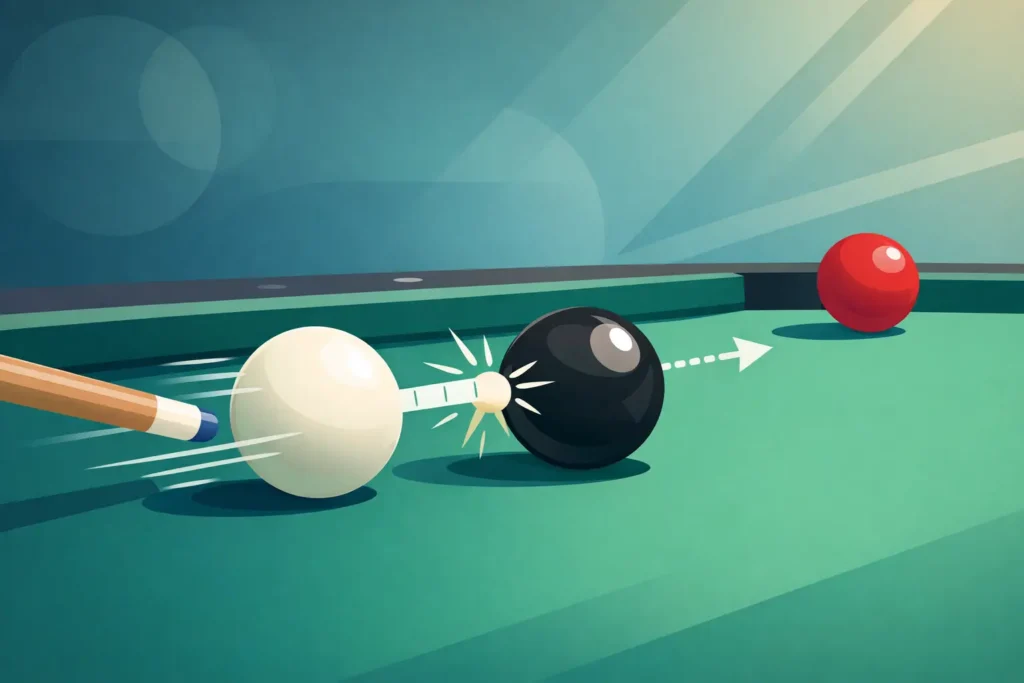
How to Play Stun Shots with Real Control
A stun shot is the difference between merely potting a red and leaving yourself the next red on the black. If you want to know how to play stun shots, start with this principle: strike the cue ball below centre, deliver the cue level, and let the backspin wear off just as the cue ball reaches the object ball.
At impact, the cue ball has no forward or backward roll. It is sliding. That is what produces the familiar stun reaction – the cue ball travels away from the object ball at a predictable angle rather than running through or drawing back. For players who want to build breaks with purpose, this is one of snooker’s essential control shots.
What a stun shot really does
A true stun shot is often confused with a screw shot because both begin with cue-ball contact below centre. The difference is timing. On a screw shot, the cue ball still has backspin when it reaches the object ball, so it returns towards you after contact. On a stun shot, the backspin has expired at the moment of contact, leaving the cue ball sliding.
That sliding cue ball departs on what players commonly call the tangent line – roughly at a right angle to the line of the object ball’s travel. The exact route can change with cut angle, pace, cloth conditions and any unwanted side, but the principle remains reliable enough to plan position around it.
A follow shot creates the opposite effect. Contact above centre gives the cue ball forward roll, so it continues beyond the object ball line after the pot. Each option has a place. Stun becomes invaluable when you need to hold the cue ball in the centre of the table, avoid a blocker, create a better angle on the colour, or take the cue ball across the table with measured certainty.
How to play stun shots: the essential technique
The shot begins before you get down. Decide where you want the cue ball to finish, not simply whether the ball will go in. Picture the object ball’s path to the pocket, then picture the tangent line that will send the cue ball into your chosen position area. This turns stun from a clever-looking shot into a repeatable tactical choice.
Strike below centre, but do not force it
For most medium-length stun shots, aim a small distance below the vertical centre of the cue ball. Think of a controlled low-centre strike rather than digging down towards the bottom edge. Going too low introduces excessive screw and makes the cue ball draw back. Going too high allows it to roll forward and destroys the intended angle.
How far below centre depends on the distance between cue ball and object ball. With a short distance, use less bottom because there is little time for backspin to fade. With a longer distance, you can strike slightly lower because the cloth will remove the backspin as the cue ball travels. There is no single chalk-mark position that works for every shot. Elite cue-ball control comes from recognising that the same contact point behaves differently over different distances.
Keep the cue as level as the shot allows
A level cue is the foundation of clean stun. Raise the butt of the cue too much and your tip action becomes steeper, increasing the risk of a miscue, unwanted swerve or a cue ball that bites into the cloth. The shot may still pot, but its route will be less dependable.
Set your bridge at a practical length, settle your head close enough to the cue to see the line clearly, and make sure the cue can travel through the ball without striking the cushion or your body. On shots close to a cushion, a perfectly level cue may be impossible. Accept the compromise, reduce the ambition of the positional route, and favour a simple pot if the margin is too tight.
Deliver through the cue ball
Stun needs a positive, decisive delivery. That does not mean hitting hard. It means accelerating smoothly through the cue ball with a still head and a straight cue action. A tentative jab often adds inconsistency, while an exaggerated punch can make the cue ball skid or send it too far along the tangent line.
Keep the grip relaxed in the final backswing, pause if that is part of your natural rhythm, then let the cue travel straight through. Stay down after contact. Many players lift their head because they are eager to watch the object ball, and the cue is pulled off line at the very moment accuracy matters most.
Match the pace to the position, not just the pot
The pace of a stun shot decides how far the cue ball travels after impact. A softer stun may hold the cue ball near the object-ball line. A firmer stun sends it further along the tangent line. Neither is automatically better.
If the next ball is nearby, remove pace from the shot and let the cue ball die into a manageable area. If you need to travel across open table, increase the pace while keeping the same clean low-centre contact. The key is to make the cue-ball journey deliberate. Hitting every stun shot firmly is one of the quickest ways to lose the white and end a promising break.
Read the tangent line before you address the cue ball
A useful practice habit is to stand behind the object ball and identify the potting line first. Once you know where the object ball is going, imagine a line perpendicular to it at the point of contact. That is your starting forecast for the cue ball’s route on a stun shot.
On a half-ball pot, the tangent line is especially visible: the object ball goes towards the pocket while the cue ball leaves across the table. On thinner cuts, the geometry becomes more deceptive, and even a trace of unwanted side can alter the outcome. Use middle-ball stun when learning the pattern. Adding side before you own the basic line is not advanced cue-ball control – it is unnecessary uncertainty.
The table itself also has a vote. New, fast cloth can preserve spin for longer; heavier or slower conditions can take it away sooner. A polished cue ball, a damp room, and balls that have not been cleaned can all affect throw and skid. Good players make these adjustments quietly. They do not blame the table after every positional error, but they respect its conditions before playing the shot.
Build stun into real break-building situations
The most valuable stun shots are rarely spectacular. They are the small positional shots that keep the cue ball below the blue, bring it off a red towards the black, or hold it in a narrow corridor between reds. In these moments, centre-table control is usually worth more than chasing the perfect angle.
Imagine a red near the right middle pocket with the black available. If a plain follow shot sends the white too high and a screw shot pulls it too low, a controlled stun can take the cue ball across into the black’s natural line. You are not trying to land on a pinhead. You are creating a larger, repeatable area from which the next shot feels simple.
This is where amateurs often overcomplicate position. They see one precise route and try to force it with side, power and a low-percentage pot. The stronger decision is often a straightforward stun that leaves a slightly longer colour but preserves the next red. Breaks are built by retaining options, not by demanding perfection from every cue-ball path.
Common mistakes that spoil a stun shot
The first is confusing low contact with a stun result. If the cue ball screws back, you did not play a bad stun shot – you played a screw shot. Move your contact point slightly nearer centre or allow more travel distance for the backspin to run off.
The second is striking too softly. With insufficient speed, the cue ball may begin to roll forward before it reaches the object ball. The result is an unintended follow shot. A stun shot needs enough initial backspin and enough pace for the timing to work.
The third is trying to stun with side spin too early. Side has its place, particularly when cushions are involved, but it magnifies errors in tip contact and can disguise the real cause of poor position. First make the cue ball leave on the expected tangent line with no side. Then introduce side only when it gives a clear advantage.
Finally, do not judge the shot only by whether the object ball drops. If the pot goes in but the cue ball repeatedly finishes on the wrong side of the next ball, your process needs attention. Position is the standard.
A practice routine that gives honest feedback
Place a red around the pink spot and the cue ball a comfortable distance away, with a natural pot to a corner. Choose a point on the table for the cue ball to reach after the pot. Play the same stun shot ten times, using no side, and assess the cue ball rather than the red.
Then change only one variable: move the cue ball further away, reduce the pace, or make the cut thinner. This teaches you how contact point, distance and pace combine. Randomly scattering balls may feel like practice, but it gives you little reliable feedback.
Once the basic action is settled, set up a red-colour-red sequence and use stun to bring the cue ball into a defined zone for each colour. Give yourself a realistic landing area, perhaps the size of a dinner plate, rather than expecting perfection. As control improves, make the zone smaller and introduce more demanding angles.
The Rocket Method teaches snooker as a connected game of technique, cue-ball knowledge and decision-making. A better stun shot is not just a mechanical gain. It gives you more routes, calmer choices and more chances to stay at the table.
The next time you practise, resist the urge to hit a ball hard simply because the shot looks impressive. Pick one red, one position area and one clean stun route. When you can send the cue ball there on command, the table starts to look very different.

Snooker Coaching for Clubs That Builds Better Players
A club can have full tables, a committed committee and a loyal membership, yet still struggle to move players forward. The missing piece is often not enthusiasm. It is a clear standard. Snooker coaching for clubs gives members a route from random practice to deliberate improvement – and gives the club a stronger reason to be the place players choose to spend their time.
For many members, improvement has traditionally meant borrowing a tip from the best player in the room, watching a few clips online, then hoping it holds up in a match. That approach can be enjoyable, but it rarely produces consistent progress. A club that offers structured learning makes a more serious promise: players can understand their technique, practise with purpose and build the tactical judgement that wins frames.
Why clubs need more than an occasional coaching night
An occasional exhibition or one-off coaching evening can create a buzz. It may fill the room, bring members together and introduce a few useful ideas. But isolated advice is difficult to retain, particularly in a sport where the fundamentals depend on repeatable habits.
A player might leave with a better understanding of cue action, only to return to their old stance the following week. Another may be capable of making breaks in practice but lose control of a frame through rushed safety choices. Neither problem is solved by more information alone. They need a sequence: what to work on first, how to revisit it, and how to test it under pressure.
That is the real value of a club coaching programme. It creates continuity. Newer players gain a proper foundation rather than copying flaws. Regular league players can identify the parts of their game that cost them matches. Stronger competitors can sharpen their tactical discipline without being treated as though they are starting from scratch.
It also changes the culture of the club. Practice stops being a private struggle at an empty table and becomes part of a visible standard of improvement. Members have something meaningful to discuss beyond the result of the latest match: line of sight, cue delivery, shot selection, break-building routes and the decisions that turn a promising visit into a winning frame.
What good snooker coaching for clubs looks like
The strongest programmes are not built around a coach talking while everyone else watches. They combine expert instruction with table time, reflection and repetition. Members should leave each session knowing exactly what they are trying to improve before the next one.
A useful structure begins with technique, but it should not stay there. Snooker is a precision sport, yet perfect-looking mechanics mean little if a player cannot judge when to attack, when to contain an opponent or how to keep the cue ball on the correct side of the next red.
Start with a shared technical language
A club does not need every member to have the same style. Elite players have individual characteristics, and body shape, experience and physical limitations all matter. What a club does need is a shared understanding of sound fundamentals.
That means covering grip pressure, stance, alignment, sighting, cueing and the purpose of a controlled follow-through. The aim is not to make everyone look identical. It is to help each player produce a cue action they can trust when the score is close.
This is where vague instructions cause problems. Telling a player to “keep still” or “hit through the ball” may be well intended, but it can mean different things to different people. Quality coaching breaks the movement down, explains why it matters and gives the player a simple way to check whether the change is working.
Move quickly from potting to cue-ball control
Many club players practise pots because potting offers instant feedback. The ball either drops or it does not. But the difference between a player who makes the occasional good break and one who controls frames is often their cue ball.
Coaching should therefore connect each pot to a purpose. Can the player judge pace? Can they hold for the correct angle rather than merely any angle? Can they use stun, screw and side with an understanding of the risks involved? A programme that develops these questions will improve more than break-building. It will make safety exchanges calmer and decisions more intelligent.
Teach match play as a skill
A player can look excellent during solo practice and still make poor choices in competition. Match snooker brings consequence, nerves and an opponent who can punish loose errors. Clubs should treat this side of the game as coachable rather than assuming it appears naturally with experience.
That includes recognising percentage shots, setting practical safety targets, protecting a lead and responding after a mistake. The best decision is not always the most exciting pot. It is the shot that gives the player the greatest chance of winning the frame from that position.
A club coaching programme should make room for tactical discussions around real layouts. Ask members what they would play and why. Then examine the likely outcomes. This builds judgement, which is one of the most transferable advantages a player can take into league competition.
Build a programme members will actually attend
Ambition is useful, but a programme must fit the life of the club. Members have different work patterns, abilities and reasons for playing. A rigid, high-volume schedule may suit a serious team but put off casual members. Equally, making every session too broad can leave committed improvers under-challenged.
A practical model is to organise learning in short blocks, each with one clear theme. For example, a four-week cycle could focus on stance and alignment, cue-ball control, scoring opportunities and tactical match play. Each theme should return in later cycles, because improvement is rarely linear.
Within a session, keep the balance clear:
- Begin with a short demonstration that identifies the key principle.
- Give players a focused drill with a measurable outcome.
- Create a game-based exercise that introduces decision-making or pressure.
- Finish with one personal practice intention for the week ahead.
This approach gives beginners enough structure without overwhelming them, while better players can raise the difficulty of the same task. A straight pot drill, for instance, can become a cue-ball control challenge, then a scoring exercise, depending on the player.
Attendance improves when members can see progress. That does not mean turning every session into an assessment. It means recording useful markers: successful repetitions, quality of positional play, safety success, highest practice break or confidence in a previously uncomfortable shot. Visible evidence gives people a reason to return.
Give every level a credible route forward
The common fear is that coaching will favour either beginners or the strongest players. A well-designed offer does neither. It creates entry points.
Beginners need clarity and reassurance. They should learn the etiquette of the table, basic technique and simple scoring patterns without feeling exposed in front of established members. Their early wins might be a smoother cue action, a better understanding of angles or the confidence to join a friendly frame.
Intermediate players need diagnosis. They often know what they want to do but cannot repeat it often enough. Their progress comes from identifying the few errors with the largest impact, rather than attempting a complete rebuild every month.
Advanced club players need challenge. They may already pot well, but they can still improve their route planning, shot selection, safety play and ability to perform under match conditions. Giving these members a serious development path helps retain the players who set the competitive standard for everyone else.
Use premium digital coaching to support the club coach
Not every club has access to a qualified coach every week. Even when it does, one person cannot give every member individual attention across a busy evening. High-quality digital instruction can extend the coaching environment beyond a single session, provided it is used with purpose.
The Rocket Method gives clubs access to elite instruction from Ronnie O’Sullivan, supported by Alan McManus, in a structured masterclass format. It is particularly valuable when a club wants a consistent coaching reference that members can revisit between table sessions rather than relying on fragmented advice.
The advantage is not simply the name behind the instruction, although learning from the sport’s most decorated player carries obvious weight. It is the ability to return to a specific lesson, watch the detail again and bring that understanding back to the table. A club captain or coaching lead can set a theme, members can study it in their own time, and practice nights can be used for application rather than explanation alone.
Digital coaching is not a substitute for watching someone play in person. A local coach can spot individual movement patterns, offer immediate corrections and adapt a session to the room. But for clubs with limited coaching availability, or those seeking a higher and more consistent standard of instruction, it is a powerful complement.
Make improvement part of the club’s identity
The best clubs do not merely provide tables. They give members a reason to belong. A visible commitment to player development tells a newcomer that the club welcomes ambition, whether that ambition is making a first 20 break, winning a local league match or becoming the player others do not want to draw.
Promote the programme clearly, but do not overpromise instant transformation. Snooker rewards patience. Members who understand that progress comes through sound instruction, purposeful practice and honest review are far more likely to stay engaged when a difficult habit takes time to change.
Set the standard, give players a credible path and keep the table at the centre of the learning. When members can feel their game becoming more controlled, more intelligent and more reliable, coaching stops being an extra. It becomes one of the strongest reasons your club keeps moving forward.
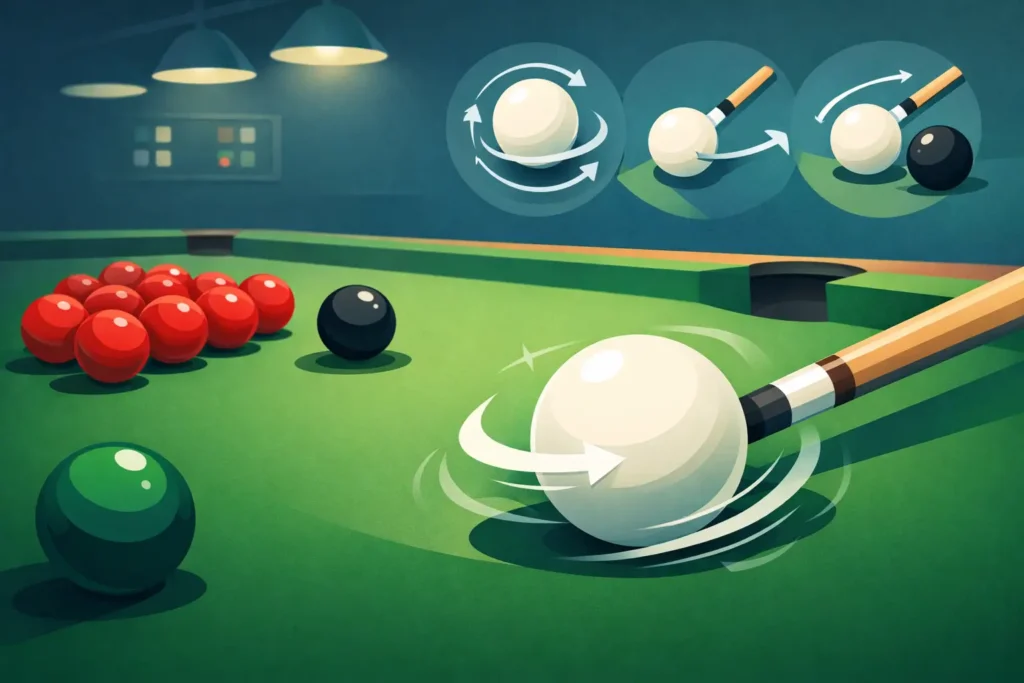
Advanced Snooker Spin Techniques That Win Frames
A black along the cushion, the cue ball tight behind the blue, and no natural path to the next red: this is where advanced snooker spin techniques stop being exhibition shots and become frame-winning tools. At a serious level, spin is not about making the cue ball perform. It is about giving yourself one more playable pot, one more controlled angle, and one fewer difficult recovery shot.
The best players use side, screw and stun with restraint. They understand what the cue ball will do before they address it, then deliver the cue with enough accuracy to make that prediction reliable under pressure. That is the standard worth training towards.
Advanced snooker spin techniques start with a pure strike
Spin magnifies every small technical fault. If your cue action is loose, your bridge hand moves, or your cue is not travelling through the centre of the ball on a straight line, adding side will not create control. It will create uncertainty.
Start by treating the white as a clock face. The centre is your reference point. High cue-ball contact creates topspin, low contact creates backspin, and left or right contact adds side. But the contact point alone is not the whole story. Cue elevation, speed, cloth condition, ball cleanliness and the distance travelled all affect the final route.
A premium strike is delivered with a still head, a stable bridge and a cue that follows through on the intended line. Do not jab at the cue ball when using side. A jab often produces an accidental mixture of side and unwanted top or screw, making position play impossible to read. Let the cue travel through the ball smoothly, while keeping the tip precisely where you intended.
Before practising extreme side, be able to pot a straight blue repeatedly with centre ball, then with a small amount of left and right side, without missing to either jaw. If side consistently changes your potting accuracy, your first task is not learning bigger shots. It is improving cue delivery.
Use side to change angles, not chase miracles
Side is the most misunderstood part of advanced position play. Players often see a professional bring the white around three cushions and assume the secret is generous side. Usually, the secret is choosing the correct line, pace and first cushion. The side simply refines the route.
Running side for wider cue-ball routes
Running side is applied on the side of the cue ball that helps it continue naturally around a cushion. If the white is travelling towards the right-hand cushion and you want it to come off with more angle towards the top cushion, right side is generally running side. It helps the cue ball retain energy and open the table.
This is especially valuable when coming around cushions from the black end to the blue or pink area. Rather than forcing the cue ball at speed, a measured stroke with running side can carry it around the angle with greater control. The trade-off is that the pot can become more difficult because side alters the object ball’s contact and the cue ball can pick up throw.
Use less side than you think. A half-tip of side, struck cleanly, often does more than an exaggerated offset. On fast, lively tables, heavy side can turn a comfortable positional shot into a guess.
Check side when the natural line runs too far
Check side works against the cue ball’s natural direction off the cushion. It shortens or deadens the angle, helping the white hold a tighter line. It is a high-value technique when you are close to a cushion and need to stay below the blue, avoid drifting into a red, or prevent the white racing past the ideal side of the next ball.
The danger is overchecking. Too much opposing side can make the cue ball grip, die off the cushion or react unpredictably if the contact is imperfect. It can also make a pot play thick or thin depending on the cut angle. Use it when the natural route is clearly wrong, not because it looks clever.
A useful question before every side-spin shot is simple: can pace alone solve this? If the answer is yes, pace is often the higher-percentage choice. Side earns its place when it creates an angle that speed cannot produce safely.
Screw, stun and drag: control the distance first
Elite break-building depends less on spectacular side spin than it does on controlling how far the cue ball travels after impact. Screw, stun and drag each give a different answer to the same question: where must the white stop to keep the break alive?
A screw shot uses low cue-ball contact and enough cue speed for backspin to survive the journey to the object ball. After contact, the white returns towards the player. It is indispensable when a red is available but the cue ball must come back towards the black or pink rather than roll forward into traffic.
The common error is trying to screw too far with a forced stroke. When the distance is long, a low hit can lose its backspin before impact and arrive as stun or even roll-through. That does not mean the shot has failed. It means the selected route was unrealistic. Choose a closer colour, use a cushion, or accept a less perfect angle rather than forcing a low-percentage recovery.
Stun is the cue ball striking the object ball while sliding, with no forward roll or backspin remaining. It sends the white roughly along the tangent line – the line at right angles to the object ball’s path. This is one of the most dependable tools in snooker because it removes the uncertainty of roll. A controlled stun can hold the white in a narrow positional window, particularly around the pink when reds are clustered.
Drag, sometimes called stun-drag, begins with low contact but is played softly enough for the cue ball to develop forward roll before impact. It is excellent for killing the cue ball’s pace and gaining delicate control. A drag shot can be safer than screw when you need the white to travel forward only a short distance after potting. The feel matters: too soft and the cue ball may not reach the intended line; too firm and it becomes stun.
Read throw before you add side
When side is applied, the object ball may be thrown slightly away from its natural line. On a thin cut, the effect may be minimal. On a fuller contact, slow pace and certain types of side can make it significant enough to miss a pot that looks routine.
This is why advanced players separate two decisions: the cue-ball route and the potting line. Do not assume that because you can see a route with right side, you can aim the object ball exactly as if you were using centre ball. Build experience by repeating the same pot at different speeds with centre, running side and check side. Watch the object ball, not only the white.
Throw is more pronounced when balls are not sliding cleanly, the cloth is heavier, or the pot is played slowly. On clean, fast match tables, the reaction may be different again. There is no substitute for reading the conditions during the first few visits to the table.
The swerve shot is a recovery tool, not a default
Swerve occurs when an elevated cue and side spin curve the cue ball around an obstructing ball. It can rescue a snooker situation or create a path where no straight line exists. It is also among the least repeatable shots in the game.
For a controlled swerve, raise the butt of the cue only as much as needed, use side in the direction you want the cue ball to bend, and give the shot enough pace to reach the object ball without excessive curve. More elevation increases the curve, but it also increases the risk of miscuing, jumping the cue ball slightly, or losing judgement of the contact point.
Whenever possible, compare the swerve with a safer alternative: a thin escape off a cushion, a controlled safety, or a deliberate foul avoidance route. The professional choice is not always the most dramatic shot. It is the one that gives away the fewest points and leaves the opponent the least.
Build advanced spin into your practice
Randomly striking the cue ball with side is not practice. Set a clear route, define a finish zone and judge every attempt by whether the white arrives in that zone with a usable next pot.
Begin with a red near the black end and a colour in open space. Pot the red and bring the cue ball to a hand-sized area for the colour using centre ball. Repeat with running side, then check side, while keeping the same potting line. You will quickly learn how little spin is required and where your personal delivery begins to break down.
Next, place a red near a side cushion and practise three outcomes: screw back to the black area, stun across to the pink area, and drag gently forward for a nearby red. This develops touch, not just power. Finish with a simple clearance challenge: no more than one cushion after any colour, and no excessive side unless it creates a clearly better angle. Constraints expose whether spin is serving the break or merely decorating it.
Film a few attempts from behind the cue. Look for cueing across the ball, a raised head, or a bridge that collapses at impact. The cue ball tells the truth, but video often reveals why it behaved that way.
The Rocket Method approaches this standard through structured instruction: develop the cue action first, understand the route second, then make spin a dependable part of your match play. The goal is not to produce one memorable shot in practice. It is to stand over a crucial ball late in a frame and know exactly what the white will do.

Break Through Your Snooker Practice Plateau
There is a particular frustration in snooker when you are no longer a beginner, you are putting in the hours, and yet your results barely move. The snooker practice plateau is not usually a lack of effort. More often, it is the point where familiar practice stops demanding enough of you to create change.
You may still make the balls you expect to make. Your long potting may look sharp for ten minutes. But under match pressure, the cue ball drifts, the safety choice arrives a second too late, or a promising break ends because the next position was never properly planned. That gap between what feels good in solo practice and what holds up in a frame is where progress has stalled.
The answer is not simply to spend longer at the table. It is to make every session expose the weakness that is currently costing you frames.
Why a snooker practice plateau happens
A plateau tends to appear after the early gains have been made. At first, almost any focused table time improves cue delivery, potting confidence and basic positional awareness. Later, improvement becomes more specific. You need to identify whether the limiting factor is technical, tactical, mental or physical, then train it with enough precision to force an adjustment.
The common mistake is repeating your favourite drills. A player who enjoys long pots may keep cueing across the table for an hour, seeing a healthy percentage go in and leaving feeling productive. Yet if their frames are being lost through loose safety, poor shot selection or a failure to control pace, that hour has reinforced comfort rather than addressed the problem.
There is also a difference between a good shot and a repeatable action. One cleanly struck red proves very little. The question is whether your stance, sighting, cue action and follow-through stay reliable when the object ball is awkward, the cue ball is tight to the cushion, or one miss changes the frame.
Diagnose the real barrier before changing everything
Do not rebuild your technique because of one bad night at the club. Snooker is a game of fine margins, and even a sound player can have a poor session. Look instead for recurring patterns over several matches and practices.
Keep a simple record after each competitive frame. Note how your visit ended, not merely that it ended. Did you miss a pot? Lose position? Take on the wrong ball? Leave a loose safety? Rush because you were annoyed by the previous shot? Within a handful of sessions, the same themes usually appear.
Separate technical errors from decision errors
A technical error is an execution issue: unwanted side, an inaccurate cue ball, a jabbed delivery or a missed ball you had properly selected. A decision error happens before the cue is delivered: taking on a low-percentage pot when a containing safety was available, playing for a narrow positional window, or continuing a break when the table calls for a reset.
This distinction matters because each requires different work. Technical faults need deliberate rehearsal and, where possible, expert observation. Decision faults need scenarios, match reflection and a clearer understanding of risk. Trying to cure poor choices by hitting more balls rarely works.
Check whether your practice has become too clean
Practice can become artificially comfortable. You place the cue ball exactly where you like it, begin with a straightforward red and restart the drill after a mistake. Match snooker offers no such generosity. The balls are imperfect, the opening is unclear and every error leaves a consequence.
If you routinely reset rather than play out the position you have created, you are training the first shot but avoiding the skill that follows it: recovery. Strong players are not perfect position players. They are excellent at recognising when position is imperfect and still finding the right next decision.
Build practice that transfers to frames
Your sessions need a purpose that can be measured at the end. “Work on my cueing” is too vague. “Deliver the cue straight through 30 centre-ball shots, with the cue ball returning consistently along the line” gives you something to observe. “Improve safety” becomes “play 20 baulk-line escapes and judge each leave as winning, neutral or loose”.
A productive session normally has three parts: technical calibration, pressure-based repetition and realistic application. The balance depends on your game. A player with an unstable cue action may spend more time on fundamentals. A solid potter losing close frames should spend more time on tactical situations and score management.
Start with a non-negotiable technical standard
Before chasing high breaks, establish your basics. Set up carefully. Stay still on the shot. Allow enough cueing time to feel the line. Deliver the cue without forcing acceleration. Hold the finishing position long enough to see what the cue ball tells you.
This is not about copying a single professional’s appearance at the table. Players have individual styles, but the essentials are shared: stable alignment, a controlled cue action, accurate contact and committed decision-making. Film a few shots from cue level if you can. What you feel and what you do are often different things.
Add consequences to your drills
Once the action is settled, make the drill matter. Give yourself a score, a target or a penalty that reflects competitive snooker. For example, play a line-up and count only breaks that reach a defined number. If you lose ideal position, do not replace the cue ball. Play the shot that remains.
For safety practice, set a specific starting layout and alternate turns with a practice partner. Award points not just for snookers, but for leaving the opponent without a straightforward attacking option. This better reflects the real objective of a safety exchange: controlling the next visit, not merely hiding the cue ball.
Pressure must be calibrated. If a drill is impossible, it encourages poor habits. If it is effortless, it offers no reason to improve. The right standard is challenging enough that success feels earned and failures give you useful information.
Stop measuring progress by your best break
A highest break is satisfying, but it can hide the state of your game. One fluent visit may come from a generous opening. More revealing measures include the number of unforced misses from routine range, how often you gain first meaningful control of a frame, the quality of your safety leaves and your conversion rate after an opponent’s error.
Set a short review point, perhaps every four weeks. Compare your notes and choose one priority for the next block. Do not attempt to overhaul potting, break-building, safety, temperament and fitness at once. Focus concentrates learning. Once a weakness becomes less costly, move on to the next one.
This is also where honest match play becomes essential. Regularly play opponents who test you, including players who are a little better than you. A weaker opponent may allow a loose habit to survive. A stronger one exposes it quickly. The aim is not to protect your confidence with easy wins, but to build a game that stands up when opportunities are scarce.
Use expert structure when self-correction stops working
There comes a point where determination cannot replace informed feedback. If you are unsure whether the problem begins in your stance, bridge, backswing, cue delivery or shot selection, random online tips can create more confusion than clarity. You need a coherent method, with the reasons behind it.
That is the value of learning from proven championship experience. The Rocket Method brings Ronnie O’Sullivan’s approach to the details that decide whether practice translates into stronger frame play, from technique and break-building to tactical awareness and mindset. The goal is not to imitate every flourish of a great player. It is to understand the standards and decisions that make elite snooker repeatable.
The plateau is useful if you respond properly
A plateau is evidence that the easy improvements are behind you. That can feel discouraging, but it is also the moment your practice can become more serious, more intelligent and far more rewarding. You are no longer just learning to pot balls. You are learning to build a reliable game.
Next time a session feels flat, resist the temptation to hit more of the same shots. Write down the one situation that repeatedly costs you control of a frame, then make that situation the centre of your next practice. Progress returns when your table time becomes honest enough to demand it.
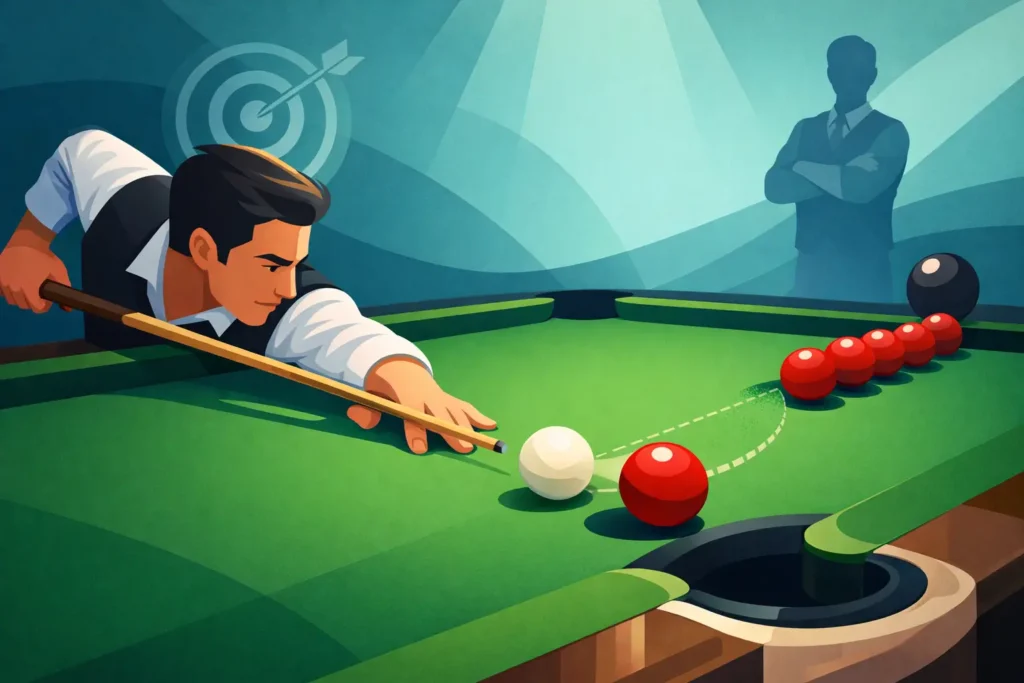
How to Pot Long Reds With More Confidence
A long red is rarely just a pot. It is the shot that decides whether you take control of the table or hand your opponent an open invitation. Learning how to pot long reds means replacing hope with a precise routine: a clear line, a committed cue action and a cue-ball plan that gives the shot a purpose.
For club players, the temptation is to blame the distance. Usually, distance only exposes a flaw that is already there: uncertain sighting, a drifting cue, rushed delivery or a player who has not fully decided whether to attack. Long potting rewards simplicity under pressure. The objective is not to force every difficult red into the pocket. It is to make sound decisions, then execute the shots you choose with conviction.
How to pot long reds: start with the right shot choice
The first improvement is tactical, not technical. Before getting down, ask whether the red offers enough value. Is there a clear path to the pocket? Can you see enough of the object ball to send it naturally towards the centre of the pocket? More importantly, where will the cue ball finish if you miss?
A long red with the cue ball near the baulk line can be an excellent attacking chance when the red is close to a cushion and the cue ball is likely to return safely up-table. The same pot may be reckless if a miss leaves an easy red over a middle pocket or opens the pack. The best players are not merely better at potting difficult balls. They understand which difficult balls deserve to be played.
Commit fully once you have chosen the shot. Half-commitment is destructive on a long red. If you are thinking about the consequences of missing while delivering the cue, your action will tighten and the cue ball will rarely travel on the intended line.
Build the line from pocket to cue ball
Long potting begins with accurate visual information. Stand behind the line of the shot and picture the exact route from the centre of the object ball to the heart of the pocket. Then extend that line back through the red to identify the cue-ball contact point.
Do not let the pocket disappear from your awareness once you are down on the shot. A common amateur error is becoming absorbed by the cue ball and red, then treating the pocket as an assumption. On a straight or near-straight long red, that missing final reference can turn a fraction of error into a jawed ball.
Your aim should favour the centre of the pocket, not a thin acceptance of one side. A red travelling the full length of the table has time to magnify any inaccuracy. Give yourself the widest effective target by seeing the pocket opening clearly and sending the object ball on a true line.
There is one useful exception. If a red is close to a cushion, the natural potting line may need a little more care because the cue ball cannot always contact the object ball exactly where your eye first expects. Do not invent complicated adjustments, but give yourself time to see whether the cushion changes the available contact point.
Set your body before you set your cue
A straight cue action starts with a stable stance. Your feet should allow you to lower into the shot without reaching, twisting or feeling as though your weight is falling forwards. Settle your head so that your eyes are directly over, or very close to, the cue line. The exact position varies from player to player; what matters is that you see the line consistently.
On a long red, poor alignment often appears as a cue that feels straight during practice swings but cuts across the ball at delivery. The cause may be a shoulder that has been forced into the line, a bridge hand placed too far from the cue ball, or a stance that leaves no room for the cue to travel freely.
Take the extra second to stand up and reset if the shot does not look right. Professionals do it because a clean set-up is more valuable than preserving a quick rhythm. There is no prize for staying down on a poorly aligned shot.
Keep the cue ball simple
For most long reds, centre-ball or a trace of stun is the percentage choice. Trying to manufacture heavy screw, side or dramatic position adds variables to the most demanding basic pot in the game. First make the red the priority. Then use only enough cue-ball movement to leave a realistic colour.
A plain centre-ball strike allows the cue to travel through the cue ball without manipulation. It also helps the object ball roll cleanly. If the black is available and you need the cue ball to hold its line, a small amount of stun may be appropriate, but the strike must still be controlled rather than jabbed.
Side spin deserves particular caution over distance. It can be useful when the cue ball must return from a cushion or avoid traffic, yet unintended side is one of the chief reasons a long red drifts. If you are missing consistently to one side, check whether your cue tip is arriving off-centre before changing your aim.
The stronger tactical play is sometimes a soft, controlled long red that leaves the cue ball in baulk or near the side cushion if it does not drop. Potting power is not proof of confidence. A measured stroke, delivered through the centre, gives the pocket its best chance and protects you when the margins are thin.
Deliver the cue with a quiet finish
The final delivery should look almost uneventful. Your grip hand stays relaxed, your bridge remains still, and the cue follows through on the line you established while standing. Do not snatch at the cue ball in an effort to make the stroke positive. Positivity comes from committing to the line, not from hitting harder.
Use enough practice swings to confirm your cue is travelling straight, then pause briefly at the cue ball. This pause separates preparation from execution. It gives your eyes a final chance to settle and prevents the rushed transition that causes so many misses.
Keep your head still until the object ball reaches the pocket. Lifting early is especially costly on a long red because it can pull the cue off line at the exact moment of contact. Remain down, listen for the ball entering the pocket, and only then rise into the next shot.
A repeatable pre-shot routine
Your routine does not need to be elaborate, but it must be repeatable. Stand behind the line, decide the shot and cue-ball outcome, step in with your feet settled, place the bridge hand, make measured practice swings, pause, and deliver. Use the same process for a routine red as for one from baulk to the far corner.
Consistency is what holds up when the score matters. If your process changes whenever a long red appears, pressure has already gained an advantage. A reliable routine gives your attention somewhere useful to go instead of letting it drift towards fear of the miss.
Train long reds with purpose
Randomly scattering balls and firing at them can be enjoyable, but it is a slow way to improve. Set up a single long red from baulk to a corner pocket and repeat it in blocks. Begin with the cue ball and red on a line that gives you a fair chance, then gradually introduce thinner angles and cue-ball control.
Record not only how many balls you pot, but where your misses go. A repeated miss thick on the near jaw suggests one problem; a miss thin across the face suggests another. If the red is travelling true but the cue ball feels inconsistent, inspect your striking point and cue delivery. Feedback turns practice into coaching.
A productive session can include four distinct challenges:
- Straight long reds to each corner, using centre-ball only.
- Long reds with a controlled stun finish for the black or pink.
- Safety-minded long pots where a miss should leave the cue ball in baulk.
- Pressure sets, such as needing three pots from five attempts before moving on.
Do not practise until fatigue makes your technique careless. Fifteen focused minutes with a clear intention is more valuable than an hour of hurried hitting. Film a few attempts from behind the cue if you can. The camera will reveal head movement, a cue that feathers across the line, or alignment faults that are hard to feel from the table.
Bring match-table discipline to the shot
Long reds are emotionally charged because they are visible opportunities. A red left at the far end can make you feel that you ought to attack, especially after watching elite players make the shot look routine. Resist that pressure. Your percentage is shaped by the table layout, your current cueing and the match situation.
When the pot is right, trust your preparation. When the safety is better, play it with the same intent. That balance is what turns long potting from a highlight-reel gamble into a dependable scoring weapon.
The Rocket Method teaches this standard of decision-making alongside the technical foundations that support it. Learn to see the opening clearly, trust a disciplined action and respect the value of every visit. The next long red is not asking for magic. It is asking for a calm, complete shot.
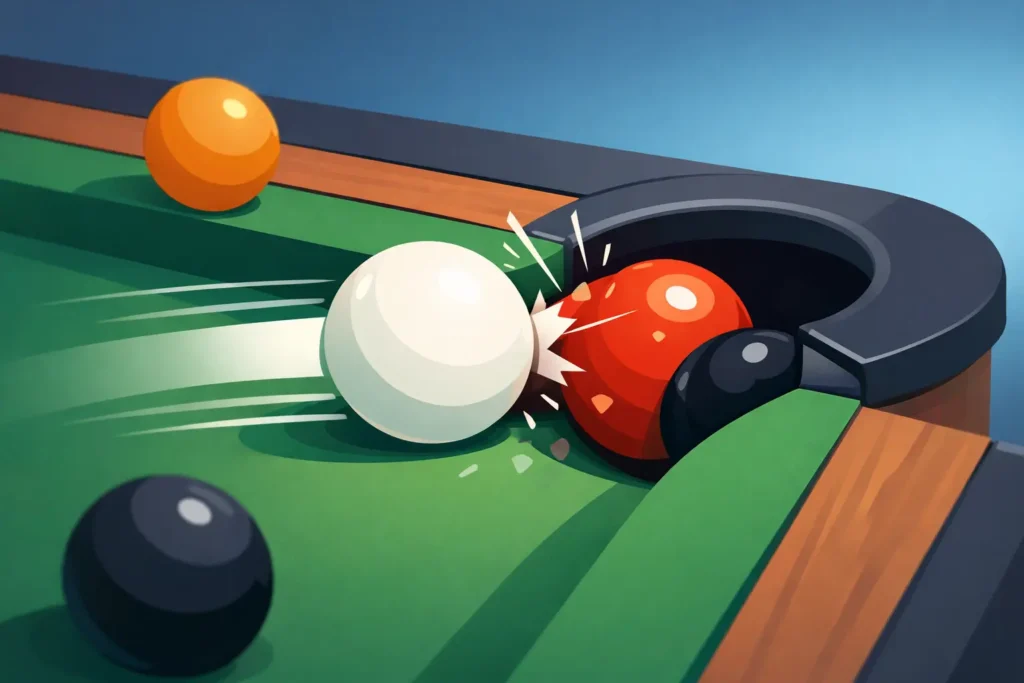
Why Do Snooker Shots Rattle at the Pocket?
A red reaches the pocket on the line you saw, catches both jaws and somehow stays out. It is one of snooker’s most frustrating sounds – especially when the pot looked routine. If you have ever asked, “why do snooker shots rattle?”, the answer is rarely bad luck alone. A rattled ball is useful feedback: it tells you something about the delivery, the contact point, the pace or the route into the pocket.
At a high standard, players do not simply aim to send the object ball towards the pocket. They aim to send it into a generous part of the pocket, at a pace the pocket will accept, while controlling cue-ball contact well enough to avoid unwanted throw. That distinction turns more near-misses into confident pots.
Why do snooker shots rattle at the pocket?
A ball rattles when it enters the mouth of the pocket without enough clearance to fall cleanly. Instead of passing the near jaw and dropping into the pocket, it clips one jaw, then the other, often losing enough momentum or changing direction to stay on the table.
The key point is that a rattle is not a single fault. A ball can rattle because it was fractionally undercut, fractionally overcut, struck too firmly, played with side, or sent down a line that offered no margin. Often, two small errors combine. A player may choose a thin cut, add a little unintended side and hit it harder than necessary. Each element is manageable on its own; together, they make the pocket very small.
The tighter the cut angle, the less room there is for error. On a straight pot, the object ball has a broad route into the centre of the pocket. On a long pot or a thin cut to a corner, a movement of only a few millimetres at the cue tip can alter the object ball’s path enough to find a jaw.
The line is usually the first issue
Most rattled pots begin with the object ball travelling too close to one side of the pocket. Players often call this “nearly in”, but nearly is not the same as correctly aimed. A ball entering close to the jaw needs perfect pace and favourable contact to survive. That is not a repeatable way to pot under match pressure.
When you address a pot, look beyond the pocket opening. Picture the object ball’s route to the centre of the pocket, not merely its route to any part of it. This changes the question from “can I make it?” to “where do I want the ball to enter?” The second question produces better decisions.
On many cut shots, particularly down the cushion, amateurs overvalue the sight of the pocket and under-value the final few inches of the object ball’s journey. The line can appear right from behind the cue-ball yet still deliver the object ball into the far jaw. Pause behind the shot, identify the intended entry point and commit to that route.
Undercut and overcut rattles
A ball struck too thinly can catch the near jaw. A ball struck too full can catch the far jaw. Which jaw it hits gives you a clue, although the table angle and side applied can complicate the diagnosis.
Do not make major technical changes after one rattle. Look for the pattern over several attempts. If the same type of pot repeatedly catches the same jaw, your perception of the cut angle or your cue delivery may need attention. If misses vary wildly, the more likely issue is inconsistency in alignment, cue action or cue-ball contact.
Pace decides whether a marginal ball survives
The harder you strike an object ball, the more severely it reacts when it meets a pocket jaw. A firm, slightly inaccurate pot can bounce across the opening or rattle back onto the bed. At a controlled medium pace, the same ball may have enough time to take the pocket’s natural fall.
That does not mean every pot should be rolled in. Slow pace can make a ball more vulnerable to cloth conditions, nap, skid and throw. It can also leave you poor position. The objective is intelligent pace: enough authority to remove uncertainty from the route, but not so much that a minor contact with the jaw becomes fatal.
A useful standard is this: if position allows, pot with the softest pace that still sends the object ball confidently to the back half of the pocket. You retain a greater margin for error and usually gain better cue-ball control. When the cue-ball must travel, choose the extra pace deliberately rather than letting positional anxiety turn every pot into a thump.
Side spin and throw can narrow the pocket
Unwanted side is a common reason a shot looks correctly aimed but rattles. If the cue tip does not strike through the vertical centre of the cue-ball, or the cue is not delivered straight, the cue-ball can carry side spin into the object ball. At contact, that can throw the object ball off its expected line.
The effect depends on the cut angle, the speed of the shot, the cleanliness of the balls and the amount of spin. It is not identical on every pot, which is why players can become confused. They aim at the same apparent contact point and see different outcomes. But the principle remains simple: side creates another variable, and a marginal pot does not need another variable.
For a pressure pot, favour centre-ball or a small, purposeful amount of top or stun whenever position permits. Keep the cue as level as practical and complete the cue action directly through the line of aim. Trying to force the cue-ball around the table with excessive side often makes the object ball’s path less trustworthy.
The danger of compensating by eye
Experienced players can allow for throw and side, but it must be based on understanding rather than guesswork. If you routinely aim thicker or thinner to compensate for a cue action that sends the cue-ball off line, you are building a fragile game. It may work on a familiar practice table, then disappear on a tighter club table or under the tension of competition.
Build a delivery that produces the contact you intend. Then learn when the shot itself calls for adjustment.
The cue action behind a clean pot
A rattle can begin before the cue ever meets the cue-ball. Poor stance alignment forces a player to steer the cue. A loose bridge allows the cue to wander. A rushed backswing and jabbed follow-through make precise contact harder. These are not glamorous details, but potting is decided by them.
Settle into the shot with your chin and cue on a consistent line. Make enough warm-up strokes to feel the route, then pause briefly before the final delivery. The pause is valuable because it separates preparation from execution. Once you commit, let the cue travel through smoothly instead of attempting to guide the object ball into the pocket.
A straight cue action does not mean a stiff one. Tension in the grip hand and forearm often creates a poke at impact. The best cueing has purpose, but it remains free. You should feel that the cue has travelled through the cue-ball, not been stopped at it.
Table conditions matter, but they are not the excuse
Pocket cut, cloth speed, humidity, worn cushions and dirty balls can all affect whether a ball drops. Some tables accept balls generously; others punish any entry near the jaw. A skiddy ball can also alter contact in a way that makes a clean-looking pot behave badly.
Assess conditions early. During practice, play a few controlled pots to each corner and notice how the pockets react at different speeds. If the table is tight, respect it. Choose safer lines, avoid taking on unnecessary thin cuts and aim for more of the pocket. Championship snooker is not about proving that every pot is possible. It is about choosing shots you can deliver repeatedly.
A practice routine that turns rattles into information
Set up a straight blue-to-middle pot first, then move the cue-ball gradually off line to create increasingly thin cuts. Pot each ball at three paces: soft, controlled medium and firm. Your aim is not simply to make balls. Watch exactly where they enter the pocket and listen for the sound of jaw contact.
Then repeat the exercise with centre-ball, gentle stun and a small amount of side. You will quickly see how much the object-ball line changes when contact is not neutral. Keep the side modest. This is a calibration drill, not an invitation to play exhibition shots.
Finally, practise a consequence routine. Give yourself ten identical pots and record clean pots, rattles and outright misses. A clean pot into the heart of the pocket counts as the standard. A rattled pot that falls is still a warning. That mindset matters because it rewards quality, not fortunate outcomes.
The Rocket Method is built around this level of deliberate practice: understanding what the ball is telling you, then developing a cue action and decision-making process you can trust.
The next time a ball rattles, resist the urge to blame the pocket. Identify whether the object ball approached too close to a jaw, arrived too hard, carried unwanted throw or was delivered from an unstable cue action. Make one clear adjustment, return to the centre of the pocket, and let the sound of a cleanly struck ball become your measure of progress.

Ronnie O’Sullivan Teaching Style Explained
A snooker player can spend years trying to copy Ronnie O’Sullivan’s cue action and still miss the point. The real value of Ronnie O’Sullivan teaching style is not imitation for its own sake. It is the way he strips world-class performance back to decisions and habits that ordinary players can understand, rehearse and trust under pressure.
His game looks effortless because the work behind it is precise. That is the standard his approach sets: less noise, fewer gimmicks and a clearer route from the practice table to better matchplay.
Ronnie O’Sullivan Teaching Style Starts With Feel
Many players arrive at the table looking for a fixed set of positions. Where should the elbow be? How long should the pause be? Should the cue finish high or low? Those questions matter, but they can become a trap when they turn snooker into a checklist.
O’Sullivan’s teaching places technique in its proper context. A good cue action must be repeatable, but it must also allow a player to feel the shot, judge the pace and stay free enough to deliver the cue. He does not present the game as a collection of rigid poses. He treats it as a connected movement, from seeing the line to committing to the strike.
That distinction is crucial for amateurs. A player who is constantly thinking about six mechanical details rarely gives full attention to the object ball. By contrast, a player with a dependable pre-shot routine and a simple cueing thought can put their concentration where it wins frames: on the line, the contact and the required outcome.
This is not an argument against technical discipline. It is an argument for building technique that serves the shot. If a stance is stable but leaves you uncomfortable or unable to cue straight, it needs attention. If a grip is relaxed but your delivery is inconsistent, it needs work. The aim is not to look identical to a professional. The aim is to produce the ball consistently.
Simplicity Is a Performance Advantage
At elite level, snooker is already demanding enough. Every visit requires judgement of angles, pace, spin, risk, position and score. Adding unnecessary technical clutter makes the sport harder.
O’Sullivan’s approach values simple, usable cues. Settle over the ball. See the line. Deliver with purpose. Let the cue do the work. These ideas may sound straightforward, but they are difficult precisely because they demand honest repetition. Players often prefer a complicated tip to the quieter work of grooving a dependable action.
The lesson is not that every shot should be played the same way. Cue-ball control requires variation. It is that the player should make those variations deliberately, rather than allowing tension, indecision or poor preparation to make them by accident.
Build the Shot From the Balls Back
A defining feature of the Ronnie O’Sullivan teaching style is its emphasis on seeing the game clearly. Before the cue moves, the player has to understand what the balls are asking for.
That means reading the potting line, identifying the right contact point, choosing a sensible route for the cue ball and recognising when the percentage shot is not the most spectacular one. Great break-building is not merely the ability to pot difficult balls. It is the ability to keep creating manageable ones.
For club players, this can be a revelation. Too many missed chances begin with a successful pot followed by careless position. The red goes in, but the cue ball runs too far, finishes on the wrong side of the blue or leaves a thin angle that forces an unnecessary recovery shot. A break ends not because the player could not pot, but because the previous shot lacked a clear positional purpose.
A more professional way to practise is to name the destination before getting down. Do not just think, “pot this red”. Decide whether the cue ball needs to finish above, below, left or right of the next colour, and how much margin you have. Then select the pace and spin that give you the best chance of arriving there.
There is a trade-off. Chasing perfect position can make a player overplay the cue ball. In some situations, particularly when the table is awkward, a larger positional area is the smarter target. The best players are not trying to be perfect on every shot. They are trying to leave themselves a good next decision.
Pace Is Not an Afterthought
O’Sullivan’s fluency is often associated with speed around the table, but speed of play should never be confused with rushed play. His best work is built on early, decisive assessment. Once the picture is clear, there is no need for endless hesitation.
Pace is central to that picture. It determines how the cue ball reacts off cushions, how much side takes, whether a stun shot holds its line and how forgiving the positional result will be. A player who only practises potting has missed a large part of the game.
Try making pace the purpose of a practice session. Play familiar pots but set a clear cue-ball target. Use a small area rather than accepting any result on the right half of the table. Then change the required pace: soft screw, rolling follow, controlled stun and firmer run-through. The pot is the entry ticket. Cue-ball control is the real test.
Learn Through Repetition, Not Randomness
There is a major difference between hitting balls for two hours and training for two hours. The first can feel enjoyable while leaving weaknesses untouched. The second exposes the details that cost frames.
The teaching philosophy associated with O’Sullivan’s game respects repetition because repetition creates trust. When a player has played the same fundamental shot enough times with clear feedback, they no longer need to hope that it will work in a match. They have evidence.
That does not mean mindlessly repeating one straight blue until boredom takes over. Productive repetition has an objective. It might be delivering the cue without unwanted side, landing the white in a defined zone, recovering from an awkward angle or building a short, controlled clearance. The player should know what success looks like before the first ball is struck.
A strong practice block also needs pressure. Give yourself a consequence for a miss: restart the drill, reduce the score or play a final ball that must be made before you finish. Match nerves cannot be fully recreated alone, but standards can. The table will quickly reveal whether your routine survives when the shot matters.
The Mindset: Positive, Not Reckless
O’Sullivan is renowned for attacking snooker, yet his best attacking decisions are grounded in judgement. Positive snooker does not mean taking on every low-percentage long red. It means being clear about your choice and committing fully once it is made.
This is where many recreational players lose frames. They play a shot because it looks tempting, then decelerate through it because they are unsure. Or they choose safety without selecting a genuine safety objective. Both are half-decisions, and half-decisions rarely produce strong outcomes.
A better question before each difficult shot is: what does success need to look like? For an attacking shot, it may be a pot with the cue ball in a broad area for the next colour. For safety, it may be leaving the object ball tight on a cushion while sending the white to baulk. When the answer is specific, commitment becomes easier.
Confidence follows this process. It is not something a player talks themselves into after a poor run. It is earned through preparation, clear choices and the willingness to accept that even good shots can sometimes bring a bad result.
What Players Should Take to Their Own Table
The appeal of learning from a player of O’Sullivan’s stature is obvious, but the practical benefit lies in translating elite principles into your own game. Start with one area that is holding you back. It could be alignment, cue-ball pace, break-building choices or safety. Work on it long enough to measure a change, rather than changing your entire technique after one frustrating session.
Then make your practice resemble the snooker you want to play. If you want to build more 30s and 40s, practise the shots that keep a break alive: simple reds with controlled colour position, recoveries from less-than-perfect angles and the discipline to stop when a pot is not worth the risk. If you want to compete more effectively, include tactical scenarios rather than treating safety as an interruption between pots.
The Rocket Method brings these principles into a structured masterclass, with Ronnie O’Sullivan’s insight supported by detailed guidance from Alan McManus. For players who are tired of fragmented advice, that structure matters. It turns moments of inspiration into a proper training plan.
The finest lesson in O’Sullivan’s approach is not to play faster, flashier or more like someone else. It is to make each part of your game clearer, calmer and more purposeful until good snooker starts to feel natural.
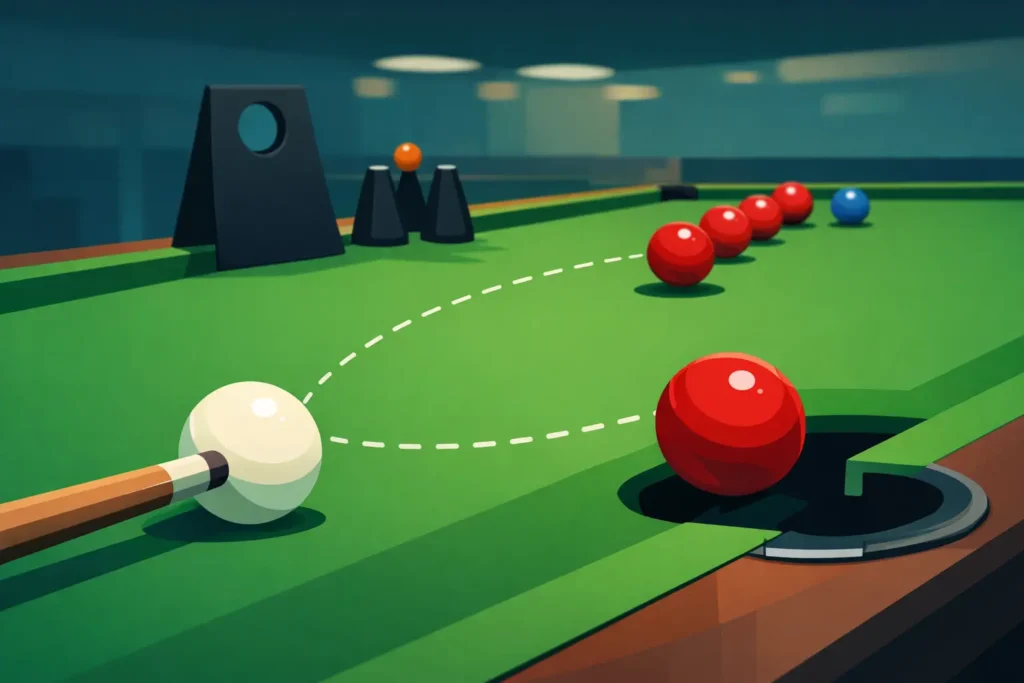
The Best Drills for Long Potting in Snooker
A long red is rarely missed because a player cannot see the pocket. It is missed because the cue ball is struck from a stance that is not settled, with a cue action that leaves the line at the last moment. The best drills for long potting expose those small faults, then give you enough meaningful repetition to remove them.
Long potting is not about forcing confidence or hitting the ball harder. It is about producing the same delivery when the cue ball and object ball are separated by most of the table. At that distance, a tiny error in alignment, cueing or contact becomes a clear miss. Train the basics under honest conditions and long pots become a reliable scoring opportunity rather than a hopeful shot.
What a Long-Pot Drill Must Train
A useful drill should demand a full pre-shot routine. If you simply drop balls on the table and fire them towards a pocket, you may groove speed, but you will not necessarily build match-standard technique. Every serious repetition starts before you get down on the shot.
Set the line from behind the cue ball, choose a precise contact point on the object ball, place your feet with purpose, and only then settle into the cue action. Your head must be still at impact and your cue must travel through the line without steering. The task is to make the process repeatable, not merely to pot a few balls when the rhythm feels good.
Use a clean, responsive table where possible. Slow cloth, dirty balls and poor cushions can distort your feedback, particularly on very thin cuts. That said, do not wait for perfect conditions. A disciplined routine transfers anywhere.
Best Drills for Long Potting: Start on the Blue Line
The blue-line long red is the right place to begin because it offers a demanding but readable pot. Place a red on the blue spot and the cue ball on the centre spot. Pot the red into either corner pocket with plain stun or a soft, centre-ball delivery. Do not add side. Your only concern is a straight cue and a true line.
Play ten attempts to one corner, then ten to the other. Record how many you make, but pay closer attention to the quality of the misses. A red that jaws in the near knuckle, or misses consistently on the same side, is information. It may point to a sighting issue, an elbow that is moving sideways, or a cue tip that is not returning to the cue ball’s centre.
Once you can make this comfortably, move the cue ball back to the baulk line. Keep the red on the blue spot. The pot is now longer, yet the geometry stays familiar. Build towards sets of 25, with a target of 18 successful pots before increasing the difficulty.
The straight-line return drill
Place the cue ball on the brown spot and a red on the blue spot, aligned directly with a corner pocket. The object ball should travel straight into the pocket. This is not a generous drill. A straight pot reveals every trace of unwanted side or deceleration.
Use a medium pace and aim to leave the cue ball close to where it started, rather than punching through the shot. If the cue ball drifts off line after contact, do not ignore it because the red went in. The cue ball is telling you that your strike was not centred.
Repeat in blocks of ten. You are looking for ten clean deliveries, not ten fortunate pots. If you miss, reset fully. Rushing the next ball is how poor technique becomes familiar.
Train Both Sides of the Table
Many club players have a favourite long red from one side and an entirely different relationship with the same shot from the other. This usually comes from body position, dominant eye alignment or an old habit of standing too close to the cue. Match play will find that weakness quickly.
Set a red on the pink spot. Place the cue ball near either baulk corner, about one ball’s width from the side cushion. Pot the red into the opposite corner. Alternate sides after every attempt.
The cue ball near the cushion makes the stance less comfortable, which is exactly why the drill works. You must adapt your bridge and feet without abandoning your fundamentals. Give yourself 20 attempts, ten from each side. A score is useful, but assess whether you stayed down on every shot and completed the cue action after contact.
For a harder variation, put the cue ball on the baulk cushion. The pot becomes a genuine long opener, but the restricted bridge makes it unsuitable for careless volume. Ten high-quality attempts are enough.
Build Cue-Ball Control Into the Pot
A long red that goes in but leaves no colour is only half a success. As your potting improves, use drills that connect the opening red to the next scoring shot.
Place a red on the blue spot and the cue ball on the centre spot. Pot the red into a corner and aim to leave the cue ball in the centre of the table for the black. Begin with a soft stun-through shot. The goal is not to force position with heavy screw or side. It is to understand how pace and a fraction of cue-ball height change the route.
Set a scoring condition: the red counts only if the cue ball finishes inside a one-foot circle around the black spot. If you pot the red and lose position, score half a point. This prevents the common habit of celebrating the pot while accepting a poor next shot.
After that, introduce a colour. Pot the long red, take the black, and replace both balls. Five consecutive red-and-black visits demand more than a single good strike. They require emotional control after success, when players often become loose and overconfident.
The Pressure Ladder
Practice breaks down when every ball feels identical. A pressure ladder gives each shot a consequence without pretending it is a tournament final.
Choose one long red, ideally from the baulk area to a corner pocket. Start at one point. Pot the ball to move up one level. Miss it and return to zero. Your target is ten. At levels four, seven and ten, you must nominate which corner pocket you will use before approaching the table.
This format changes the quality of attention. At eight or nine, most players become aware of their grip, their breathing and the fear of wasting the run. That is valuable. Rather than trying to suppress the feeling, slow your walk-in, breathe out as you settle and trust the same routine used at level one.
Do not spend an hour chasing a perfect ten. Three or four serious ladders are enough. Finish with a short technical set if your cueing has become tense.
Use Video to Diagnose, Not to Perform
A mobile phone placed behind the shot line can show faults that feel invisible at the table. Film a small number of attempts from directly behind the cue and, separately, from the side. Look for a cue that feathers off line, a head that rises before impact, or a follow-through that cuts across the body.
Avoid analysing every frame after every miss. That can make you mechanical. Review after a set, identify one priority, then return to the table with a simple intention such as keeping the bridge hand still or finishing the cue through the line.
The highest-level coaching does not replace table time. It makes table time more precise. That is the value of structured instruction: understanding what elite players see, then testing it through purposeful repetition. The Rocket Method is built around that standard, bringing Ronnie O’Sullivan’s approach to the parts of the game that separate occasional good shots from dependable scoring.
A Weekly Long-Potting Session
For most players, two focused sessions of 35 to 45 minutes are more productive than one long, unfocused practice. Begin with ten straight-line returns, then work through blue-line pots and alternating-side long reds. Finish with the pressure ladder, when your concentration has already been asked to work.
Keep a simple record: pots attempted, pots made, the side of your common miss, and whether the miss came from a technical lapse or poor shot selection. After three weeks, the pattern becomes much clearer. You may discover that your percentages are sound until the cue ball is near the cushion, or that your misses increase only when you rush after a good pot.
A great long pot should look quiet. No jab, no last-second correction, no need to watch the object ball anxiously. Put the balls in demanding positions, respect every routine, and let each clean delivery become evidence that you can trust your cue when the table opens up.

How to Avoid Snooker Miscues with Confidence
A miscue has a particular way of changing a frame. You have read the angle, chosen the right pace and settled over the shot, only for the cue tip to glance off the cue ball and send it somewhere no player intended. Learning how to avoid snooker miscues is not about hitting the cue ball timidly. It is about building a delivery you can trust when the pressure rises.
The occasional miscue happens to everyone, including excellent players. But repeated miscues are usually a clear technical signal. The cue may be arriving off-line, the bridge may be unstable, the tip may be poorly prepared, or you may be asking for more side or screw than your current action can deliver. Find the real cause, rather than simply blaming the shot, and the fix becomes far more reliable.
Why snooker miscues happen
A miscue occurs when the tip fails to grip the cue ball at impact. Instead of a clean, controlled strike, it skids across the ball’s surface. Most often, this happens when contact is too close to the edge of the cue ball, particularly when attempting side, screw or a combination of both.
That does not mean side spin is the enemy. High-level snooker demands it. The issue is whether your cue can travel straight through the intended contact point without unwanted movement. A slightly loose grip, a bridge that shifts by a few millimetres, or a cue action that lifts at the end can turn a playable contact point into a miscue.
There is also a decision-making element. Players commonly miscue after deciding they need a spectacular amount of side to force position. Often, a more natural angle, a different route around the table or accepting a slightly less perfect position would reduce the technical demand. Good snooker is not only about what is possible. It is about choosing the percentage shot you can execute repeatedly.
Build a cue action that reaches the ball cleanly
The most dependable answer to how to avoid snooker miscues starts before the final backswing. Get your body still and balanced enough that the cue can move freely on its intended line. If you are reaching, falling into the shot or holding tension through your shoulder, your hand is likely to make a late correction.
Your cue should feel as though it is swinging from the elbow, with the forearm delivering through the line of aim. The grip hand is there to guide the cue, not squeeze it into submission. Excess pressure restricts the swing and often causes the wrist to turn or the cue to jerk across the ball at impact.
A useful standard is to finish every routine shot with the cue pointing along the line you intended to play. Hold that finish for a moment. If the cue consistently finishes to one side, rises sharply, or your body has moved before contact, the stroke is giving you valuable feedback.
Keep the bridge hand firm and quiet
A stable bridge is non-negotiable when playing with side. The cue must have a solid channel through which to travel, especially when the tip is approaching the outer areas of the cue ball. A soft or sliding bridge gives the cue room to wander at precisely the wrong moment.
On an open bridge, make sure the thumb and forefinger create a clear, firm groove. On a closed bridge, avoid gripping the cue so tightly that it cannot travel smoothly. In both cases, plant the hand with purpose and check that it will not move when you play through the ball.
Bridge length matters too. A longer bridge can encourage a smooth, flowing stroke, but if it leaves you feeling unstable on a demanding screw shot, shorten it slightly. There is no single perfect measurement. The right bridge length is the one that lets you strike the chosen point accurately without tension or wobble.
Deliver through the cue ball, not at it
Many miscues come from a player trying to manufacture spin with a sharp jab. Spin is created by accurate off-centre contact and a free acceleration through the ball, not by stabbing at it. A jab makes timing fragile and encourages the tip to glance off the surface.
For controlled screw, stay down, allow the cue to travel level and commit to a smooth follow-through. Do not pull the cue away at impact in an attempt to drag the white back. That instinct is understandable, but it interrupts the delivery. The cue ball will respond to a clean strike far better than a forced one.
Choose contact points you can own
The further from centre you strike the cue ball, the smaller the margin for error. This is why a player can feel completely secure on plain-ball pots, then miscue when adding a little side. The change may look modest, but it demands much greater precision.
Start by treating the cue ball as having zones rather than chasing its absolute edge. Centre, high, low, left and right are your foundation. Once you can strike those areas cleanly, blend them gradually: a touch of low-left, then a touch more. There is no prize for using maximum side when a half-tip of side produces the required angle.
This approach pays off under match pressure. When nerves arrive, players tend to grip tighter and steer more. A contact point that is safe in practice can become risky in competition. Build your game around the spin you can deliver on your worst composed day, not only the spin you can find when the table is empty.
Prepare the tip properly
Technique carries most of the responsibility, but equipment cannot be ignored. A glazed, shiny or badly shaped tip is less likely to hold chalk and can make clean contact less predictable. Chalk is not decoration. It creates friction between tip and cue ball, particularly on off-centre strikes.
Apply chalk lightly and evenly before shots that require side or screw. Avoid grinding it into the tip or leaving a thick, uneven layer. Check the tip regularly: it should have a rounded, maintained shape rather than a flattened face or ragged edge. If it has become hard, glazed or badly compressed, it may need careful attention or replacement.
Cueing too close to the floor can cause trouble as well. On a low cue-ball position, especially near a cushion, it may be difficult to keep the cue level. Recognise that restriction. Sometimes the correct response is to use less screw, change the positional route or play a containing safety rather than force an unreliable strike.
Practise the shots that expose the fault
Random potting can hide a technical problem because the next shot is always different. Deliberate practice reveals it. Begin with the cue ball near the centre of the table and play straight pots using centre ball. Your task is not merely to pot the ball, but to send the cue ball forward on the exact line of the cue after impact.
Then repeat the same shot with a small amount of left and right side. Watch whether the cue ball reacts as expected and whether your cue action remains still. If miscues occur, reduce the amount of side until you can produce clean contact ten times in succession. Only then move further from centre.
For screw practice, set a simple straight pot and aim to draw the cue ball back a short, controlled distance. Prioritise clean strike and balance over dramatic backspin. Add distance gradually. This teaches you to trust the delivery rather than snatch at the cue ball.
It is also worth filming a few practice strokes from behind the line of aim. What feels straight is not always straight. You may see the cue feathering across the ball, a grip hand tightening on the final delivery, or an elbow dropping too early. One clear observation can save weeks of guessing.
When a miscue happens in a match
Do not let one miscue persuade you to abandon your cue action. The next shot is not a test of character. It is simply another chance to run your routine. Clean the tip if needed, chalk it, choose a sensible contact point and make the same calm delivery you have rehearsed.
If two miscues arrive in quick succession, be practical. Reduce the amount of side, favour centre ball where possible and play for larger positional areas. This is intelligent frame management, not negative snooker. The best players adapt to what their action is giving them on the day.
A reliable cue action is built through informed repetition, not hope. The Rocket Method brings championship-level thinking to the details that decide whether a cue ball obeys you or escapes you. Keep the bridge still, strike within your controllable range and give every demanding shot the full attention it deserves. Confidence follows when clean contact becomes your normal standard.
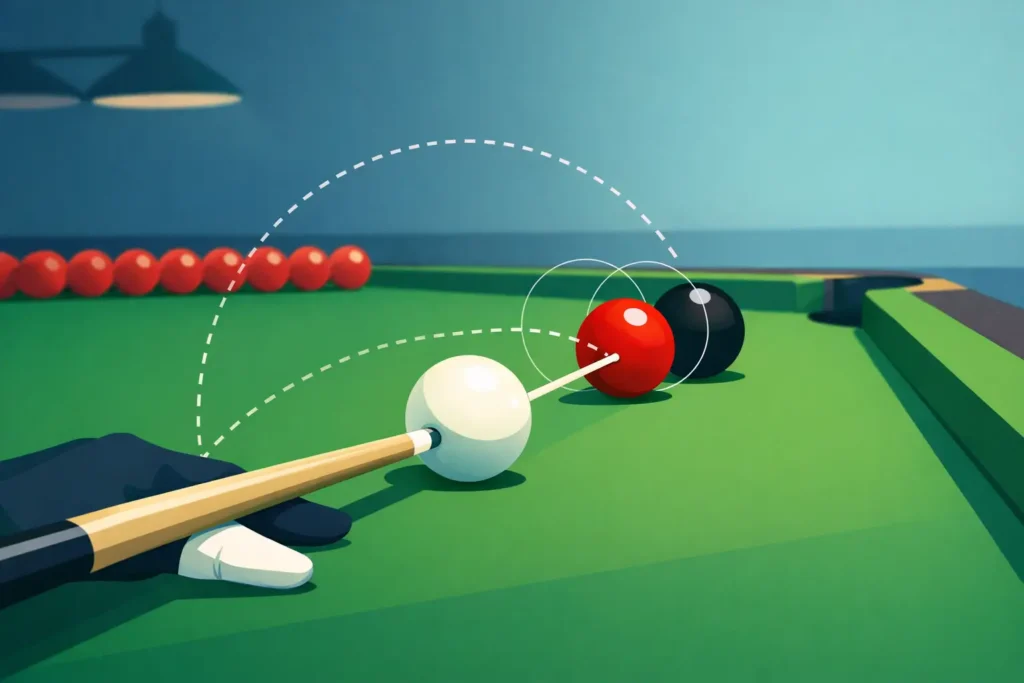
Best Snooker Aiming Methods for Cleaner Potting
A red sits a few inches from the pocket, apparently straightforward, yet it rattles in the jaws. Most misses of this kind are not caused by a lack of talent. They come from a vague picture of the shot, a rushed final look, or a cue delivered somewhere other than where the player intended. The best snooker aiming methods give you a repeatable way to see the pot and then trust your action.
There is no single aiming system that replaces judgement. Snooker is played over changing distances, angles, cloth speeds and positional demands. But the strongest players do share a discipline: they identify the correct contact point, align their body to it, and refuse to let unnecessary thought interfere once they are down on the shot.
The best snooker aiming methods start with the line
Every pot has a target line. Imagine a line running from the centre of the pocket through the centre of the object ball. For a centre-pocket pot, the cue ball must strike the object ball on the point that sends it along that line. That sounds elementary, but many players aim at the pocket rather than at the contact point on the ball.
Stand behind the cue ball and look through the object ball towards the intended pocket. Your first job is to see the object ball’s route clearly. Your second is to identify where the cue ball needs to arrive. When those two lines make sense in your mind, step into the shot without changing the picture.
This is the foundation of accurate potting. It works on a straight red, a thin cut to the middle and a long black because the geometry stays the same. What changes is the margin for error. A thick pot may accept an imperfect contact point; a long thin red will expose every fraction of a degree.
Centre-pocket thinking creates a useful margin
Do not merely aim to make the ball. Aim to send it into the centre of the pocket, especially when the ball is travelling at a controlled pace. This gives the shot its maximum usable margin and stops you from accepting a line that only works if the ball catches one side of the jaw.
There are exceptions. A positional shot may require you to use a side of the pocket, perhaps to change the cue ball’s escape route or hold an angle. That is a deliberate advanced choice. For normal practice, centre-pocket visualisation builds cleaner judgement and exposes whether your alignment is genuinely sound.
Ghost-ball aiming: useful, but do not overcomplicate it
The ghost-ball method asks you to picture an imaginary cue ball frozen against the object ball at the exact point of impact. The centre of your real cue ball must travel towards the centre of that imagined ball. It is one of the clearest ways to understand cut angles.
For beginners, it turns an abstract instruction such as “hit it thinner” into a visual target. For experienced players, it can be a valuable reset when a particular angle feels uncomfortable. It is particularly helpful on long pots, where a small error at contact becomes a large miss by the time the object ball reaches the pocket.
The limitation is that you cannot stand over the shot trying to hold a perfect imaginary ball in your mind. That usually creates tension and indecision. Use ghost-ball aiming while you are upright to establish the line, then let your pre-shot routine and cue action do the work.
Use the object ball, not the cue tip, as your reference
A common club-player habit is to stare at the cue ball and try to steer the cue tip towards a chosen point. The cue ball matters, of course, but the pot is decided by the contact on the object ball. Your visual priority should be the object ball’s line into the pocket.
As you settle into your stance, make a final confirmation that the object ball has a clear path to the centre of the pocket. Then return your eyes to the cue ball only when you are ready to deliver the cue through it. This sequence prevents the cue ball from becoming a distraction.
Different players favour different final-look patterns. Some look at the object ball last, others at the cue ball. The right choice is the one that produces a still head, a committed delivery and repeatable contact. Test both in practice, rather than copying a professional’s routine without understanding why it works for them.
Alignment is the aiming method players overlook
You can read the angle perfectly and still miss if your body is not aligned with the shot. Once you have chosen the cue-ball path, your cue, forearm and vision must be organised around it. If you are reaching across the line, twisting your shoulders or craning your neck to see the shot, you are asking your cue action to rescue poor set-up.
Approach the table from behind the line. Place your bridge hand on the intended cue path, lower yourself into the shot, and check that the cue is travelling freely beneath your chin. The head should be still and the eyes level enough to judge the line without strain.
This is where aiming becomes physical rather than theoretical. A player may say they “see” the right contact point, but if their cue points slightly elsewhere at address, the visual picture is irrelevant. Practise getting down on simple straight shots until your cue naturally arrives on line. Only then add difficult cuts and pace control.
Keep the delivery honest
A straight backswing and follow-through do not guarantee a pot, but they reveal whether your aim was right. If the cue is jabbed, dragged sideways or decelerated, you cannot learn much from the result. A miss might be poor judgement, poor alignment or poor delivery.
Give yourself a simple test: set up a straight blue into a middle pocket and play it softly enough that any side spin or unwanted swerve is obvious. If the ball repeatedly drifts to one side, inspect your cue action before searching for a more elaborate aiming system. Precision begins with an honest stroke.
Fractional-ball language can sharpen your judgement
Many players find it useful to describe cut shots in fractions: full ball, three-quarter ball, half-ball, quarter-ball and very thin. These are not exact measurements to calculate at the table. They are reference points that develop feel.
A half-ball hit is especially useful because it gives a recognisable visual relationship between the balls. From there, you can learn the difference between a slightly fuller and slightly thinner contact. Over time, the brain becomes better at reading the in-between angles that decide competitive frames.
Be careful not to turn fractions into rigid rules. The same apparent contact can behave differently when the cue ball is sliding, rolling, carrying side or affected by throw. Use fractional-ball aiming to train your eye, then allow experience to refine the final decision.
Side spin changes the picture
The cleanest way to improve your aiming is to begin with centre-ball striking. Side spin introduces cue-ball deflection, swerve and throw on the object ball. All three can alter the line enough to turn a confident pot into a miss, particularly at slow speed or over distance.
That does not mean avoiding side altogether. In serious snooker, side spin is essential for position, escaping cushions and widening cue-ball routes. It means acknowledging the trade-off. When the pot is difficult, first ask whether the positional gain really justifies adding another variable.
If you do use side, commit to the correction based on your own cue, cue action and table conditions. There is no universal amount of compensation. Practise the same shot with plain ball, then with running and check side, at several speeds. The table will teach you more than a diagram ever can.
Build aim through purposeful practice
Random potting feels productive because balls go in, but it rarely isolates the source of a miss. Choose one line and repeat it from both sides of the table. Begin with a short straight pot, move to a half-ball cut, then stretch the distance while keeping the pace controlled. Record where misses go: thick, thin, left, right, short of the pocket or into the far jaw.
That pattern matters. Consistently cutting balls too thick may indicate that you are under-reading the angle. Repeated misses to the same side on straight pots often point to stance or cue delivery. A useful practice session diagnoses, rather than merely entertains.
The Rocket Method places this kind of technical clarity within a wider standard of cueing, routine and match play. Elite aiming is not a trick seen once and forgotten. It is a trained process that holds together when the score is close and the table feels less forgiving.
When you next face a pot you should make, slow down before you get down. See the object ball travelling to the centre of the pocket, find the cue-ball line that creates it, and build your stance around that decision. Then deliver the cue without trying to correct the shot halfway through. That is where cleaner potting begins.
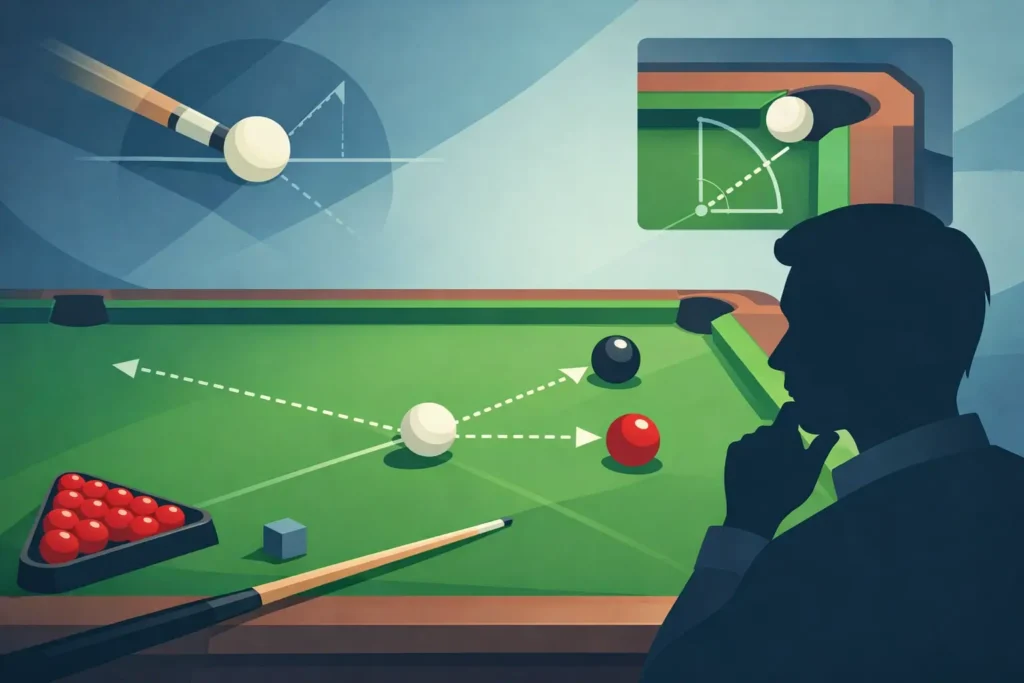
How to Judge Snooker Angles with Confidence
A shot can look straight, feel straightforward and still be missed by half a pocket. That is usually not a cueing problem. It is a picture problem. Learning how to judge snooker angles means seeing the true route of the object ball before you settle into the shot, then matching that picture with the right cue-ball contact and pace.
The best players do not rely on guesswork or a vague sense that a ball “looks right”. They build a reliable visual process. Once that process becomes familiar, pots become less dependent on confidence and more dependent on clear information.
How to judge snooker angles from behind the shot
Start where the shot actually begins: directly behind the line of the object ball and the target pocket. Before you think about side, screw or position, decide whether you can see a clean line from the object ball to the part of the pocket you intend to use.
For a centre-pocket pot, imagine a line running from the centre of the target pocket through the centre of the object ball. That is the object-ball line. Now ask where the centre of the cue ball needs to arrive to send the object ball down it. This is your contact point.
On a thin cut, the cue ball strikes closer to the outside edge of the object ball. On a fuller pot, it contacts nearer the middle. The principle is simple, but the table makes it deceptive: your eye can easily be drawn towards the cue ball rather than the object-ball route. Make the object ball and pocket your priority first.
A useful discipline is to stand behind the shot for an extra second. If the intended path is unclear while standing, it will not become clearer once you are down on the cue. Get up, reset your view and only address the ball when you can describe the shot to yourself in plain terms: full ball, three-quarter ball, half ball or thin cut.
Use the ghost-ball picture, but do not depend on it blindly
The classic method is to imagine a “ghost ball” resting behind the object ball, exactly where the cue ball must be at impact. Its centre sits on the line from the object ball to the pocket. Aim to send the real cue ball into that imagined position.
It is a powerful training image because it converts an abstract cut angle into a physical destination. Yet it has a limitation. You cannot see the ghost ball, and when the shot gets thin or the cue ball is travelling with side, players often start aiming at an imagined point with too much certainty.
Use the ghost ball to understand the geometry, then refine the picture through experience. On a long pot, a tiny error in the contact point is magnified over the length of the table. On a short, straightforward pot, you have more margin for error. The required precision changes with distance, pocket access, cushion conditions and cue-ball speed.
Rather than treating every shot as an exact mathematical calculation, develop reference points. Learn what a half-ball pot looks like from different positions, how a three-quarter-ball contact sends the cue ball across the table, and how a very thin cut feels when the object ball is close to a top pocket. These familiar pictures become your visual library.
Find the contact point before getting down
Many missed pots begin with a player getting into their stance too early. They see a general line, lower themselves over the cue and then try to solve the angle with small adjustments of the bridge hand or cue. That is rarely a winning process.
From upright, identify the object-ball route. Then picture the cue-ball route into the required contact point. Finally, step into the shot along that cue-ball line. Your feet, body and cue should support the decision you have already made, not search for it after the event.
If you feel yourself steering the cue at the last moment, it is usually a sign that the line was never fully committed to. A still, direct delivery is much easier when the picture was settled before the final backswing.
See the pocket, not just the pot
A pocket is not simply a hole at the end of a line. It has near jaws, far jaws and usable sections that change according to the approach angle. A ball sent too close to a near jaw can rattle even when the general line seemed correct. A ball played towards the far side may need a slightly different object-ball line, especially on a tight cut.
For routine pots, aim through the centre of the pocket. This gives you the greatest margin and keeps the decision uncomplicated. But when the cue ball is awkwardly placed, when position demands a particular route, or when a ball is close to a jaw, you may need to choose a specific part of the pocket.
That choice has consequences. Cheating the pocket can make a positional route available, but it reduces your potting margin. In a match, the correct decision depends on the score, the value of the break, the table conditions and your confidence in the shot. Championship snooker is not about forcing the most ambitious route. It is about choosing the percentage that keeps control of the visit.
Let cue-ball direction confirm the angle
The cue ball provides immediate feedback on whether you have judged a pot correctly. On a plain-ball shot, the cue ball generally travels away from the object ball on a line determined by the thickness of contact. A fuller hit sends it nearer the original line; a thinner hit sends it wider across the table.
This is why simple stun shots are so valuable for learning angles. With no excessive top, screw or side to complicate the outcome, you can see the natural cue-ball path clearly. Pot a series of balls using centre-ball stun and observe where the cue ball finishes. Over time, the connection between contact thickness and cue-ball route becomes instinctive.
Topspin, backspin and side are tools, not substitutes for accurate judgement. Top can lengthen the cue-ball path after contact, screw can pull it back, and side can alter both the cue ball’s journey and the object ball’s response off cushions. But if you are unsure of the basic potting angle, adding side often introduces another variable at exactly the wrong moment.
Build your game in the right order: see the pot, select the contact, understand the natural path, then add the minimum cue-ball action needed for position.
Train your eye with purposeful routines
Angle judgement improves fastest when practice has a clear purpose. Random potting can be enjoyable, but it gives poor feedback because every shot is different. Repetition lets you compare what you saw with what actually happened.
Place the blue on its spot and the cue ball in a fixed position below it. Pot the blue into one corner several times using centre-ball, then move the cue ball a few inches wider and repeat. Notice how the contact changes from full to thin and how the cue ball leaves the object ball. Do not rush to increase difficulty. Your goal is to make the picture accurate.
Next, use the same object-ball position and alternate between the two corner pockets. This forces you to read two distinct angles from one cue-ball location. Then introduce a simple positional target for the cue ball, such as finishing above or below the pink spot. You are now connecting potting geometry with break-building intention.
For longer pots, practise looking from behind the line, walking into the stance, delivering the cue and holding your finish. Record a few attempts if possible. Video can reveal a common fault: a player may correctly see the angle while standing, then move their head or cue off-line as they address the shot.
Make decisions that hold up under pressure
Pressure narrows attention. Players begin to stare at the pocket, jab at the cue ball or overthink the contact point. Your answer is not a more complicated routine. It is a familiar one.
When the pot matters, return to the same questions: Where is the object ball going? How full do I need to hit it? What is the natural cue-ball path? Is the positional reward worth the reduction in potting margin? Answer them before you get down, then trust the decision.
Great angle judgement is not a gift reserved for naturally gifted players. It is trained observation, reinforced until the table starts to look calmer and more legible. The Rocket Method approach is built around that standard of deliberate practice: clear fundamentals, repeatable decisions and the confidence to execute when the chance arrives.
The next time a shot appears awkward, resist the urge to manufacture a miracle. Stand behind it, find the object-ball line, choose the honest contact point and let a disciplined cue action do the rest.
Best Snooker Pre Shot Routines for Real Control
A missed black is rarely caused by one bad cue action alone. More often, the player has rushed the picture, stepped into the shot without commitment, or changed their mind halfway through delivery. The best snooker pre shot routines remove that uncertainty. They give every shot, from a simple red to a tough long pot under pressure, the same dependable process.
A routine is not theatre. It is the practical bridge between seeing the shot and playing it. At its best, it protects your technique when your nerves, scoreline or opponent are trying to pull you away from it.
Why a pre-shot routine changes your scoring
Snooker asks you to make precise decisions before you ever address the cue ball. You must judge the potting line, choose the correct contact point, understand the cue-ball path, decide on pace and then commit to a delivery. Players who skip from decision to action tend to carry too many of those thoughts into the stance.
That is where tension arrives. The head moves to check the line again. The cue is steered. The backswing becomes hesitant. A routine puts each job in its proper place: think while standing, then trust the decision once you are down on the shot.
It also creates a valuable emotional reset. After a missed chance, a fluke or a poor kick, the table can feel personal. Your routine gives you something objective to return to. You do not need to force confidence. You simply need to complete the next process well.
The best snooker pre shot routines have one purpose
There is no single routine that suits every player. Ronnie O’Sullivan’s natural rhythm will not look identical to yours, and copying another player’s exact number of feathers is not the aim. The best routine is one that is clear enough to repeat, short enough to maintain for a full match and disciplined enough to hold up when a frame is on the line.
It should answer five questions before the cue is delivered:
- What is the potting line?
- Where must the cue ball finish?
- What speed and spin create that result?
- Where does my body need to be to cue straight?
- Am I fully committed to this shot?
If you are still answering any of these questions while your cue is moving back and forth, you are not ready to play. Stand up, reassess and begin again. That can feel slow at first, but it is far quicker than donating chances through indecision.
A championship-standard routine, step by step
Build the picture from behind the line
Approach the shot from behind the intended line of the cue ball. This is your viewing position, not merely somewhere you happen to stand. Take a moment to see the object ball entering the pocket and then work backwards to the cue ball.
Next, establish the cue-ball route. On a straightforward black off the spot, this may be almost automatic. On a red requiring check side, stun, or a controlled screw, give the route proper attention. Identify the danger as well as the desired position: a middle pocket, a touching ball, a blocking red or the risk of running too far.
Be decisive here. A player who cannot select a clear plan often defaults to a tentative cue action. Pick the percentage option, accept its margin for error and commit.
Rehearse the shot with your eyes and body
Before dropping into stance, make one or two relaxed rehearsal movements. These are not practice strokes in the air for their own sake. They help your body understand the line, pace and reach of the shot.
Your eyes should move naturally between the object ball and cue ball. Feel whether your feet will allow you to place the cue on line without stretching, twisting or crowding the shot. If the table layout demands an awkward bridge or a stretch, acknowledge it before you get down. The routine must adapt to the table, but the standards do not change.
Step in on line, not around it
A common amateur fault begins before the cue tip reaches the cue ball. The player steps into the stance from the side and then uses their upper body to search for the line. That makes a straight delivery harder than it needs to be.
Instead, bring the cue through the intended line as you lower into the shot. Let your bridge hand settle first, then allow your body to come down into a balanced, stable position. Your head should arrive where it can see the line clearly, without being forced or tilted.
There is no prize for getting down quickly. A composed entrance creates a composed shot. If you feel off balance, too close to the cue ball or unable to see the contact point comfortably, get up. Professionals do it. It is discipline, not weakness.
Use practice strokes to confirm, not to decide
Once down, make a consistent number of smooth practice strokes. For many players, three to five is enough. The exact number matters less than their purpose: to check that the cue is travelling freely, the tip is addressing the intended point on the cue ball, and your grip remains quiet.
Do not use endless feathers to negotiate with yourself. If doubt appears about the line, spin or pace, reset fully. If everything looks right, let the final backswing be unhurried and deliver through the cue ball with the same intention you saw while standing.
A useful standard is this: your final delivery should not look as though it is trying to save the shot. It should look like the natural finish of a decision already made.
Stay down and read the result
Remain still after striking the cue ball. Keep your head down long enough to feel the completion of the cue action, then watch the balls. This protects the strike, particularly on delicate stun shots and long pots, but it also makes practice more productive.
When you miss, diagnose the shot honestly. Did you misread the line? Choose the wrong pace? Lose your alignment while stepping in? Lift your head? A routine turns vague frustration into useful feedback. You can improve what you can identify.
Make the routine work under pressure
The real value of a pre-shot routine is revealed late in a close frame. Pressure does not usually erase ability. It changes tempo. Some players rush to escape discomfort; others become so cautious that the cue stops flowing.
Your answer is not to slow every movement artificially. It is to keep the sequence familiar. Take the same look from behind the shot. Choose the same line. Step in the same way. Use the same calm practice strokes. Let the routine control your pace rather than the score controlling it.
Breathing can help, especially after a tactical exchange or a missed opportunity. One controlled breath while standing behind the line is enough to reduce urgency. Avoid turning breathing into another complicated instruction. Snooker is demanding enough without giving yourself a checklist that overwhelms the shot.
Tailor the routine to different shots
Your core process should stay consistent, but the amount of analysis changes. A simple red with open position needs a brisker routine than a long red with the cue ball tight to the cushion. On an easy shot, overthinking can manufacture tension. On a difficult safety, rushing can hand over the frame.
Long pots deserve extra time behind the line. Confirm the true centre of the pocket, especially when the object ball is near a cushion where the visual picture can deceive you. Shots using side need a deliberate final check of tip position and speed. Touch shots demand even greater stillness, with no jab at the cue ball.
For break-building, include the next ball in your standing assessment. You are not only potting the current red or colour; you are creating a playable angle for what follows. That said, do not let position become so dominant that you compromise the pot. The ball in front of you remains the first job.
How to practise your pre-shot routine
Do not reserve routine work for matches. Build it during solo practice, even when you are potting the same black repeatedly. Start behind the line every time, walk in with purpose and reset after each shot. Repetition is what makes the process available when the pressure rises.
A productive drill is to place a red on its spot and play it into the corner from several distances. Give yourself a clear cue-ball finishing zone for the black. Score only shots where you complete the full routine and achieve both pot and position. This discourages casual practice and exposes where your decision-making breaks down.
You can also film a short session from the side. Look for changes in tempo, head movement, cue alignment and whether you remain down after contact. The routine should look repeatable, not rigid. You want calm authority at the table, not a performance that consumes your concentration.
The Rocket Method teaches snooker as a complete performance skill: cue action, tactical awareness and the composed habits that allow good technique to appear when it matters. A repeatable pre-shot routine is one of those habits. It is where preparation becomes execution.
Your next frame will still contain awkward angles, pressure pots and moments when the table refuses to cooperate. Meet each one with the same clear process. See it properly, decide with conviction, get on line and let the cue do the work.
How to Align Snooker Shots with Confidence
A straight red sitting over the middle pocket can look like the easiest ball on the table – until you miss it thick, thin or jaw it under pressure. That is why learning how to align snooker shots is not about finding a clever trick. It is about building a routine that makes the correct line clear before the cue ever moves.
The best players make alignment look automatic because they remove doubt early. They see the potting line, place their body around it and deliver the cue on that line with commitment. For club players, the same standard is available, but it demands patience and an honest look at the moments where the process breaks down.
How to align snooker shots from ball to cue
Every pot begins with a line from the object ball to the intended part of the pocket. That line determines the contact point on the object ball. Only once those two things are settled can you establish the line from cue ball to object ball.
Start behind the shot, where you can see the full picture. Pick a precise target inside the pocket rather than aiming vaguely at its centre. On a simple, straight pot, the centre is often appropriate. On a cut shot, particularly one played with pace or into a tight angle, your target may need to be a fraction away from centre to allow for the ball entering the pocket cleanly.
Now imagine a line from that target back through the centre of the object ball. The point where this line reaches the ball is the contact point you must strike. From there, trace the line back to the cue ball. This is your cueing line.
Do not rush down onto the shot because you think you have seen it. Take a second look. Ask one clear question: does the cue ball need to arrive at this exact point on the object ball for the ball to travel into this specific part of the pocket? If the answer is not immediate, stand up and reset. A few extra seconds before getting down are far cheaper than a missed opportunity and a lost visit.
See a line, not a collection of balls
A common amateur error is to focus on the object ball alone. The player walks in, gets low and attempts to steer the cue towards what looks right from the table. But a pot is a relationship between three fixed points: cue ball, contact point and pocket target.
Your job is to make those points feel like one line. This is why the view from behind the cue ball matters. It gives you perspective that disappears once your chin is close to the cue. Get the decision made while standing. When you are down on the shot, your only task is to confirm the line and deliver the cue straight.
Build your stance around the line
Good alignment can be lost during the approach. You may identify the correct line perfectly, then step into a stance that leaves your cue pointing slightly across it. The shot will feel awkward, and the usual response is to manipulate the cue with the arm. That is where consistency disappears.
Approach the shot with your cue already held on the intended line. As you lower into position, let your bridge hand land naturally beneath that line. Your back foot should provide a stable base, while your head settles so your eyes can look directly along the cue.
There is no single identical stance for every player. Height, build, flexibility and cue action all matter. What does not change is the requirement that the cue can travel freely and straight, without your body forcing it offline. If your chest, shoulder or grip hand feels cramped, do not try to fight through it. Stand up and adjust your position.
A useful checkpoint is your final feathering. When the cue moves back and forth, does the tip repeatedly pass through the centre of the cue ball on the line you selected? If it appears to sweep sideways, your stance or grip is interfering. Alignment is not only about where the cue begins. It is about whether it can remain true throughout the action.
Keep your head still, but do not freeze
A stable head gives your eyes a dependable reference point. If your head moves during the delivery, the line can appear to shift and tempt you into correcting mid-stroke. Keep your eyes quiet through the cue action and remain down long enough to watch the object ball begin its journey.
Stillness should not mean tension. A rigid jaw, raised shoulder or tight grip makes a free cue action harder. The elite look composed because their body is stable and their cue arm is able to swing. Seek that combination: firm foundations, relaxed delivery.
Straight pots reveal the truth
Straight pots are the purest test of alignment. They expose a cue that is not travelling straight, an eye line that is off-centre, or a player who lifts up before impact. Instead of treating them as routine balls, use them as technical evidence.
Set a red a comfortable distance from a corner pocket with the cue ball directly in line. Play the shot at a medium pace, with a plain centre-ball strike. Your intention is not merely to pot the red. Watch whether the cue ball stops cleanly or drifts to one side after contact. A drifting cue ball usually tells you that you have struck the object ball off-centre or delivered unwanted side.
Repeat the exercise from both sides of the table. Then gradually increase the distance. If you miss, resist the temptation to change three things at once. First check whether you chose the line properly. Next check whether you stepped into that line. Finally, assess the delivery. This sequence prevents random adjustments and gives your practice a purpose.
Cut shots require a fuller picture
On cut shots, players often underestimate how precise the contact point must be. The thinner the cut, the smaller the margin for error. A tiny change in cue-ball path can turn a confident pot into a miss to the near jaw.
Take your time selecting the pocket target. For a slow, natural-paced cut, aim for a route that lets the object ball enter with room either side. For a firmer shot, account for the way pace can alter the effective line into the pocket. There is no universal rule that says every ball should be aimed at the same point in every pocket. Table conditions, cloth speed, ball cleanliness and the angle all have a say.
Use the object ball as your reference, not the cue ball’s final path. Positioning matters, of course, but first earn the pot. Trying to force ideal position can lead to unwanted side and a less reliable contact. When a ball is difficult, choose the simplest cue-ball strike that achieves the next shot. Championship snooker is often built on disciplined percentages, not on making every visit spectacular.
Let the cue action prove your alignment
Once down on the shot, your practice swings should confirm the decision rather than reopen it. Feather with a consistent rhythm. Let your eyes move naturally between the object ball and cue ball if that is your established routine, then settle on the object ball for the final delivery if that helps you trust the target.
Avoid a last-second poke. A jabby stroke is often a sign that the player does not fully trust the line. Give yourself a measured pause at the back of the cue action, then accelerate smoothly through the ball. The cue should follow through on the intended line, with no attempt to twist the grip or guide the white towards the target.
This is especially significant under pressure. Nerves do not usually erase your ability to see a pot. They shorten your routine, tighten your hand and encourage you to rush the moment of delivery. Your answer is not to think harder. It is to return to the same visual and physical sequence you have practised when the table was quiet.
Practise alignment with intent
Randomly knocking balls around can be enjoyable, but it rarely fixes an alignment fault. Set aside part of each session for deliberate work. Begin with straight pots, then add half-ball cuts, thin cuts and long pots. Keep the cue-ball strike simple until the potting line feels dependable.
Film a few shots from directly behind the cue and from the side. You may notice that the cue is not as straight as it feels, or that your head rises during the strike. Video is valuable because feel can be misleading. The table tells the truth, and a clear recording helps you see it.
It also helps to judge progress by the quality of your routine, not just by your pot percentage. A well-aligned miss gives you something useful to examine. A fluked pot from a hurried, crooked approach reinforces the wrong habit. Demand a repeatable process and the results will become more reliable.
The Rocket Method teaches this standard of preparation through elite-level instruction: see the line clearly, build a stable address and trust a cue action that has been prepared properly. The goal is not to look polished for one shot. It is to create a method you can rely on when the match, the break and the next red all matter.
The next time a key ball presents itself, do not ask whether you fancy it. Stand behind it, define the line, step into it with intent and give yourself the best possible chance to let the cue do its job.

Top Snooker Mistakes Amateurs Make and Fix
A straight red to the centre pocket should feel routine. Yet it is exactly this sort of shot that exposes the top snooker mistakes amateurs make: a rushed approach, an unstable cue action, eyes moving too soon, or a decision made without considering the next ball. The miss is rarely mysterious. It is usually the visible result of a habit that began several seconds earlier.
Better snooker is not built on finding a single magical cueing tip. It comes from recognising where standards slip, then replacing loose habits with a repeatable process. The strongest amateurs do the simple things to a higher standard, especially when the score matters.
Top Snooker Mistakes Amateurs Make at the Table
1. Treating every shot as a potting test
Many players see a makeable red and think only about getting it in. Professionals see the same red as part of a sequence. They assess the pot, the cue-ball route, the likely next colour, the value of the break and the cost of failure.
This does not mean an amateur must attempt difficult professional-level recovery shots. It means every shot deserves a simple question: where does the cue ball need to finish? If you cannot name a useful target area before addressing the shot, you are relying on hope rather than planning.
Start with a modest positional target, not a perfect pinpoint finish. On a red followed by the black, for example, aim to leave a comfortable angle rather than trying to land dead straight. A wider target area produces more margin for error and keeps the break alive.
2. Rushing the pre-shot routine
The shot often goes wrong before the cue has moved. Amateurs commonly walk into position, bend down quickly and begin striking before their eyes and body have settled. Under pressure, this becomes faster still.
A dependable routine creates a pause between decision and execution. Stand behind the line of the shot, decide the route and pace, approach the table with purpose, set the cue, take measured feathering strokes and only then deliver. The exact number of feathers is less important than their consistency.
Do not confuse speed with fluency. Ronnie O’Sullivan plays quickly when the shot is clear, but quick decision-making is not the same as hurried cueing. Your routine should be calm enough to hold up on the final red of a close frame.
3. Trying to steer the cue ball
Steering is one of the most damaging amateur habits. It happens when a player senses the cue is not travelling perfectly and attempts to correct it during the delivery. The cue then moves across the line, often producing a thin cut, an unintended side spin or a complete miss.
The cure is not to force the cue through harder. It is to make the action simpler. Keep the grip relaxed, let the forearm swing freely and allow the cue to follow the line you selected while standing up. A tense hand cannot deliver a straight cue consistently.
Practise a straight blue or black from a comfortable distance, with the cue ball directly in line. Do not judge the exercise by whether the ball drops alone. Watch the cue ball after contact. If it drifts sideways without a reason, your strike needs attention.
4. Lifting the head to see the result
Players do not usually lift their head because they are careless. They lift it because they want instant confirmation. Unfortunately, the movement can pull the shoulder, hand and cue off line at the precise moment accuracy is required.
Stay down until you have heard the object ball reach the pocket or seen the cue ball travel away. This is particularly valuable on long pots, where anxiety encourages the player to peek early. Hold the finish for a beat. It feels deliberate at first, then becomes part of a composed delivery.
5. Using side spin as an automatic answer
Side is a valuable scoring tool, but it magnifies imprecision. It changes the cue ball’s path off cushions, alters throw on the object ball and demands a more accurate strike. Too many amateurs reach for it to manufacture position they could have created with a better route or a more sensible shot choice.
Use plain ball first whenever the table allows it. Top or screw can often provide enough cue-ball movement with fewer variables. When side is genuinely required, choose the amount deliberately and allow for the effect rather than adding it as an afterthought.
There is a trade-off here. Playing safe, simple routes will occasionally leave you a slightly less attractive angle. That is still preferable to turning a routine scoring chance into a low-percentage shot with uncontrolled side.
Mistakes That Cost Frames, Not Just Pots
6. Attacking when the table calls for safety
A long red may be available, but available is not always advisable. This is where recreational players often give frames away. They judge a shot by whether it can be potted, rather than by what happens if it is missed.
Before committing, consider the object ball’s distance from the pocket, the cue ball’s likely resting place and whether your opponent will be handed an open table. If the answer is uncomfortable, a well-weighted safety may be the stronger choice.
Good safety is not passive snooker. It is pressure applied through cue-ball control, distance and restraint. Leaving the cue ball tight on a cushion, sending it to baulk, or placing the object ball near a cushion can turn an ordinary position into a genuine problem.
7. Ignoring the value of the first safety shot
After a break ends, amateurs often play a casual containing shot and assume they have done enough. Against a capable opponent, one loose safety can be an invitation to score.
Give the first safety of an exchange the same focus as a key pot. Identify the danger balls, decide which side of the table you want the cue ball to finish on and avoid leaving an easy long red. The objective is not always an immediate snooker. Often it is simply to make the return shot difficult enough that your opponent cannot control the table.
8. Failing to practise the shots they actually miss
An hour spent hammering exhibition pots can feel productive, but it may not address the weakness that is costing matches. Most amateur misses repeat in patterns: long pots from one side, awkward bridging, thin cuts, shots along the cushion, or positional shots played with too much pace.
Your practice should reveal those patterns, not hide them. Keep a short note after matches. Did you miss because of alignment, pace, poor position, nerves or shot selection? Over several sessions, the answer becomes clearer.
Then build exercises around the problem. If long reds are the issue, do not merely pot ten and move on. Recreate the same distance, use a full routine and include the consequence of a miss by playing a safety return. Practice becomes more useful when it resembles the decision-making of a frame.
The Hidden Error: No Standard for Pace
9. Hitting the ball harder than the shot requires
Excess pace reduces pocket acceptance, sends the cue ball further than intended and makes positional margins disappear. It is especially costly on delicate colours, touch shots and safeties. The sound may be satisfying, but the result is often uncontrolled.
Think of pace as part of the line, not an extra decision added at the last moment. Before getting down, decide whether the shot needs a rolling cue ball, a firm stun, controlled screw or a containing safety weight. Your backswing and delivery should then match that intention.
A useful benchmark is this: if you are trying to leave the cue ball in a defined area, it should arrive with little excess travel. Pace is what turns a pot into position and a safety into pressure.
10. Letting one miss ruin the next shot
The best players miss. What separates strong competitors is their response. Amateurs can replay a missed black for three visits afterwards, carrying frustration into the next safety, the next long red and the next decision.
Create a reset between shots. Acknowledge the error without theatrics, return to your chair, take one slow breath and focus on the new table situation. There is no value in pretending the miss did not happen, but there is even less value in allowing it to decide the rest of the frame.
Mental discipline is not separate from technique. When attention is scattered, routines shorten, grips tighten and shot selection deteriorates. The ability to return to the present shot is a competitive skill.
Build a Game You Can Trust
The top snooker mistakes amateurs make are rarely caused by a lack of talent. More often, they come from asking too much of inconsistent fundamentals: forcing position, rushing the delivery, attacking at the wrong time or practising without a purpose.
Set one clear standard for your next session. It might be holding your finish, choosing a cue-ball target before every pot, or refusing low-value long reds when safety is the percentage play. Improve that standard before adding another.
The Rocket Method is built around this principle: elite snooker is not a collection of tricks. It is a repeatable way of seeing the table, preparing for the shot and executing under pressure. Give your game that structure, and the ordinary balls will begin to feel far less ordinary.
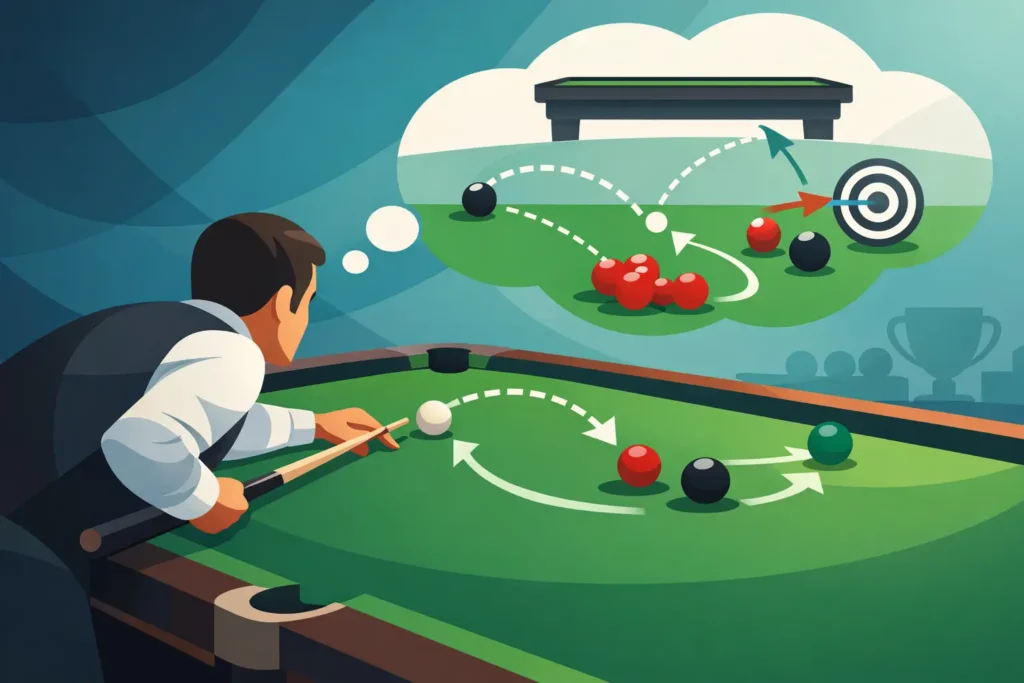
How to Play Snooker Safeties with Purpose
A missed pot does not have to hand the table away. In serious snooker, the difference between a loose visit and a difficult chance for your opponent is often one decision: knowing how to play snooker safeties with intent. A good safety is not simply a cue ball hidden behind a colour. It is a shot that controls the next visit, limits risk and asks a question your opponent may not be able to answer.
The best tactical players make the table feel smaller for the other person. They leave awkward cueing, long distances, blocked paths and reds that offer no easy route into a break. That is why safety play matters at every level. It gives beginners a way to stop donating open frames, and it gives stronger players a method for winning the fine margins that decide close matches.
How to Play Snooker Safeties That Create Pressure
The first principle is simple: do not play a safety just to avoid potting. Play it to achieve a clear outcome. Before getting down on the shot, decide what you want the opponent to face. Perhaps you want the cue ball tight on the baulk cushion, the object ball on the opposite rail, or a full snooker behind the brown, blue or pink.
A safety has two jobs. The cue ball must finish in a difficult position, and the object ball must not become an invitation. Many club players achieve one but neglect the other. They tuck the cue ball behind a colour but leave a red hanging over a middle pocket. Or they send the red safe to a cushion but leave the cue ball in open space with a simple escape route.
Think in terms of your opponent’s best reply. If they can see enough of the ball to strike it cleanly, can they leave you safe? If they can hit it thin, will the cue ball naturally return to cover? If a miss is likely, where will the balls finish? A thoughtful safety takes these replies away before they happen.
Start With the Table, Not the Shot
Before choosing a safety, read the layout as a tactical problem. Identify the open reds, the available colours and the routes that might open a scoring chance. A red near a pocket is dangerous even when it is at the far end of the table. A loose colour can be more damaging than a difficult long pot.
Your priority changes with the frame. Early in a break-building opportunity, you may favour a containing safety that keeps every red difficult. When the colours are tied up or the score is close, a more aggressive snooker can be worth the risk. If you are comfortably ahead, a simple safety that makes the opponent play from distance may be the percentage choice.
The score matters too. With only a few points between you, avoid gifting an easy starter. When you need penalties, pursue a proper snooker rather than merely leaving a long pot. Tactical awareness is not passive play. It is choosing the level of risk the frame demands.
Find the natural routes
High-quality safety play becomes easier when the cue ball travels naturally. Use the cushions rather than fighting them. A thin contact on a red can send the cue ball around two or three rails and back into baulk, while the red drifts safely towards the side cushion.
Start by learning the standard paths: cue ball to baulk, object ball to a side rail; cue ball tucked behind the baulk colours; and thin safety contacts that send both balls towards opposite ends. These patterns appear repeatedly. Once they become familiar, you can judge pace and contact with far more confidence.
Do not force side on every safety. Side can create useful angles, but it also adds variables. If plain ball or a touch of running side takes the cue ball where it needs to go, that is usually the stronger option. Under pressure, simple routes tend to hold up best.
The Core Snooker Safety Shots
The most effective safety game is built from a small number of reliable shots, not from endlessly clever escapes and exhibition spins.
The thin cut safety is a foundation shot. Strike the object ball finely enough to send it towards a cushion, while allowing the cue ball to travel up-table or back to baulk. The key is a smooth delivery. Decelerating into a thin contact often produces a thicker hit, leaving the opponent a simple pot.
The roll-up safety is especially valuable when balls are close to a cushion. Bring the cue ball gently onto the object ball and leave it tight behind it or close to the rail. A ball frozen or nearly frozen to a cushion is difficult to pot and difficult to control in return. It can turn an apparently harmless shot into a genuine test.
The snooker behind a colour is more attacking. Here, the object ball must be placed safely as well as the cue ball hidden. The brown is often useful in baulk because it covers central lines, while the green and yellow can block routes to balls near their side cushions. The blue and pink offer powerful cover in the open table, but leaving the cue ball near them carries greater danger if your position is not exact.
Then there is the containing safety: no full snooker, no extravagant cue-ball route, just a long, awkward shot with no obvious reward. This is often the professional choice. If your opponent has to bridge over a cushion, play from distance and judge a thin escape, you have made scoring difficult without exposing yourself to a counter-attack.
Pace Is the Difference Between Safe and Sell-Out
Most failed safeties are not tactical failures. They are pace failures. The player sees the right shot but leaves the cue ball six inches too far from cover or sends the object ball one foot off the cushion. At that point, the plan has disappeared.
Train pace deliberately. On a practice table, place a red near the side cushion and repeatedly send it to the opposite rail while bringing the cue ball back into baulk. Do not measure success by whether you hit the target area once. Measure it by whether you can leave both balls in a controlled zone ten times from fifteen.
Use the cue ball’s final speed as your reference. On a delicate safety, it should arrive with no unnecessary energy. A cue ball that reaches cover quickly but dies in open space is not controlled. A cue ball that rolls gently into the colour or cushion has a far greater chance of staying hidden.
Strike through the cue ball
Soft does not mean tentative. Deliver the cue smoothly and finish the stroke. A jabbed safety creates poor contact and inconsistent pace, especially when you need a thin cut. Keep your head still, allow the cue to travel straight and commit to the line you have chosen.
This is where sound technique supports tactical ambition. If you cannot trust your cue action at low speed, you will avoid the very safeties that win frames. Build the stroke first, then give it a job to do.
Put Your Opponent Under the Right Kind of Pressure
A full snooker is valuable, but it is not always the best safety. If the escape route is obvious and the balls are open, your opponent may simply hit the object ball and leave you in trouble. A less spectacular safety that forces a difficult long pot can be far more effective.
Ask whether your opponent is likely to attack, defend or miss. Against a confident potter, remove the tempting long red and make the cueing awkward. Against someone who struggles with touch shots, leave a thin safety that demands exact pace. Against a player chasing the frame, a full snooker can force them into a risk they would otherwise avoid.
The finest safety players understand that pressure compounds. One good shot may not win the frame. Two or three disciplined safeties can create frustration, impatience and eventually an error. Your job is to stay composed enough to take that error when it arrives.
Practise Safeties as Competitive Routines
Do not reserve safety practice for the final ten minutes of a session. Give it a proper place in your training. Set up common situations and score yourself on the quality of the leave, not just whether you avoided a pot.
A useful routine is to place a red around the middle of the table, choose a baulk colour as cover and play ten attempts to leave a full snooker. Then reverse the task: practise escaping and returning safe. You quickly learn which routes are realistic, where the cue ball naturally wants to travel and how much pace each shot needs.
Match practice matters as well. When playing a friendly frame, deliberately choose the safety in positions where you would normally attempt a low-percentage pot. You will lose some chances at first, but your judgement will sharpen. The aim is not cautious snooker. It is better decision-making.
At The Rocket Method, the standard is not simply making difficult shots. It is understanding why the right shot at the right moment gives you control of the frame.
A safety should leave you feeling prepared for the next exchange, not relieved that you escaped the current one. Choose a clear destination, respect pace, protect both balls and make every reply uncomfortable. That is how patient, purposeful snooker starts to turn tight frames in your favour.

Snooker Coaching That Builds a Better Game
A missed black is rarely just a missed black. It may reveal a rushed approach, a cue action that breaks down under pressure, poor position on the previous red, or a tactical choice that left no margin for error. Proper snooker coaching teaches you to see the cause, not merely replay the disappointment.
For players who are serious about improving, random practice has a ceiling. You can spend years potting balls in an empty club room and still repeat the same faults because nobody has shown you what to look for, what to change and how to measure whether it has worked. A structured coaching system turns effort into progress.
What Great Snooker Coaching Actually Does
The value of coaching is not simply being told to keep your head still or follow through. Those instructions can be useful, but on their own they are incomplete. The best coaching connects every part of your game: stance, sighting, cue delivery, strike, cue-ball control, shot selection and competitive thinking.
That connection matters because snooker is a sequence sport. A technically sound long red is of limited value if it leaves no route to the black. Excellent position can still be wasted by poor safety judgement. And a player with a strong practice-table game can struggle in competition if their process disappears after one early mistake.
A high-standard programme gives each area its place. It helps a beginner build foundations before bad habits become ingrained, while giving an experienced player a way to identify the small losses that separate a solid break from a match-winning visit.
Technique needs a repeatable process
Reliable technique is less about copying a pose and more about creating a delivery you can trust. Your approach to the shot should settle your body, eyes and cue in the same order. Your grip should allow the cue to move freely. Your bridge should provide stability without tension. Your final backswing and delivery should be calm enough for you to observe the cue travelling through the ball.
There is no single stance that suits every player. Height, build, flexibility and eye position all matter. Coaching should therefore avoid forcing everyone into an identical shape. The aim is a balanced, comfortable address position that lets you see the line clearly and deliver the cue straight.
This is where video-led instruction can be especially valuable. You can revisit a demonstration, compare it with your own routine and work on one detail over several sessions rather than trying to remember a dozen comments from a single lesson.
Cue-ball control is where scoring changes
Most club players can pot straightforward balls. The difference appears in what happens next. Can you hold for the black when the cue ball is close to the object ball? Can you use a controlled stun to avoid drifting into the wrong side of the next red? Can you judge the pace of a safety so the cue ball finishes tight on a cushion?
Coaching makes these skills deliberate. Instead of hitting balls around the table and hoping to develop touch, you learn how different cue actions affect the cue ball. You start to understand when to use a plain-ball strike, when to stun, when to screw and when a simpler shot is the stronger choice.
The important trade-off is between ambition and percentage. A heavy screw shot may look impressive, but it is not always needed. The best players make difficult snooker look uncomplicated because they consistently choose the shot that keeps the next ball manageable.
Why Fragmented Advice Slows Progress
There is no shortage of tips online. One clip tells you to lower your chin, another changes your grip, and a third recommends a completely different stance. Taken separately, each may have merit. Taken together without context, they can make your game feel less certain.
The problem is not access to information. It is sequence. A player who has not yet established a stable cue action should not be preoccupied with advanced side spin. Someone who loses position through poor pace control will gain more from a disciplined line-up drill than from memorising elaborate break-building patterns.
Good snooker coaching gives you an order of work. It tells you what deserves attention now, what can wait and how each improvement supports the next. That is why a complete course can be more effective than a library of disconnected videos.
Build Practice Around Evidence, Not Hope
Practice becomes powerful when it has a purpose. You should finish a session knowing what you trained, what held up and what needs another look. That does not mean every visit has to feel like an examination. It means your time at the table should produce useful evidence.
Start with a single technical intention. Perhaps it is remaining still through the strike, pausing at the end of the backswing, or checking that your cue is delivered on the intended line. Use simple routines that allow repetition, then bring the skill into more realistic patterns.
A productive session might move from straight potting to stun-and-follow exercises, then into a red-and-colour sequence where position matters. Finish with a short frame or pressure drill. That progression matters: it tests whether the improvement survives when there is a score, a choice of shot and something to lose.
Keep a brief record after playing. Note recurring misses, safety errors, lost position and moments when you rushed. Over time, patterns become clear. If you repeatedly fail on thin cuts to a top corner, the answer may be your alignment. If pots go in but the cue ball runs too far, pace and contact point may be the issue. Coaching works best when observation is honest.
The Tactical Side of Snooker Coaching
A player does not need to pot every ball to win a frame. In fact, many frames are decided by the quality of the decisions made before a genuine scoring chance appears. Knowing when to attack, when to contain and when to leave the cue ball in a difficult area is a major part of competitive improvement.
Tactical coaching develops your ability to assess risk. Ask what happens if the pot is missed. Is there an easy red available? Will the opponent see a colour? Can you leave the cue ball safe while opening a route for your next visit? A shot that offers a modest chance of a break may be inferior to a safety that creates a strong chance of getting back in.
This does not mean playing timidly. It means earning the right to attack. The finest players are aggressive because their judgement is exceptional, not because they ignore danger. They recognise a scoring opportunity quickly, but they also know when the table is asking for patience.
Pressure exposes weak routines
Under pressure, players tend not to rise to a new level. They revert to what they have practised. If your pre-shot routine is vague, your thoughts scatter when the deciding pink appears. If your routine is settled and familiar, it gives you something dependable to return to.
A strong routine is practical, not theatrical. It helps you make the decision, see the line, settle into the shot and commit to the delivery. Once down on the ball, avoid reopening the tactical debate. Indecision is a common source of tentative cueing.
Pressure practice should be included, but intelligently. Set targets that are demanding enough to create consequence without turning every session into frustration. For example, require a certain number of successful line-up continuations before leaving the table, or play short frames where every safety mistake is reviewed. The point is to train composure, not punish yourself.
Learn From Elite Standards
There is a clear difference between watching great snooker and being taught how great players think. A proper masterclass reveals the decisions behind the shot: the preparation, the cue-ball intention, the safety calculation and the mindset that supports consistent performance.
The The Rocket Method brings that level of instruction into a structured digital format, with Ronnie O’Sullivan teaching the game alongside expert insight from Alan McManus. For players without regular access to a high-level coach, this provides a rare opportunity to study elite standards in detail and return to the lessons whenever their game needs recalibration.
Digital coaching is not a replacement for every form of feedback. A qualified coach at the table can spot physical habits that a player may not notice. But a comprehensive course has its own advantage: it is always available, works around your schedule and gives you a coherent framework rather than a one-off correction. For many players, the strongest route is to use both where possible.
Choose Coaching That Matches Your Goal
Before committing to a programme, be clear about what you want from it. A new player may need confidence with basic potting, rules, stance and cue delivery. A regular league player may need better break-building and tactical discipline. A serious competitor may be searching for the fine margins in safety, scoring under pressure and match preparation.
Look for instruction that is clear enough to apply immediately but deep enough to grow with you. It should explain why a technique or tactical choice works, not merely show the finished result. Most of all, it should give you a plan for the next time you pick up your cue.
The table is honest. It will show whether your preparation is improving, whether your decisions are becoming calmer and whether your cue ball is finishing where you intended. Give your game the quality of guidance it deserves, then let disciplined practice turn that guidance into results.

Cue Ball Control for More Consistent Breaks
A red can disappear cleanly and still leave you with nothing. That is the difference between potting ability and cue ball control. The strongest players do not simply see the next shot after the cue strikes the object ball. They have already decided where the white must finish, how it will arrive there, and which route gives them the greatest margin for error.
For the serious club player, this is where breaks begin to grow. Better positional play reduces difficult pots, steadies your rhythm and stops a promising visit from ending after two or three balls. It is not about producing extravagant side spin at every opportunity. It is about making the cue ball predictable.
Cue Ball Control Starts Before the Stroke
Position is decided before you address the shot. Start by choosing the next red, then identify the part of the table from which that red becomes simple. Think in areas, not pinpoints. A cue ball that finishes within a useful zone gives you options; one that must land on a precise spot leaves no room for a slightly firmer strike or a fraction more stun.
This is one of the clearest habits separating experienced break-builders from players who chase the pot in front of them. They work backwards. First comes the intended next ball, then the line to the current pot, then the cue-ball path needed to connect the two.
Ask three questions before every routine scoring shot: where is the next ball, what angle do I want on it, and what is the simplest way to send the cue ball there? If the answer requires heavy side, three cushions and perfect pace, look again. There may be a safer route or a more forgiving next red.
The most valuable positional routes are often the least dramatic. A soft roll-through, a controlled stun to the side cushion, or a plain screw-back into open space will usually outperform a shot played for effect. Championship snooker is built on repeatable decisions.
Speed Is the First Language of Position
Players often blame spin when position goes wrong. More often, the real cause is pace. Speed determines how far the cue ball travels, how much angle it retains after contact, and whether it reaches the correct side of the next ball.
Practise seeing speed as a range rather than a single perfect weight. On a straightforward red, pick a target area for the white and play the same shot three times: once to finish short of the area, once inside it, and once through it. This teaches your eye and delivery what a usable margin looks like.
A useful rule applies across most break-building situations: use the minimum pace that achieves the route. Excess pace narrows the landing zone. It can send the cue ball beyond the line of the next red, introduce unwanted side effects from the cushions and turn a comfortable black or pink into a recovery shot.
That does not mean every shot should be delicate. When the cue ball needs to travel, commit to the stroke. Hesitation is not touch. A positive, smooth delivery with a clearly selected pace is more reliable than trying to nurse the white around the table.
Let the Cue Do the Work
Many amateur players interfere with the cue at impact when they want precise position. The grip tightens, the cue is jabbed, or the follow-through is cut short. The result is inconsistent contact and a cue ball that behaves differently from one attempt to the next.
Build your position around a stable set-up and a straight cue action. Keep the head still, complete the backswing without rushing, and allow the cue to travel through the ball. Whether you are playing stun, screw or follow, the contact point only works if the delivery is sound.
Understand the Three Core Cue-Ball Reactions
You do not need every shot in the professional repertoire to make larger breaks. You do need a dependable understanding of follow, stun and screw.
A follow shot, struck above centre, sends the cue ball forward after it contacts the object ball. It is ideal when you need to move naturally up the table or hold a simple line into the next scoring area. The common mistake is applying too much top, which can make the white run farther than expected. Start with a modest amount of top and let the pace create the distance.
A stun shot is played close to centre ball with enough pace for the cue ball to slide into the object ball before taking its natural angle. It is one of the most useful positional shots in snooker because it gives a clean, controlled route across the table. Stun is also demanding: an off-centre strike or a slowing cue ball changes the result. If you need a true stun response, deliver positively and avoid adding accidental side.
A screw shot, struck below centre, draws the cue ball back after contact. It can rescue awkward angles, bring the white back towards the black spot and keep a break in a compact scoring area. But it comes with a trade-off. The harder you screw, the greater the demand on timing, cueing and cloth conditions. Use enough bottom to create the route, not enough to impress anyone watching.
Side Spin Is a Tool, Not a Default
Side spin has a place in high-level positional play, particularly when cushions are involved. It can widen or shorten angles, help the cue ball avoid a ball, and improve access to the next red. Yet it also adds variables: throw on the object ball, deflection from the cue, and a greater dependence on the table conditions.
For that reason, develop your cue ball control first with centre, top and bottom. If a no-side route is available, it is usually the percentage choice. Add side only when it creates a clear advantage – perhaps to hold the white away from a cushion, change the exit angle from a rail, or avoid travelling into traffic.
When you do use side, reduce the ambition of the shot. Aim for a larger positional zone and allow for the fact that the cue ball may react differently on a fast, polished table than on the heavier cloth at your local club.
Build Position Around the Black, Pink and Open Reds
The best breaks have a shape. In many scoring visits, that means returning to the black or pink while keeping access to open reds. Cue ball control is therefore as much about protecting the table as it is about reaching a single ball.
Avoid finishing directly underneath a colour when a slight angle would let you move naturally into the next red. Avoid forcing the cue ball into congested areas when an open red offers a simpler continuation. And do not always chase the black if the route is low percentage. A controlled blue or pink that preserves the break is the better decision.
This is where tactical awareness matters. A beginner may see a red and black. A stronger player sees the red, the colour, the next red, the surrounding balls and the route back into scoring position. The more you train that picture, the less rushed you will feel at the table.
A Practice Routine That Produces Real Change
Random potting can be enjoyable, but it rarely exposes why position is inconsistent. Give your practice a clear purpose. Set a red near the middle of the table, place the black on its spot, and play red-black repeatedly while returning the cue ball to a marked zone for the next red. Begin with a large zone, then make it smaller only when you can achieve it consistently.
Next, place two reds in different areas and practise choosing the correct one after each colour. The aim is not to force a maximum break. It is to learn when a simple positional shot keeps the table open better than an ambitious one.
Finally, record a short practice session from the side. Look for the cause, not merely the outcome. Did the white finish long because the pace was too strong? Did it drift because the cue was not delivered straight? Was the route too demanding from the start? Honest feedback is how a good technical intention becomes a dependable habit.
The The Rocket Method brings this standard of thinking into structured snooker education: not isolated tricks, but the technical and tactical decisions that make a better score possible.
Your next break will not improve because you attempt harder shots. It will improve when you begin treating every successful pot as an instruction for the cue ball. Give the white a clear job, choose the simplest route, and practise until that decision feels as natural as the pot itself.
Ronnie O’Sullivan Masterclass Review: Worth It?
Most snooker players do not lack advice. They lack a reliable system. One video tells you to cue straighter, another says to change your grip, and a well-meaning player at the club offers a fix that works for them but not necessarily for you. This Ronnie O’Sullivan masterclass review looks at whether learning from the game’s greatest natural talent can turn that noise into a clearer route to better snooker.
The short answer is that this is not a collection of celebrity clips or a highlight reel with a few coaching tips attached. It is a serious, structured course built around the technical, tactical and mental standards that made Ronnie O’Sullivan the sport’s defining player. Across 12 episodes and nearly 12 hours of instruction, he explains the parts of the game that recreational players repeatedly struggle to build on their own: a dependable action, better shot selection, stronger break-building habits and a calmer approach under pressure.
What the Ronnie O’Sullivan Masterclass Covers
The course begins where meaningful improvement should begin: with the fundamentals. Ronnie addresses stance, alignment, cue action, grip, bridge hand and delivery in a way that makes the game feel less mysterious. The value is not simply seeing a textbook position. It is hearing why each element matters, how the pieces work together and what he is trying to feel at the table.
That distinction matters. A player can copy a professional’s appearance and still miss the reason their action breaks down under pressure. Ronnie’s teaching consistently comes back to rhythm, freedom and simplicity. He does not present snooker as a set of rigid poses. He shows how sound basics create the freedom to play naturally when the score matters.
From there, the teaching moves into practical scoring. Potting is only one part of compiling a break. The course gives proper attention to cue-ball control, routes through the colours, pace, angles and the choices that keep a visit alive. For players who can make individual pots but regularly lose position, this is where the material becomes particularly valuable.
Safety, tactical awareness and matchplay thinking are not treated as afterthoughts either. Strong club players often plateau because they focus almost entirely on making balls. Ronnie explains the professional habit of assessing risk, recognising the right moment to attack and leaving opponents with awkward decisions when a pot is not on. These are the margins that turn a promising frame into a winning one.
Why Learning From Ronnie Is Different
Plenty of coaches can explain a technique. Very few can explain how the game feels from the position Ronnie O’Sullivan has occupied for decades: competing for the biggest titles, producing under intense scrutiny and finding solutions at a pace no other player has consistently matched.
His authority is obvious, but the most useful aspect is his directness. Ronnie does not overcomplicate the game to make it sound exclusive. He returns to repeatable principles: see the line clearly, commit to the shot, deliver the cue smoothly and think one or two balls ahead. For a beginner, that clarity prevents bad habits becoming deeply ingrained. For an experienced amateur, it can expose the small compromises that have been holding progress back for years.
Alan McManus adds another important dimension. His contribution gives the course the perspective of an elite professional and respected analyst who understands how to translate high-level ideas for the wider game. The conversations and demonstrations help connect Ronnie’s instincts to practical decisions a player can take into their next practice session.
The production also deserves mention. This is filmed as a premium masterclass rather than a set of casually recorded lessons. Clear camera work matters in snooker, where a slight change in cueing line, body position or contact point can make the difference between understanding and merely watching. The cinematic quality gives the instruction the attention it deserves without getting in the way of it.
Who Will Get the Most From It?
This course is designed broadly enough for a new player, but it is not only for beginners. Its greatest strength is that the same lesson can offer a different benefit depending on your level.
A beginner gets a far better foundation than the usual trial-and-error route. Instead of building a stance around comfort alone, they can understand alignment early and practise with a purpose. That can save months of frustration, particularly for players who have started enjoying the game but do not know how to make their improvement consistent.
The regular club player may find the biggest immediate gains. If you can pot confidently but miss too many routine balls, lose the cue ball after two or three colours, or allow one poor safety to cost a frame, the course gives structure to those weaknesses. It helps replace vague ambitions such as “play better position” with specific work on speed control, routes and decision-making.
For serious recreational competitors, the appeal is the professional mindset. At that level, technique is rarely the whole story. You need to manage nerves, reset after mistakes and choose percentage shots when the tempting pot could leave the frame exposed. Ronnie’s experience gives those subjects weight because his advice comes from the sport’s highest-pressure environments.
Fans of Ronnie will naturally enjoy the access to his philosophy, but the course earns its place only if you are prepared to practise. Watching the greatest player of all time cannot substitute for time at the table. It can, however, ensure that your practice is focused on the right things.
The Real Trade-Off: Course Versus Personal Coaching
A fair Ronnie O’Sullivan masterclass review should be clear about what an online course can and cannot do. It cannot stand behind you, spot that your elbow is drifting, or tailor a correction to your exact physical build in real time. If you have a major technical fault or are preparing for high-level competition, individual coaching can be invaluable.
Yet one-to-one coaching is not always available, affordable or consistent. Many players have limited local options and end up relying on fragmented clips, conflicting opinions and whatever they happen to remember from the previous session. A comprehensive course gives you an elite reference point that you can revisit whenever a part of your game needs attention.
That lifetime access is a meaningful advantage. Snooker improvement is not linear. You may watch the sections on break-building when you first enrol, return to fundamentals after a difficult month, then revisit tactical play before a league match. A subscription can create pressure to consume content quickly. A one-off purchase lets the course remain part of your training over time.
The sensible approach for many players is to use the masterclass as the framework, then add occasional table-side coaching if needed. You arrive at any coaching session with better questions, a clearer understanding of your own game and less risk of paying simply to be told the basics you could have learned properly at home.
How to Get Results Rather Than Just Watch
The difference between entertainment and training is what happens after the screen goes off. Do not try to absorb nearly 12 hours in a weekend and expect your cue action to transform. Choose one area, watch it carefully, then take it to the table for several sessions.
If your long potting is unreliable, begin with alignment and delivery rather than endlessly setting up difficult reds. If your breaks die early, work on simple colour-to-red patterns and controlled cue-ball speed before attempting ambitious recoveries. If matches slip away after an error, focus on the safety and decision-making lessons instead of blaming your temperament.
Record a few practice sessions from the front and side. The camera is not there to criticise you. It is there to show whether your feeling matches reality. Compare your movement against the principles taught in the course, make one adjustment at a time and give it enough repetitions to settle.
The Rocket Method is strongest when treated as a training standard, not a quick fix. Ronnie’s game looks effortless because the foundations are deeply embedded. The goal is not to copy every mannerism of a once-in-a-generation player. It is to build a game that is more reliable, more intelligent and more composed under your own pressure.
Is It Worth It?
For anyone seeking a few instant tricks, probably not. Snooker has no shortage of short-form tips, and this course asks for more attention than that. Its value lies in bringing the game together: technique supports cue-ball control, cue-ball control supports break-building, and tactical discipline protects the frames where scoring is not possible.
For committed beginners, ambitious amateurs and players who have reached a frustrating plateau, it is hard to think of a more credible digital learning experience. You are getting structured instruction from Ronnie O’Sullivan, supported by Alan McManus, presented at a level that respects both the sport and the player watching it.
Give the lessons the same seriousness you would give a practice table. Pick the part of your game that costs you most often, work on it patiently, and let each improvement earn the next one.

How to Build Snooker Breaks That Keep Growing
A 30 break is rarely stopped by a difficult pot. More often, it ends because the cue ball finishes six inches wrong, the next red is blocked, or the player rushes the shot that should have kept the table open. Learning how to build snooker breaks is therefore not about chasing spectacular shots. It is about making the next shot easier, repeatedly, until the table begins to feel smaller.
The best break-builders make scoring look simple because their decisions are made early. They know which red creates access to the black, where the cue ball must finish, and when to abandon the perfect route for the percentage route. That is a skill that can be trained, whatever your current standard.
How to build snooker breaks from the first red
A break begins before the first pot. When you arrive at the table, do not simply identify a red you can make. Read the position as a sequence: the first red, the colour after it, the next red and the route between them. If you can only see one shot ahead, your cue ball will soon have nowhere useful to go.
Start by looking for reds that open the table rather than close it. A red near the side of the pack may offer a straightforward colour and leave another red available afterwards. A tempting long red into a corner can be the wrong choice if it leaves no black, no simple blue and no route back into scoring position.
Your first priority is usually to establish a reliable red-and-black pattern. The black gives the highest value, but its real advantage is positional: played from the correct side of the table, it can return the cue ball to the lower half and preserve access to several reds. Do not force the black when the angle is wrong, though. A controlled blue or pink that leaves an easy next red is better than a heroic attempt to recover the ideal position.
This is the first discipline of break-building: choose the shot that protects the break, not the shot that makes the current pot look most impressive.
Pick a landing area, not a single point
Many club players aim the cue ball at an imaginary coin. Miss it slightly and they believe the positional shot has failed. Elite positional play is more practical. Aim for a zone where the next red remains comfortable from several inches either side.
Before every colour, picture a landing area. Ask whether you need to be above or below the next red, which side gives the natural angle, and how much pace allows the cue ball to arrive without running too far. The larger the safe area, the more reliable the choice.
This also changes how you see cue-ball routes. A short, natural route is normally superior to three cushions and precise side. Side spin has a place, particularly when the table demands it, but it adds variables: throw, deflection, pace control and rebound. Build your break with plain-ball routes first. Use side to solve a genuine positional problem, not to decorate a shot.
Cue-ball control is the engine of every break
Potting is the admission ticket. Cue-ball control is what turns it into a score. You need three dependable shots before advanced patterns can become repeatable: the stun, the screw-back and the soft roll-through.
A clean stun shot keeps the cue ball on a direct, predictable line after contact. It is invaluable for holding for the black, moving across a small angle or avoiding an unwanted cushion. A controlled screw-back brings the cue ball back into the scoring area when natural roll would take it too far. The gentle roll-through creates angles and lets the cue ball travel safely into open space.
The common error is trying to produce all three with a different, improvised cue action. Keep the delivery smooth and straight. Let tip position and pace do the work. If your cue action becomes jabby under pressure, position becomes uncertain, and uncertain position makes every following pot harder.
Practise these shots with a clear purpose. Place a red near the black spot and play for the black from different angles. First hold the cue ball. Then screw back a measured distance. Then roll it through to the opposite side of the line. You are not merely practising a pot. You are teaching yourself the amount of cue-ball movement each situation requires.
Pace decides whether position is good or merely lucky
A cue ball can take the right route and still ruin a break by arriving with the wrong pace. Too hard, and it runs past the ideal side of the red. Too soft, and it dies below the angle you needed. This is why positional practice should include a defined target zone, not just an instruction to finish somewhere nearby.
On a match table, favour pace that gives the cue ball room to work. A medium-speed shot that lands in a broad area is often safer than a delicate drag shot that must finish perfectly. As your touch improves, you can reduce the margins. Until then, give yourself permission to play the sensible route.
Open the pack with a reason
A break cannot grow indefinitely while every red is tied up. At some point, you need to develop the pack. The mistake is crashing into it simply because the black is available. An uncontrolled split can leave the cue ball amongst reds, block the colours and end a promising visit at once.
The best time to open reds is when you have insurance. That might mean a red already available near a corner, an open colour after the split, or a route to the blue if the black disappears. Aim to glance the edge of the pack rather than strike its centre at full pace. A gentle nudge can release two or three reds while keeping the cue ball in open water.
Think about what you are trying to create. If the pack is tight, opening one red to a cushion may be enough. If several reds are already loose, there may be no need to disturb anything. The goal is not maximum movement. It is a table that continues to offer simple red-colour combinations.
When the pack is awkward and you have no insurance, patience is a mark of a serious player. Keep scoring from loose reds, improve the angle, and wait for a controlled chance. A break built on sound judgement is worth far more than a break ended by a hopeful cannon.
Build patterns, not isolated shots
Higher breaks are usually made from familiar patterns. A red close to a side cushion may lead naturally to the pink. A black from the left side may bring the cue ball back towards the same group of reds. A simple blue can offer a route around the table without forcing side spin.
After each pot, pause for a moment and identify your best colour, your next red and the cue-ball path. This pause does not make you slow. It makes you deliberate. Once the picture is clear, commit fully to the shot.
There will be moments when the perfect colour is unavailable. This is where tactical intelligence matters. If the black is awkward, take the blue and preserve the break. If the remaining reds are all difficult, consider whether a controlled safety after a respectable score is more valuable than a low-percentage pot. Break-building and matchplay are connected, but they are not identical. The right decision depends on the score, the opponent and the state of the table.
Train break-building under useful pressure
Potting drills alone can create a false sense of progress. To build scores in a frame, you must practise the decisions that occur in a frame. Set up a small cluster of reds below the pink and give yourself ball in hand on a colour. Your target is not a single difficult pot. It is ten red-colour combinations with the cue ball under control.
Then add constraints. Score only blacks where possible. Play every red from a chosen area. Allow yourself one recovery colour per break. These rules expose weak routes and force you to think beyond the shot in front of you.
A strong practice session might include four distinct elements:
- ten minutes of stun, screw-back and roll-through control into marked landing zones;
- fifteen minutes of red-black patterns around a loose pack;
- fifteen minutes of controlled pack development with a safety red or colour in mind;
- one frame-style drill where every shot is planned two balls ahead.
Keep a record of your highest break, but also record how it ended. Was it a missed pot, poor pace, a blocked cue ball or a rushed decision? That information gives your next session direction. The Rocket Method teaches this same principle at championship level: repeatable technique and intelligent choices create the freedom to score.
Give yourself a routine when the score rises
The moment a break reaches 20 or 30, many players begin counting it. Their attention moves from the table to the number. That is when rhythm disappears.
Use the same routine on your 35th point as your first. Assess the next two shots, select the route, take your practice strokes and deliver the cue smoothly. Do not try to manufacture a century from one visit. Build one controlled shot, then another. The score takes care of itself.
The table will not always offer perfection. Great break-building is the ability to keep finding the best available answer when the ideal one has gone. Stay patient, trust the simple route and make the next cue-ball finish your only concern. That is how ordinary visits become scores that keep growing.
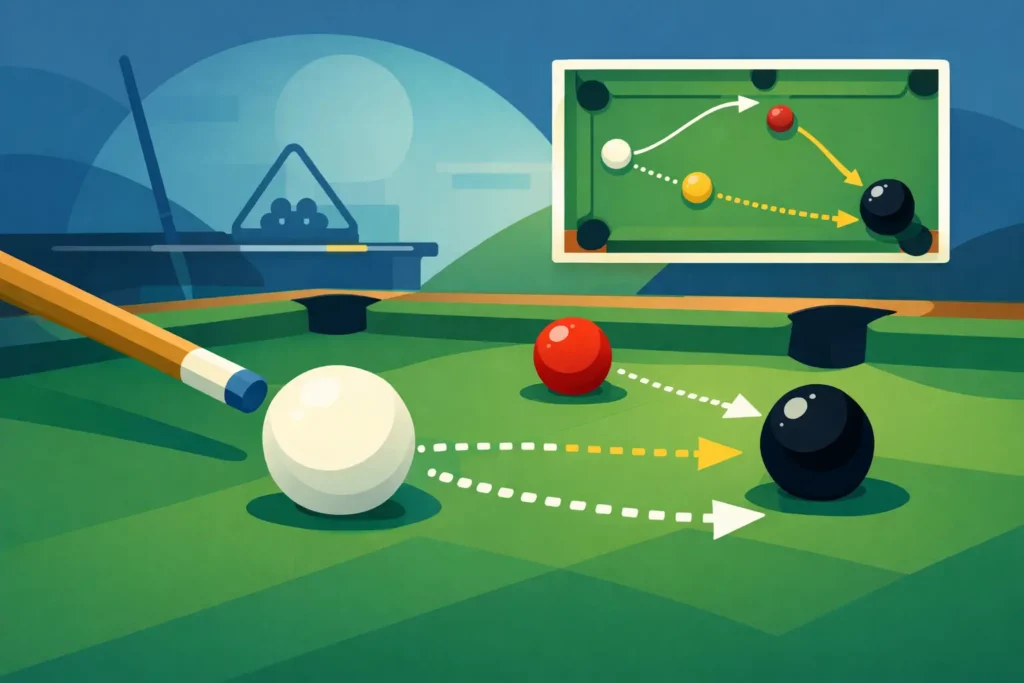
Snooker Positional Play Guide for Better Breaks
A good pot gives you one point. Good positional play gives you a break. This snooker positional play guide is about the skill that separates a player who occasionally makes a ball from one who makes the table look manageable, shot after shot.
At club level, many missed breaks are not caused by a difficult red or a flawed cue action. They end because the cue ball has been left on the wrong side, with too much angle, too little room, or no simple route to the next colour. The answer is not to strike every ball harder or add more side. It is to see the next two shots before you address the first one.
Positional play starts before the cue moves
The highest-quality positional players do not simply ask, “Can I pot this?” They ask, “Where must the cue ball finish for the next scoring shot, and what pace gets it there?” That distinction changes everything.
Before every attacking shot, identify a target area rather than an exact pin-point spot. On a full-size table, chasing a coin-sized landing zone creates tension and encourages forced cue-ball manipulation. A useful target zone gives you margin for error. If the next red can be potted from several inches of table, plan to arrive in that area rather than demanding perfection.
Then work backwards. Picture the next object ball, the pocket you intend to use, and the line from cue ball to object ball. This is your positional line. Your job on the current shot is to send the cue ball into a useful area that gives you an acceptable angle across that line.
The best position is rarely dead straight. A slight angle is often better because it lets you move naturally to the next ball. Dead straight can leave you with no route at all, particularly when you are working through a cluster of reds below the black. The question is not whether straight is ideal. It is whether the angle you leave creates a simple, controlled next shot.
The snooker positional play guide to cue-ball routes
There are usually several ways to reach the same area. The intelligent choice is the route with the largest margin, not the most spectacular route.
A natural rolling path should be your first option. If a plain stun or gentle screw shot brings the cue ball into position, there is little value in forcing three cushions with side. More rails, more pace and more spin all introduce variables. Elite players use those options when the table demands them, not because they look advanced.
Use the simplest available route
When choosing a route, consider three things: distance, traffic and pace. A shorter path is generally easier to judge. A route that avoids other reds reduces the chance of a kiss. And a route played at a controlled speed is more repeatable than one requiring the cue ball to travel at full pace.
For example, after potting a red to the middle, a gentle stun to hold for the black may be preferable to drawing the cue ball back towards the baulk end for the blue. The black offers more points and, if it keeps the cue ball in the scoring area, it protects the break. But this depends on the table. If the black is tied up or the path is crowded, the blue may be the more professional choice.
Position is not about insisting on the highest-value colour. It is about selecting the colour that keeps the break alive.
Understand the cue ball’s natural behaviour
A cue ball struck above centre rolls forward after contact. A stun shot, played close to centre with a firm enough delivery, tends to travel along the tangent line. A screw shot sends the cue ball backwards before it settles into a forward roll. These are not isolated techniques. They are your positional vocabulary.
Learn to predict each one without guesswork. On a simple red-to-black pattern, practise potting the red with top, stun and screw from the same starting position. Watch where the cue ball finishes, then adjust only the contact point or pace. This gives you a clear feel for what changes the route and what changes the distance.
Side can be valuable, especially when cushions must be used or when you need to avoid a blocker. Yet it should be added with a reason. Side affects not only the rebound from a cushion but also the throw on the object ball and the accuracy of your delivery. If centre-ball or a small amount of top achieves the same position, that is normally the higher-percentage choice.
Pace control is the foundation of reliable position
Players often focus on where to hit the cue ball and overlook how hard to strike it. In reality, pace is frequently the deciding factor. The correct route played at the wrong speed is still poor position.
Think of every positional shot as having an arrival speed. Do you want the cue ball to stop in a zone, roll through it, or reach a cushion and return? Decide this before stepping into the shot. Once you are down on the ball, your attention should be on a smooth delivery, not last-second calculation.
Soft shots demand commitment. Decelerating through the cue ball is one of the quickest ways to under-hit position and miss the pot. Deliver the cue straight, with a positive but measured follow-through. Firm shots require the same composure. Do not jab at the ball because you need it to travel. A longer, cleaner cue action gives you both pace and accuracy.
A practical test is to place the cue ball near the blue spot and roll it towards the top cushion, trying to finish within a hand’s width of it. Repeat from different positions. This may look basic, but it teaches touch more effectively than endlessly attempting difficult recovery shots.
Build breaks in zones, not single shots
When the reds are open, strong break-building becomes a matter of staying in the right part of the table. Usually, that means keeping the cue ball in the black, pink and blue zone while maintaining access to the next red.
Do not drift into a corner of the table simply because one red is available. A red near a cushion may pot cleanly, but if it leaves you no colour or forces a long recovery route, it may be a poor break shot. Look for reds that preserve options. The more pockets available after your colour, the less pressure you place on the next positional shot.
This is especially important around the pink. The pink can be the ideal colour for keeping the cue ball central, but careless position near its spot can leave the cue ball trapped behind reds or awkwardly close to a blocking ball. Give yourself room to cue. A slightly longer pot with a clear path is usually preferable to an easy pot played from a cramped, restricted stance.
Plan for the problem ball early
Every developing break has a ball that threatens to stop it: a red on the cushion, a tight cluster, or a colour blocked from its usual pocket. Spot it early. You do not always need to attack it immediately, but you should know how and when it will be dealt with.
The mistake is waiting until only one red remains and then attempting a forced split from a poor angle. Better players open clusters when they have insurance. That means a red available after the cannon, a colour in view, and a cue-ball route that does not leave them stranded.
When splitting reds, control matters more than violence. A light, well-judged cannon that creates two new potting options is often better than scattering the pack and losing the cue ball. The purpose of a split is to improve your next shot, not simply to make the table look open.
Make your safety game part of your positional thinking
Positional play does not end when the pot is difficult. If you cannot guarantee the next scoring opportunity, switch your thinking from break-building to table control.
A low-percentage long pot can be tempting when you are a few balls into a break. But if the cue ball is likely to finish open and the object ball can remain available, the cost of missing is high. A considered safety that leaves the cue ball tight on a cushion or behind a colour may be the shot that wins the frame.
This is not negative snooker. It is disciplined snooker. The strongest players know when an attacking chance has become a gamble. They protect their score, make the opponent work, and wait for the next genuine opening.
Practise position with a clear score
Randomly knocking balls around builds enjoyment, but structured practice builds repeatable decisions. Set simple challenges and keep a score. Pressure arrives when a shot matters, even if the consequence is only starting the drill again.
Try these four exercises across several sessions:
- Pot a red and black repeatedly from open positions, aiming to leave a playable angle on the next red every time.
- Place three reds in different areas and clear them with colours, awarding yourself a point only when the cue ball finishes in your chosen zone.
- Practise one-cushion routes to the blue and pink, using centre-ball first before introducing side.
- Set up a small cluster with an insurance red and rehearse controlled cannons rather than full-blooded splits.
After each missed position, do not just say you got “bad on it”. Name the cause. Was the route wrong, was the pace poor, did you choose the wrong colour, or did you fail to see the blocker? That honest diagnosis turns frustration into useful information.
The Rocket Method teaches this level of decision-making from the perspective of Ronnie O’Sullivan, where cue-ball control is not a trick reserved for professionals but a standard that can be built through clear, purposeful practice.
Your next higher break will not necessarily begin with a harder pot. It may begin with a quieter choice: take the easier colour, leave the wider angle, and place the cue ball where the next shot feels inevitable.
7 Best Snooker Drills for Consistency That Work
A missed black from close range rarely begins on that shot. It usually started two balls earlier, when poor cue-ball control created an awkward angle, or before the frame even began, when the pre-shot routine changed without you noticing. The best snooker drills for consistency expose those small errors and give you a repeatable way to correct them.
Consistency is not about producing your best break once in a quiet practice room. It is about making the same decisions, delivering the cue the same way and controlling the white when the table feels difficult. That requires practice with a purpose. Simply potting balls until your arm feels warm is enjoyable, but it does not always transfer to match play.
What makes a snooker drill worth your time?
A productive drill has a clear standard. You should know whether you succeeded, where the mistake occurred and what you will change on the next attempt. It should also be difficult enough to demand focus, without being so severe that every visit ends in frustration.
The best players make the simple elements dependable first. Straight cueing, accurate pace, consistent contact and a settled routine are the foundations of break-building. Once those are in place, you can add pressure, routes through colours and demanding positional play.
Keep a notebook or use your mobile phone to record scores. The point is not to become obsessed with numbers. It is to replace vague thoughts such as “I played badly” with useful evidence: long pots were under-hit, the white was running too far through the line, or your concentration faded after ten minutes.
1. The straight blue drill
Place the blue on its spot and the cue ball directly in line with it, around a foot to 18 inches away. Pot the blue into a middle pocket with a plain, centre-ball cue action. Replace both balls and repeat.
This looks basic because it is basic. That is its value. Any unwanted side, steering movement or rushed delivery becomes obvious on a straight pot. Start with sets of ten and make a note of cleanly struck pots, not merely pots that happen to fall. A clean pot should send the cue ball straight through the line with no visible swerve.
If you are missing to one side repeatedly, do not immediately alter your aim. First check that your head is still, your cue is travelling level and your final backswing is not changing length. Film a few deliveries from directly behind if possible. Straight cueing is not glamorous, but it underpins every other drill on this list.
2. The line-up drill with a scoring target
Set the reds in a line between the pink and the black, leaving enough space to pot each red into a corner. Begin with the cue ball in the D, pot a red, then the black, and continue for as long as the table allows.
The line-up is one of the finest tests of cue-ball control because the next shot is always earned by the previous one. You are not just potting. You are judging the correct side of the red, the pace into the black and the amount of screw or stun needed to return to position.
Give the session a target that suits your level. A newer player might aim for three reds and blacks in a visit. A stronger club player may set a target of 30 points, then 50. Reset after a miss, but do not rush to start again. Identify whether the failure was positional, technical or tactical. The answer matters more than the disappointment.
3. The red-and-colour route drill
Place six reds around the table in realistic break-building positions: some near the pink, one close to a side cushion, one nearer a top corner and at least one that requires thoughtful cue-ball movement. Start in the D and play red, colour, red, colour until the reds are gone.
This drill develops a vital match skill: choosing the right colour, not simply the highest-value colour. The black may be available, but the blue or pink might give a far easier route to the next red. Learn to see the next two shots before you address the current ball.
There is a trade-off here. Playing for perfect position can lead to over-hitting and unnecessary cue-ball movement. Early in the drill, favour a large positional area over a tiny ideal spot. Consistent players leave themselves a manageable shot more often than they produce spectacular recoveries.
4. Long-potting from the D
Place a red just above the blue spot, either side of the table’s centre line. Play from the D into the opposite top corner, then alternate sides after each attempt. Use a simple cue-ball delivery and avoid adding side unless the angle genuinely demands it.
Long potting is often practised badly. Players hit the same ball repeatedly, lose their routine and begin chasing the result. Instead, treat every attempt as if it opens a frame. Step back, choose the line, settle over the shot and stay down until the object ball reaches the pocket.
Score ten attempts from each side. Then move the red slightly wider or closer to the top cushion. This gradual progression is more useful than beginning with a near-impossible pot. The goal is to build trust in a repeatable process, particularly when a match offers one early scoring chance.
5. The stun-and-follow corridor drill
Place a red near a middle pocket and set the cue ball at an angle that allows a straightforward pot. Mark an imaginary corridor with two spare balls or chalk marks in your mind, running through the line of the shot. Your task is to pot the red while sending the cue ball into a chosen zone beyond it.
Play ten shots with stun, then ten with controlled follow. Keep the cue ball’s route narrow. This teaches the difference between hitting the white hard and delivering the correct amount of acceleration through the ball.
Positional inconsistency often comes from an uncertain strike rather than poor judgement. When you can send the cue ball through a corridor on command, angles begin to feel less like guesswork. Move the target zone gradually farther away, but preserve the quality of the cue action as difficulty increases.
6. Colours clearance under control
Set the colours on their spots and clear them in order, from yellow to black. Begin with the cue ball in hand anywhere in the D for the yellow, then play the table as it lies.
The colours clearance demands more than potting ability. It asks you to judge pace on awkward angles, cope with changing pocket lines and manage the emotional shift that comes when the black is suddenly worth the full exercise. For beginners, start with ball in hand before every colour and focus on clean potting. For more advanced players, play it as a continuous clearance and count successful attempts.
Avoid treating a miss on the blue or pink as proof that you cannot handle pressure. It is feedback. Did you tighten your grip? Did you stop moving the cue freely? Did you play the shot more quickly because the black was next? The table is honest when you give it an honest routine.
7. The one-chance pressure drill
Set up a break-building layout you can realistically score from, perhaps six reds in open positions with the colours available. You receive one visit only. Miss, lose position badly or choose the wrong route, and the attempt is over. Then reset the table before trying again.
This is where practice starts to resemble competition. There is no immediate second chance to erase a mistake, so every shot carries a little consequence. Do not make the layout excessively difficult. Pressure comes from the one-visit rule, not from setting traps that no sensible player would take on in a match.
Record your highest break, but also record how often you reached a sensible benchmark. A player who makes 20 points on six of ten attempts is building something dependable. One exceptional 50 surrounded by poor visits may be more exciting, but it is not yet consistency.
How to organise a consistency session
A focused 60-minute practice can be enough. Spend the first 15 minutes on the straight blue drill and stun-and-follow work, where technique is the priority. Use the next 25 minutes for the line-up or red-and-colour route drill, then finish with 20 minutes of long potting or one-chance pressure practice.
Do not try to train every weakness in every session. If cue-ball control is the issue, give it the largest share of your time. If you are preparing for league night, include more one-chance work and long pots. The right balance depends on your game, but each session should have one clear objective.
For players who want a more complete training structure, The Rocket Method brings championship-level instruction into a clear progression, covering the technical, tactical and mental details that turn practice into measurable improvement.
Choose one drill for your next visit to the club, set a score that demands your full attention, and play every ball as though it matters. The standard you accept alone is the standard you are likely to reproduce when the frame is on the line.