
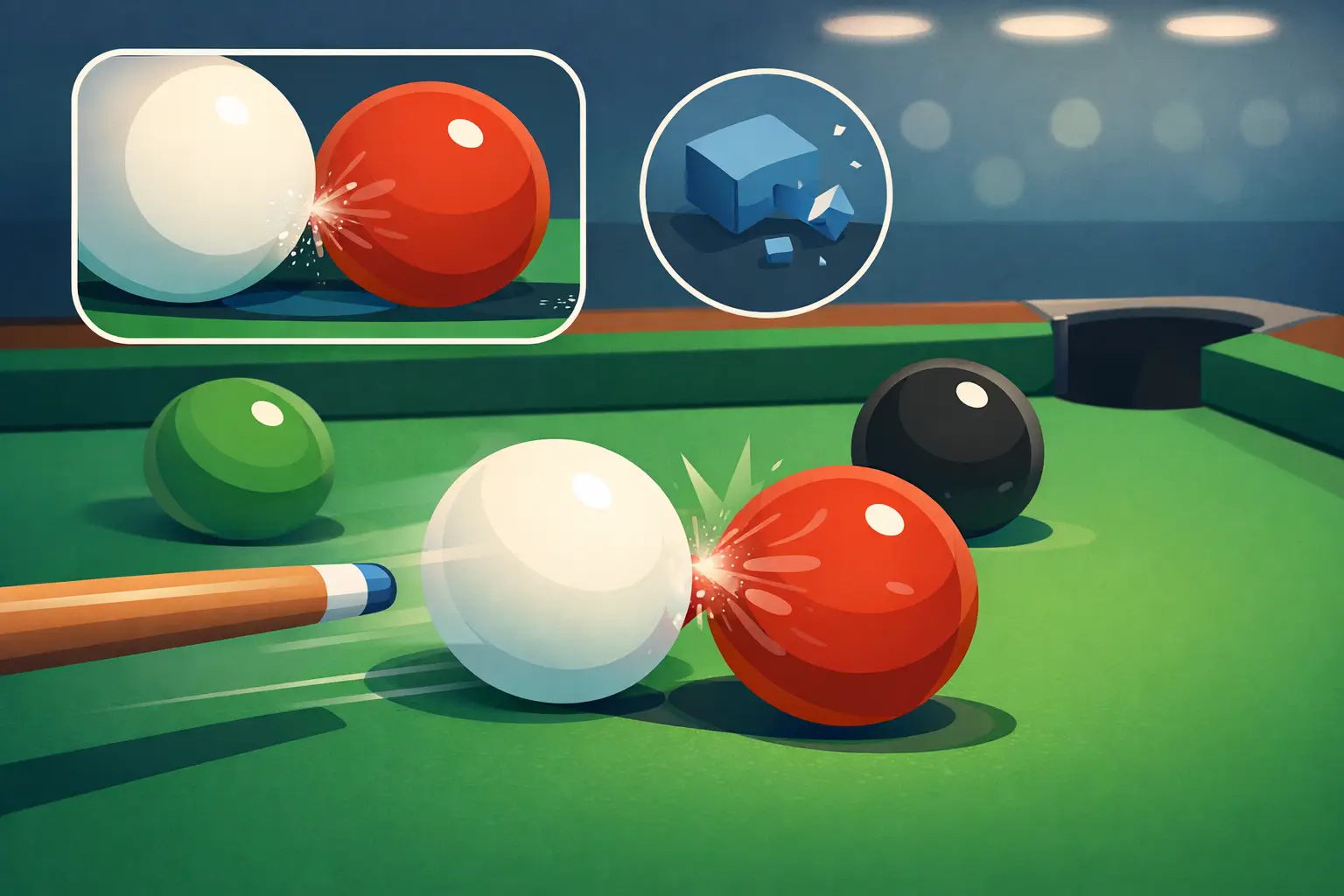
A cleanly struck red that shoots off line can feel like a personal insult. You have read the angle, committed to the cue action and sent the cue ball exactly where it should go – then the object ball takes an unexpected path. Understanding what causes snooker kick shots helps remove some of the mystery, but it also brings an uncomfortable truth: even the best players cannot eliminate them entirely.
A kick is not usually a sign that you have suddenly lost your technique. It is most often a tiny interruption at the precise point where two balls meet. At professional level, where margins are brutally fine, that interruption can turn a routine pot into a miss, a match into a swing, and a well-built break into frustration.
What causes snooker kick shots?
In simple terms, a kick happens when something interferes with the smooth, predictable contact between the cue ball and object ball. Instead of the balls meeting on clean polished surfaces, a minute particle, trace of moisture or static attraction affects the collision. The resulting deflection may be slight, but slight is all it takes on a tight pocket.
The usual culprit is chalk dust. Chalk is essential on the cue tip, yet loose chalk on the cue ball, object ball or cloth is a constant threat. When it becomes trapped between the balls at impact, it can alter the line of contact and create a small, sharp deviation. You may see the object ball appear to jump sideways, undercut the pocket or take far more throw than the shot demands.
Moisture is another major factor. In a busy club, balls are handled repeatedly and conditions change through the day. Natural oils from hands, perspiration and humidity can leave a film on a ball. That film attracts dust and chalk, creating the imperfect contact point that causes a kick. A table can look immaculate while the balls carry enough residue to affect an important shot.
Static electricity also has a part to play, particularly in dry environments. Static can draw fibres and dust towards the balls, even after they have been wiped. It is one reason a kick can occur just after a ball has been cleaned and why no amount of pre-shot discipline can offer a complete guarantee.
Ball condition and cloth fibres
Balls should be smooth, clean and consistent. As balls age, however, fine marks and surface imperfections can develop. Small imperfections do not automatically make a table unplayable, but they give chalk and dirt more places to settle. A poorly maintained set of balls raises the chance of unpredictable contact.
The cloth matters too. Loose fibres, dust and residue on the bed of the table can attach themselves to a moving ball. This is more likely on heavily used club tables or tables that have not been brushed, ironed and covered with proper care. A ball that has picked up a tiny fibre on its journey may arrive at the object ball with an invisible problem already attached.
That is why experienced players often clean the cue ball after a close-range exchange, a safety battle or a shot involving the rest. It is not superstition. It is an attempt to control the few variables that can be controlled.
Why side can make a kick look worse
A genuine kick is only one explanation for a ball taking an unexpected line. Side spin naturally creates throw – the object ball is pushed fractionally across its intended line by friction during contact. On some shots, especially slower cuts with generous side, that throw can be substantial enough to resemble a kick.
This distinction matters. If you blame every miss on a kick, you deprive yourself of useful feedback. A shot played with right-hand side may have needed more allowance for throw. A cue ball that swerves before impact may have changed the contact point. A decelerating cue action may have delivered more or less side than you intended.
The best approach is honest assessment. If the object ball changed direction abruptly at impact, particularly on a straightforward, centre-ball shot, a kick is plausible. If it drifted consistently to one side on a slow shot with side, first consider throw, swerve and your chosen contact point.
The role of pace
Pace changes the picture. A firmer shot generally gives friction less time to influence the collision, so throw is reduced. But simply hitting everything harder is not a solution. Excessive pace shrinks positional margins, makes pockets play smaller and can make cue-ball control more demanding.
On a key pot, choose the speed that gives the cue ball a clear positional route while allowing the object ball to enter the pocket confidently. If you are using side, understand that softer pace tends to exaggerate throw. That is a tactical decision, not bad luck.
Reduce kicks with professional habits
You cannot make the table clinically perfect, but you can build a routine that reduces avoidable risk. The objective is not to become fussy or slow. It is to treat the balls, cloth and cue tip with the same respect you give alignment and cue action.
Keep your hands clean and dry before you play. Avoid repeatedly touching the cue ball unless the rules and situation require it. If you are entitled to have the cue ball cleaned, use the opportunity when there is visible chalk, a mark or a genuine concern about residue. Do not turn ball cleaning into a distraction, but do not ignore obvious contamination either.
Apply chalk carefully. A light, even coating on the tip is enough. Grinding chalk into the tip creates unnecessary loose dust, which then finds its way onto the cloth and balls. Good chalking is controlled, brief and purposeful.
In a home or club setting, proper table maintenance makes a real difference. Brushing debris towards the pockets, using the correct ball-cleaning method and keeping the table covered when it is not in use all protect playing conditions. Over-cleaning with unsuitable products can leave residue, so care should be taken to use products and procedures intended for snooker equipment.
Most importantly, retain your composure when a kick happens. The ball has gone where it has gone. There is no value in replaying the injustice while your opponent is at the table or while you still have a tactical shot to play. Champions are not defined by never receiving a bad bounce. They are defined by how quickly they return to clear decision-making.
When it probably was not a kick
There are moments when the explanation is technical rather than environmental. A player may cue across the ball, lift the cue slightly, misjudge a thin contact or fail to allow for cut-induced throw. On a long pot, even a tiny alignment error looks dramatic by the time the object ball reaches the pocket.
Before calling it a kick, ask three questions. Was there side on the cue ball? Was the object ball struck at slow pace? Did the cue ball visibly swerve or did the cue action feel rushed? A yes to any of these does not rule out a kick, but it makes a technical explanation more likely.
This is where structured practice pays off. Spend time hitting straight, centre-ball pots at varying speeds, then introduce controlled side and observe the difference in object-ball path. When you know what ordinary throw feels like, a real kick becomes easier to recognise without emotion or guesswork.
The finest players build their games on repeatable fundamentals, then accept the rare variable that no player can command. A kick may cost you a frame, but it should never be allowed to cost you your focus. Keep the equipment clean, cue with conviction, understand the effect of side and pace, and trust the quality of your preparation on the next ball.