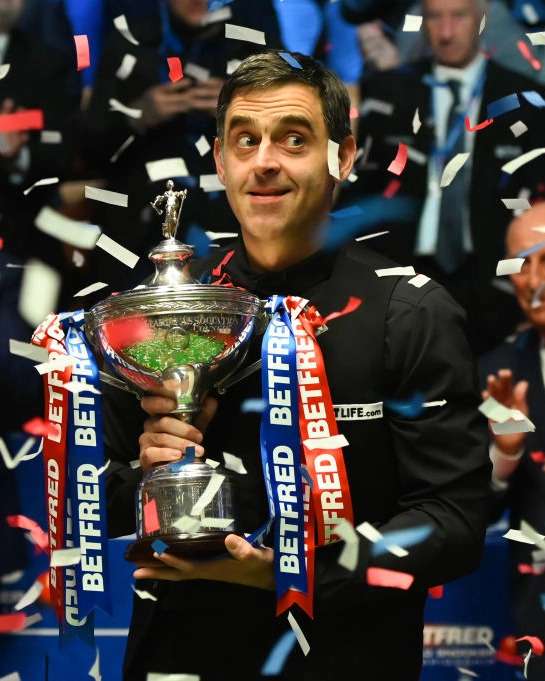
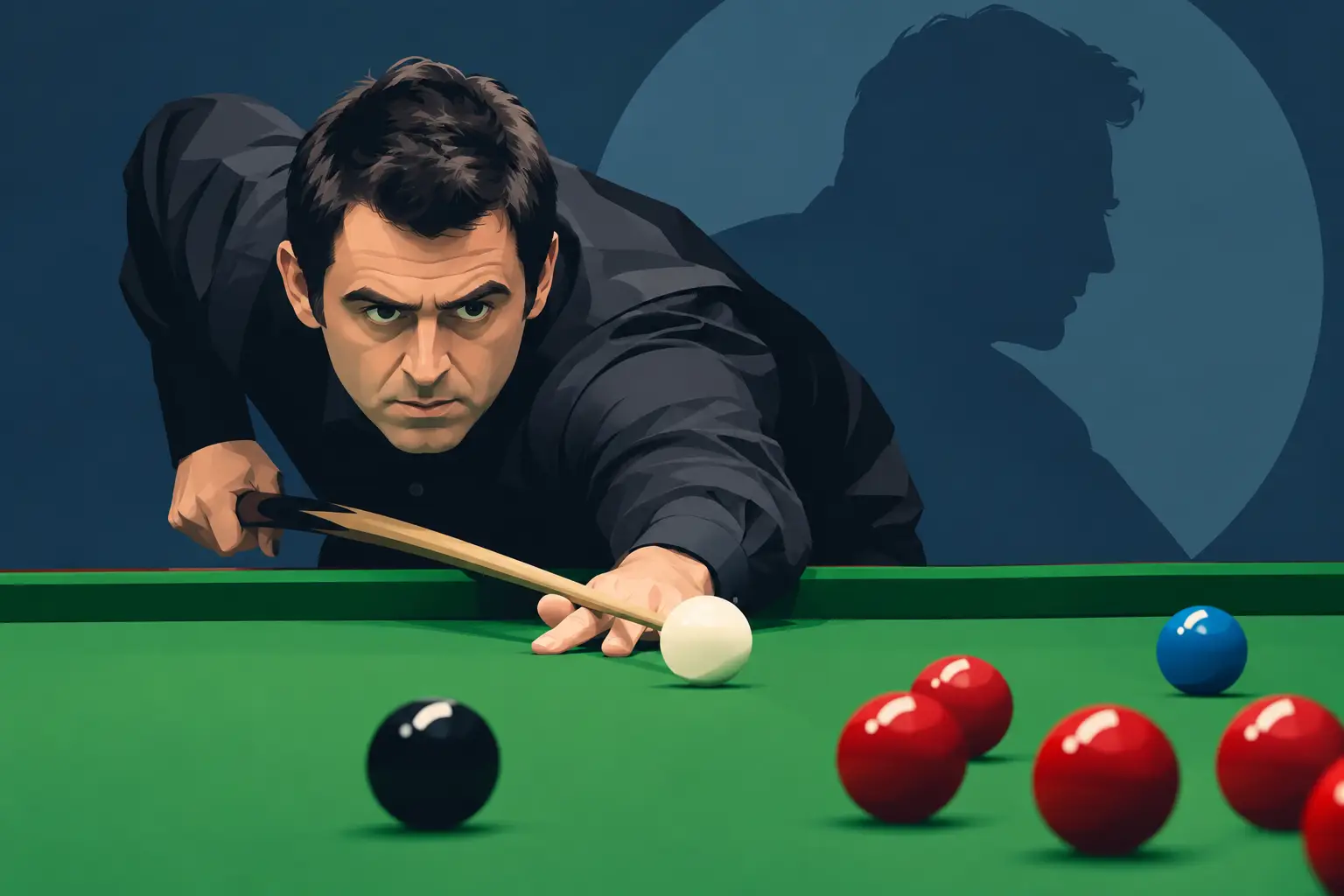
The best breaks rarely begin with a spectacular pot. They begin with a player standing behind the cue ball, seeing the whole table clearly and refusing to make the next shot harder than it needs to be. Ronnie O’Sullivan table philosophy is built around that standard: make the game flow, protect position, and let sound decisions create scoring opportunities.
For club players, this matters because most missed chances are not caused by a lack of ambition. They are caused by poor routes, awkward cue-ball placement and rushed shot selection. The great lesson in watching Ronnie is not simply that he pots balls at extraordinary speed. It is that his speed is usually the outcome of exceptional clarity.
The table is a map, not a collection of pots
A developing player often sees the most obvious red, then the most obvious colour, one shot at a time. That can produce a useful break, but it rarely produces control. A top player reads the table as a connected pattern. Every pot has a purpose beyond reaching the score.
Before addressing the shot, consider the colour that keeps the break alive, the likely red after it, and the area of the table the cue ball must reach. This does not mean planning twenty shots ahead with false certainty. Snooker changes quickly. It means recognising the high-value routes before committing to the first stroke.
Ronnie O’Sullivan’s table philosophy favours freedom through preparation. When the cue ball arrives in the right zone, the next shot looks natural. When it finishes on the wrong side of the black or drifts too close to a cushion, the player has to manufacture a solution. That is where rhythm disappears.
Position zones beat perfect spots
Amateurs can become obsessed with leaving the cue ball on one precise point. That is an admirable standard, but it can create tension and encourage over-hit or under-hit positional shots. A better objective is often a useful zone.
If the cue ball can finish in a broad area that offers two reds, or two routes back to a colour, the break has options. Options reduce pressure. They also make recovery possible when contact is not quite perfect.
This is not permission to be careless. It is a more professional way to think. The table seldom gives exact positions throughout a long break. Good scoring depends on repeatedly leaving workable angles, particularly around the black and pink, rather than demanding perfection from every stroke.
Cue-ball control is the real scoring weapon
Potting is visible. Cue-ball control is what separates a single red from a frame-winning visit. Ronnie’s approach makes this look uncomplicated because the cue ball is usually sent only as far as necessary.
That principle has practical value at every standard. Players often add side unnecessarily, force the cue ball around multiple cushions, or hit through a shot because they are thinking about the object ball alone. More speed and more spin create more variables. On a tight table, those variables can quickly become errors.
Start by asking a stricter question: what is the simplest route to the next ball? Sometimes it is a soft stun. Sometimes it is a controlled screw shot to hold the line. Sometimes the right answer is to roll through a short distance and accept a slightly thinner angle. The choice depends on the layout, but simplicity should be the default.
A useful practice discipline is to judge every positional shot on two outcomes: did the ball go in, and did the cue ball finish in a zone that made the next shot straightforward? If the pot drops but the next red is awkward, do not call it a complete success. This changes practice from potting drills into break-building training.
Pace is part of position
Cue-ball control is not only about spin. Pace decides whether a cue ball holds its line, reaches the desired side of a colour, or runs too far and loses the angle. It also changes how confidently a player can deliver the cue.
The best pace is usually the pace that leaves margin for error. A delicate shot played at exactly the minimum speed may be technically impressive, but if a slightly firmer delivery gives a wider positional area, it may be the better percentage choice. Championship snooker is full of subtle decisions like this.
For recreational players, the immediate gain comes from practising three distinct deliveries: a dead-weight roll, a controlled stun and a firm screw shot. Learn what each does on your home table before adding side. A player who knows pace well can make simple routes look effortless.
Attack with purpose, not impatience
Ronnie O’Sullivan is celebrated for attacking snooker, yet attacking does not mean attempting every difficult pot. The real aggression is often in the quality of the decision: taking a chance when the reward justifies it, then committing fully to the shot.
There is a major difference between a positive choice and a hopeful one. A positive choice has a clear line, a reliable cueing action and a sensible cue-ball destination if the pot is made. A hopeful choice is played because the player does not want to play safe, has not assessed the leave, or is chasing the feeling of a spectacular finish.
The table should decide the shot, not ego. If an attacking pot opens the reds and offers a natural route to the black, it may be the correct moment to score. If the same pot leaves the cue ball loose among reds with no colour available, the percentage can change completely.
This is where stronger tactical play begins. A safety is not an admission of defeat when the table does not offer a controlled attack. It is a way to regain the initiative. The highest standard of snooker combines ruthless scoring with the discipline to wait when the chance is not properly there.
Keep the mind clear between shots
The most valuable part of elite table philosophy may be psychological. Great players do not have perfect contact on every shot. They do not always get ideal splits or kind cannons. What separates them is their response when the table changes.
After an imperfect positional shot, avoid the emotional reaction that leads to rushed recovery. Pause, reassess the available balls and choose the best next option. There may be a thin pot, a containing safety, or a simple colour that keeps the break alive. The previous shot has already happened; it does not deserve another mistake.
A repeatable routine helps create this calm. Step back, select the shot and cue-ball destination, commit to the line, then deliver without changing your mind halfway through. The routine should be personal, but it must be reliable enough to remain in place when a frame becomes tense.
Speed can be an advantage only after the decision is made. Ronnie’s famous fluency is not a licence to rush. It is evidence of a mind that has processed the table, trusted the choice and stayed present in the shot.
Bring the philosophy into your next frame
Do not try to copy an elite player by playing faster or forcing ambitious shots. Copy the standard behind the performance. Look for routes that give you a choice of next ball. Send the cue ball the shortest sensible distance. Treat awkward position as a problem to solve rather than a reason to panic.
In practice, set up small scoring exercises and give yourself a clear brief: stay below the blue, return to the black side of the table, or make a five-red break without using side. Constraints expose where your positional control breaks down. They also teach you to see patterns rather than isolated pots.
The Rocket Method brings this level of thinking into structured, premium snooker instruction, led by the player whose game has made fluency look possible under the greatest pressure. But the principle belongs on every table: the next shot becomes easier when the current one has been chosen with purpose.
Next time you are in among the balls, resist the urge to prove how much you can force. Read the table, trust the simple route and give yourself a chance to keep playing.