
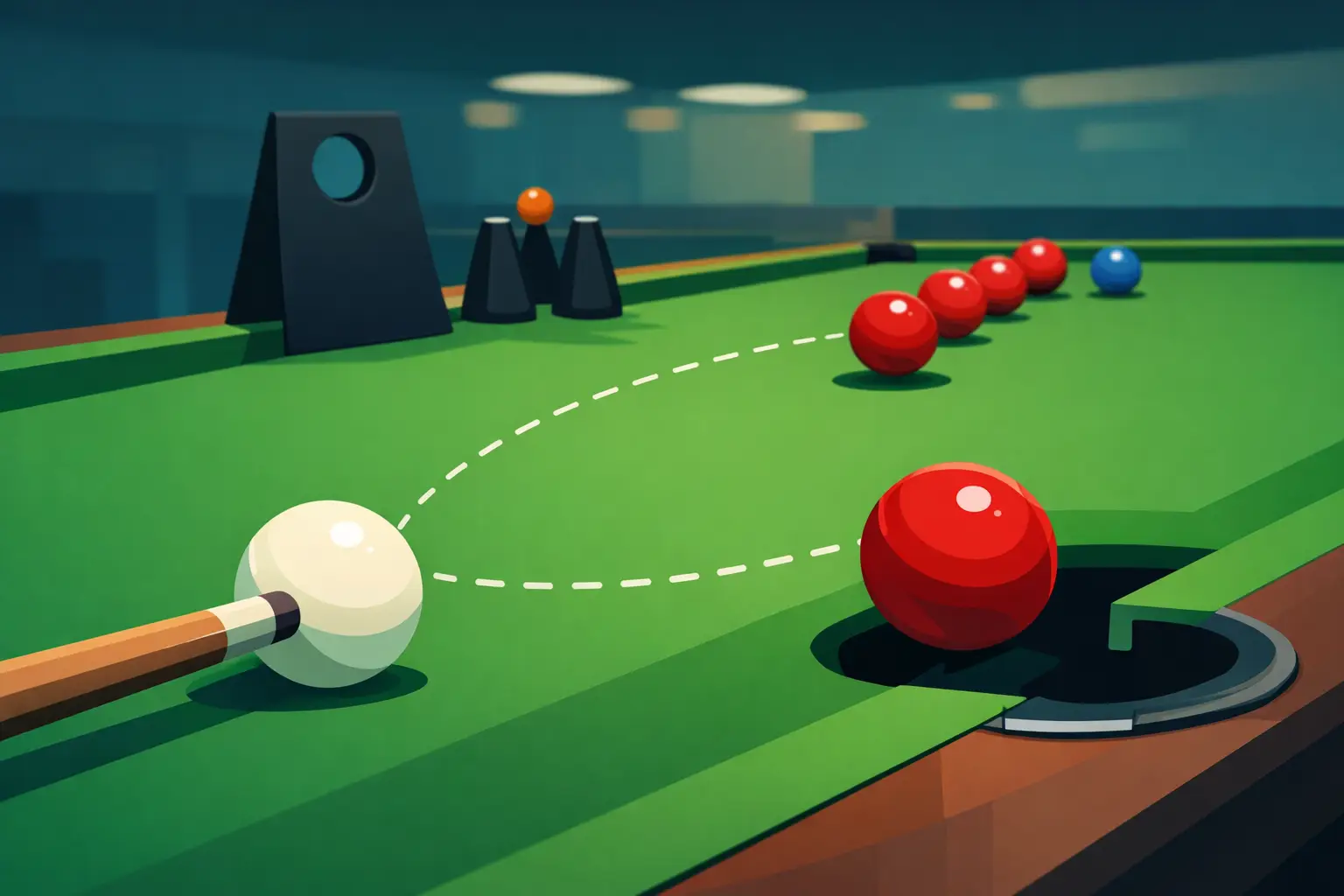
A long red is rarely missed because a player cannot see the pocket. It is missed because the cue ball is struck from a stance that is not settled, with a cue action that leaves the line at the last moment. The best drills for long potting expose those small faults, then give you enough meaningful repetition to remove them.
Long potting is not about forcing confidence or hitting the ball harder. It is about producing the same delivery when the cue ball and object ball are separated by most of the table. At that distance, a tiny error in alignment, cueing or contact becomes a clear miss. Train the basics under honest conditions and long pots become a reliable scoring opportunity rather than a hopeful shot.
What a Long-Pot Drill Must Train
A useful drill should demand a full pre-shot routine. If you simply drop balls on the table and fire them towards a pocket, you may groove speed, but you will not necessarily build match-standard technique. Every serious repetition starts before you get down on the shot.
Set the line from behind the cue ball, choose a precise contact point on the object ball, place your feet with purpose, and only then settle into the cue action. Your head must be still at impact and your cue must travel through the line without steering. The task is to make the process repeatable, not merely to pot a few balls when the rhythm feels good.
Use a clean, responsive table where possible. Slow cloth, dirty balls and poor cushions can distort your feedback, particularly on very thin cuts. That said, do not wait for perfect conditions. A disciplined routine transfers anywhere.
Best Drills for Long Potting: Start on the Blue Line
The blue-line long red is the right place to begin because it offers a demanding but readable pot. Place a red on the blue spot and the cue ball on the centre spot. Pot the red into either corner pocket with plain stun or a soft, centre-ball delivery. Do not add side. Your only concern is a straight cue and a true line.
Play ten attempts to one corner, then ten to the other. Record how many you make, but pay closer attention to the quality of the misses. A red that jaws in the near knuckle, or misses consistently on the same side, is information. It may point to a sighting issue, an elbow that is moving sideways, or a cue tip that is not returning to the cue ball’s centre.
Once you can make this comfortably, move the cue ball back to the baulk line. Keep the red on the blue spot. The pot is now longer, yet the geometry stays familiar. Build towards sets of 25, with a target of 18 successful pots before increasing the difficulty.
The straight-line return drill
Place the cue ball on the brown spot and a red on the blue spot, aligned directly with a corner pocket. The object ball should travel straight into the pocket. This is not a generous drill. A straight pot reveals every trace of unwanted side or deceleration.
Use a medium pace and aim to leave the cue ball close to where it started, rather than punching through the shot. If the cue ball drifts off line after contact, do not ignore it because the red went in. The cue ball is telling you that your strike was not centred.
Repeat in blocks of ten. You are looking for ten clean deliveries, not ten fortunate pots. If you miss, reset fully. Rushing the next ball is how poor technique becomes familiar.
Train Both Sides of the Table
Many club players have a favourite long red from one side and an entirely different relationship with the same shot from the other. This usually comes from body position, dominant eye alignment or an old habit of standing too close to the cue. Match play will find that weakness quickly.
Set a red on the pink spot. Place the cue ball near either baulk corner, about one ball’s width from the side cushion. Pot the red into the opposite corner. Alternate sides after every attempt.
The cue ball near the cushion makes the stance less comfortable, which is exactly why the drill works. You must adapt your bridge and feet without abandoning your fundamentals. Give yourself 20 attempts, ten from each side. A score is useful, but assess whether you stayed down on every shot and completed the cue action after contact.
For a harder variation, put the cue ball on the baulk cushion. The pot becomes a genuine long opener, but the restricted bridge makes it unsuitable for careless volume. Ten high-quality attempts are enough.
Build Cue-Ball Control Into the Pot
A long red that goes in but leaves no colour is only half a success. As your potting improves, use drills that connect the opening red to the next scoring shot.
Place a red on the blue spot and the cue ball on the centre spot. Pot the red into a corner and aim to leave the cue ball in the centre of the table for the black. Begin with a soft stun-through shot. The goal is not to force position with heavy screw or side. It is to understand how pace and a fraction of cue-ball height change the route.
Set a scoring condition: the red counts only if the cue ball finishes inside a one-foot circle around the black spot. If you pot the red and lose position, score half a point. This prevents the common habit of celebrating the pot while accepting a poor next shot.
After that, introduce a colour. Pot the long red, take the black, and replace both balls. Five consecutive red-and-black visits demand more than a single good strike. They require emotional control after success, when players often become loose and overconfident.
The Pressure Ladder
Practice breaks down when every ball feels identical. A pressure ladder gives each shot a consequence without pretending it is a tournament final.
Choose one long red, ideally from the baulk area to a corner pocket. Start at one point. Pot the ball to move up one level. Miss it and return to zero. Your target is ten. At levels four, seven and ten, you must nominate which corner pocket you will use before approaching the table.
This format changes the quality of attention. At eight or nine, most players become aware of their grip, their breathing and the fear of wasting the run. That is valuable. Rather than trying to suppress the feeling, slow your walk-in, breathe out as you settle and trust the same routine used at level one.
Do not spend an hour chasing a perfect ten. Three or four serious ladders are enough. Finish with a short technical set if your cueing has become tense.
Use Video to Diagnose, Not to Perform
A mobile phone placed behind the shot line can show faults that feel invisible at the table. Film a small number of attempts from directly behind the cue and, separately, from the side. Look for a cue that feathers off line, a head that rises before impact, or a follow-through that cuts across the body.
Avoid analysing every frame after every miss. That can make you mechanical. Review after a set, identify one priority, then return to the table with a simple intention such as keeping the bridge hand still or finishing the cue through the line.
The highest-level coaching does not replace table time. It makes table time more precise. That is the value of structured instruction: understanding what elite players see, then testing it through purposeful repetition. The Rocket Method is built around that standard, bringing Ronnie O’Sullivan’s approach to the parts of the game that separate occasional good shots from dependable scoring.
A Weekly Long-Potting Session
For most players, two focused sessions of 35 to 45 minutes are more productive than one long, unfocused practice. Begin with ten straight-line returns, then work through blue-line pots and alternating-side long reds. Finish with the pressure ladder, when your concentration has already been asked to work.
Keep a simple record: pots attempted, pots made, the side of your common miss, and whether the miss came from a technical lapse or poor shot selection. After three weeks, the pattern becomes much clearer. You may discover that your percentages are sound until the cue ball is near the cushion, or that your misses increase only when you rush after a good pot.
A great long pot should look quiet. No jab, no last-second correction, no need to watch the object ball anxiously. Put the balls in demanding positions, respect every routine, and let each clean delivery become evidence that you can trust your cue when the table opens up.