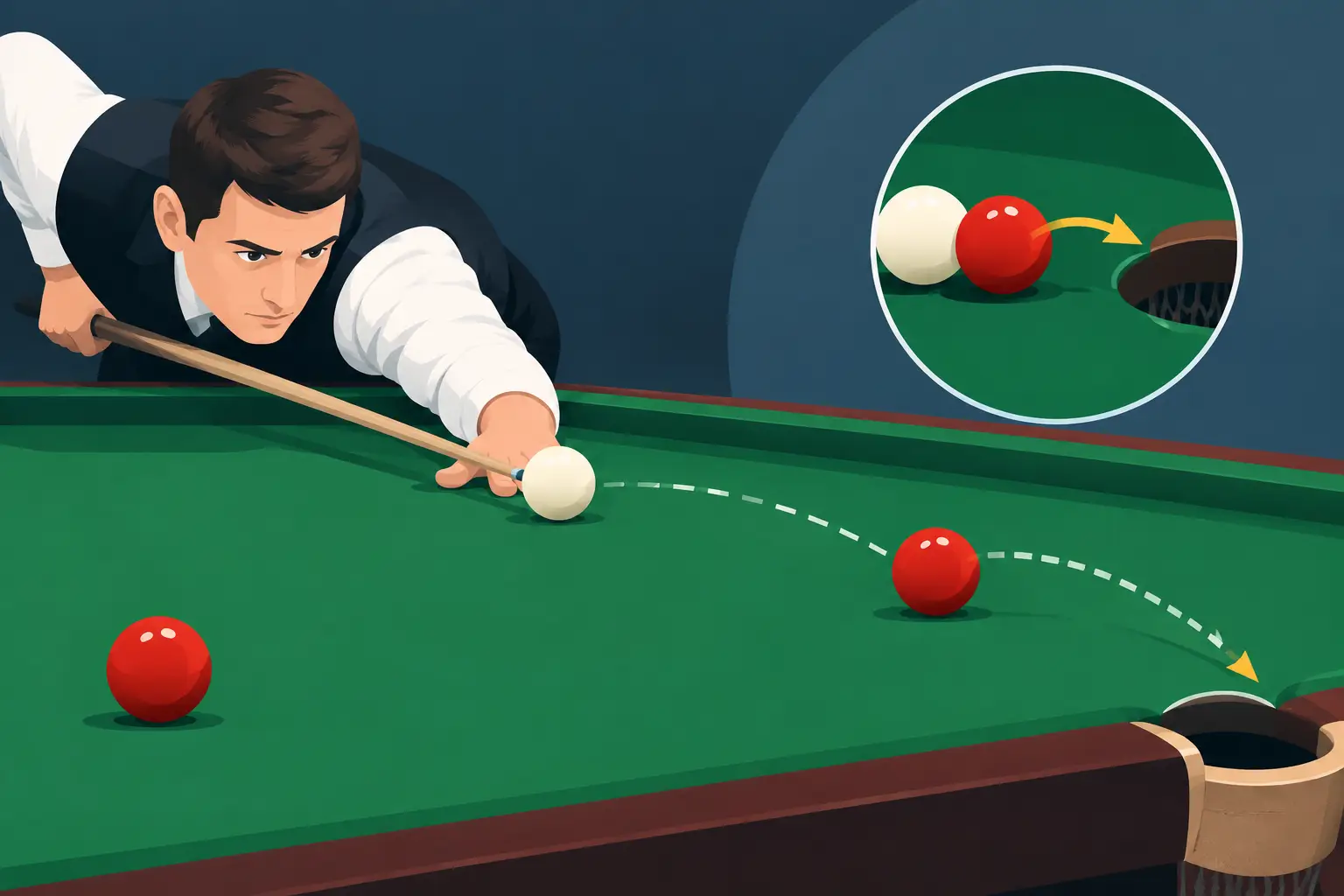
A thin red looks available, the cue ball arrives cleanly, and yet the object ball misses the pocket on the thick side. Before blaming your cue action, ask a more useful question: what is snooker throw effect? It is the subtle sideways deflection of an object ball caused by friction at the moment the two balls collide. At club level it can look like bad luck. At a higher standard, it is another variable to read, control and use.
Throw is rarely dramatic, but it matters most when the margin is tight: fine cuts, slow pots, delicate stun shots and balls close to a pocket. Understanding it will not replace sound alignment or a repeatable delivery. It will, however, explain many of the near-misses that otherwise make a player doubt a perfectly reasonable shot.
What Is Snooker Throw Effect?
When the cue ball contacts an object ball off-centre, their surfaces briefly grip against one another. That friction adds a small sideways force to the object ball, pushing it away from the pure geometric line you might expect from a diagram. This is throw.
On a cut shot, the object ball is generally thrown towards the fuller side of the contact. In practical terms, if you play a fine cut and use a slow, sliding cue ball, the object ball can be pushed slightly towards the thick side of the intended line. If you aim only by geometry, it may miss the pocket.
The key word is slightly. A player should not start making large, panicked adjustments for throw. The effect varies with the shot, and the best response is measured judgement built through observation. But on demanding pots, a fraction is enough to separate a clean drop from a rattle or a miss.
Why the Effect Changes From Shot to Shot
Throw is not a fixed rule with one correction. The amount depends on how the balls meet and how they are moving at impact. The cut angle, cue-ball speed, contact point and condition of the balls all play a part.
Cut angle and contact time
Throw tends to be most relevant on cut shots rather than full-ball hits. With a fuller contact, there is less sideways component for friction to influence. As the cut becomes finer, the apparent potting line becomes more sensitive, although extremely thin contacts can produce less useful frictional grip than many players expect.
There is no need to memorise a scientific chart at the table. What matters is recognising the shots where the object ball has little pocket to work with. A fine red to a centre pocket, played at gentle pace, deserves more attention than a firm, open black into a corner.
Speed and stun
Slow shots are often more vulnerable because the balls have more opportunity to grip during collision. A cue ball that is sliding at contact, commonly produced by a stun or near-stun delivery, can create pronounced throw. This is one reason a pot that feels straightforward at medium pace can become awkward when played delicately to hold for position.
A firmer strike usually reduces the visible effect of throw, though it introduces a different problem: the object ball may not accept a narrow pocket line as generously. Pace is therefore not a universal cure. Choose the speed that gives the object ball a sensible route to the pocket and the cue ball the right positional outcome.
Side spin can increase or reduce throw
Side spin changes the friction between the balls. Depending on which side is used and the direction of the cut, it can either add to the natural throw or counteract it. This is often called throw induced by side.
For an ambitious player, the temptation is to use side to correct every difficult pot. That is usually a poor percentage choice. Side also makes cue-ball paths harder to predict, brings cushion reaction into the equation and magnifies errors in striking. Use it when the positional value justifies it or when you understand precisely what it is doing to the pot. Do not treat it as a rescue device for uncertain alignment.
Clean balls and table conditions
Chalk dust, moisture, polish and general cleanliness change how much the balls grip. Freshly cleaned balls can react differently from heavily used balls late in a long session. Temperature and cloth conditions can alter how the cue ball travels too.
This is why a correction that worked on one table may not transfer perfectly to another. Serious players use the opening exchanges of a frame to gather information. Notice whether slow cut shots hold their line, whether side takes strongly, and whether the table is lively or heavy. That feedback is part of matchplay, not an excuse after the fact.
Throw, Swerve and Kicks Are Not the Same
These three effects are regularly confused, yet they happen at different stages of a shot. Separating them makes diagnosis much clearer.
Throw occurs when the cue ball contacts the object ball. It changes the object ball’s path through ball-on-ball friction.
Swerve happens before impact. When side is applied, the cue ball can curve through the air and across the cloth, especially with an elevated cue. If a player believes they have aimed at one point but the cue ball bends into another, that is swerve, not throw.
A kick, sometimes called a bad contact, is an unpredictable disruption at impact. Dirt, chalk or moisture can stop the balls from sliding cleanly, causing the object ball to react unexpectedly. A kick can look like exaggerated throw, but it is not something you can reliably calculate. Clean equipment and good table conditions reduce the risk, but no player can eliminate it completely.
How to Allow for Throw Without Overthinking
The strongest players do not stand over every red performing calculations. They develop dependable reference points, then let repetition sharpen their feel. You can build that same clarity through disciplined practice.
Start with a simple cut-pot drill. Place an object ball a comfortable distance from a corner pocket and set the cue ball at a consistent cut angle. First pot the ball with a smooth, medium-paced plain-ball shot. Then repeat with a slow stun shot, followed by a shot using a modest amount of side. Watch the object ball rather than judging only by whether it drops. Does it enter on the same side of the pocket? Does it rattle? Does the required aim point change?
Keep the cue action quiet. If every attempt has a different pace, strike and tip position, you are not testing throw – you are testing inconsistency. Use the same pre-shot routine, pause on the final backswing and deliver through the cue ball with purpose. The aim is to give yourself useful evidence.
On the table, make small allowances only when the shot demands them. For a slow, fine cut with a tight pocket, many players will aim marginally thinner to compensate for the object ball being thrown thick. The exact adjustment depends on the conditions and your chosen cue-ball action. If the shot is played firmly with no side and plenty of pocket, trust the natural line more readily.
There is also a tactical answer. If a colour can be taken at two speeds or from two positional routes, choose the option that gives the pot more margin. Elite snooker is not about forcing the most complicated cue-ball solution. It is about repeatedly selecting the shot that holds up under pressure.
The Bigger Lesson: Control the Variables You Can
Throw effect rewards precision, but it also exposes needless complication. Players who chase perfect position with heavy side often turn a routine pot into a technical test. A slightly less exact angle for the next ball may be the superior choice if it lets you strike plain ball, use natural pace and see the pot cleanly.
That does not mean avoiding side or stun. Both are essential parts of high-level cue-ball control. The distinction is intent. Use them because they create the right scoring opportunity, not because they disguise uncertainty over the basic potting line.
A structured training approach helps here. Rather than collecting isolated tips, work on cue delivery, potting lines, cue-ball reactions and shot selection as connected skills. The Rocket Method is built around that standard of understanding: not merely copying a shot, but recognising why one option gives you more control than another.
The next time a slow cut pot misses thick, resist the automatic verdict that you have aimed badly. Check the pace, the cue-ball contact, the amount of side and the cleanliness of the balls. Then set the shot up again and learn from the result. That is how throw stops being a mystery and becomes part of your judgement at the table.