
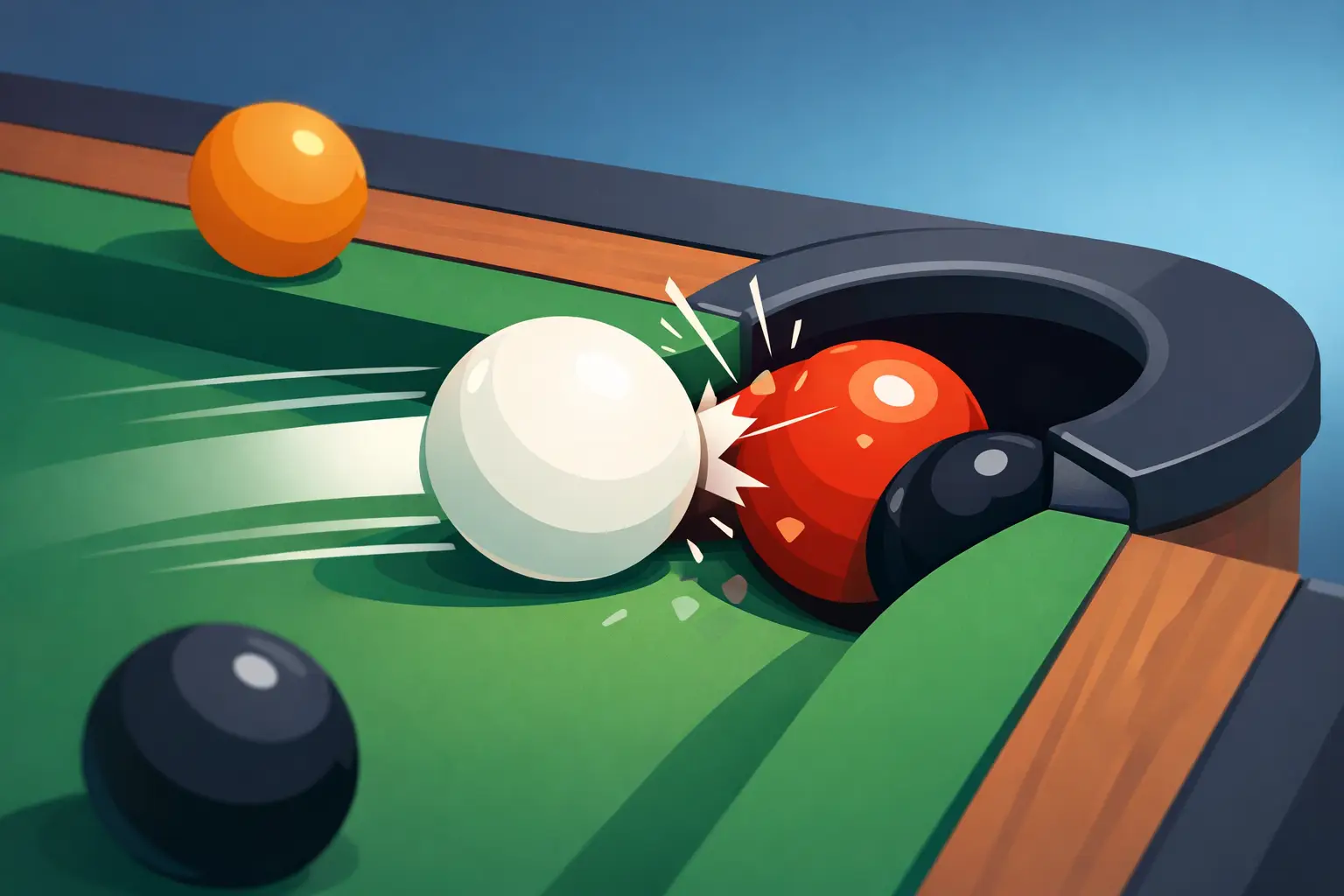
A red reaches the pocket on the line you saw, catches both jaws and somehow stays out. It is one of snooker’s most frustrating sounds – especially when the pot looked routine. If you have ever asked, “why do snooker shots rattle?”, the answer is rarely bad luck alone. A rattled ball is useful feedback: it tells you something about the delivery, the contact point, the pace or the route into the pocket.
At a high standard, players do not simply aim to send the object ball towards the pocket. They aim to send it into a generous part of the pocket, at a pace the pocket will accept, while controlling cue-ball contact well enough to avoid unwanted throw. That distinction turns more near-misses into confident pots.
Why do snooker shots rattle at the pocket?
A ball rattles when it enters the mouth of the pocket without enough clearance to fall cleanly. Instead of passing the near jaw and dropping into the pocket, it clips one jaw, then the other, often losing enough momentum or changing direction to stay on the table.
The key point is that a rattle is not a single fault. A ball can rattle because it was fractionally undercut, fractionally overcut, struck too firmly, played with side, or sent down a line that offered no margin. Often, two small errors combine. A player may choose a thin cut, add a little unintended side and hit it harder than necessary. Each element is manageable on its own; together, they make the pocket very small.
The tighter the cut angle, the less room there is for error. On a straight pot, the object ball has a broad route into the centre of the pocket. On a long pot or a thin cut to a corner, a movement of only a few millimetres at the cue tip can alter the object ball’s path enough to find a jaw.
The line is usually the first issue
Most rattled pots begin with the object ball travelling too close to one side of the pocket. Players often call this “nearly in”, but nearly is not the same as correctly aimed. A ball entering close to the jaw needs perfect pace and favourable contact to survive. That is not a repeatable way to pot under match pressure.
When you address a pot, look beyond the pocket opening. Picture the object ball’s route to the centre of the pocket, not merely its route to any part of it. This changes the question from “can I make it?” to “where do I want the ball to enter?” The second question produces better decisions.
On many cut shots, particularly down the cushion, amateurs overvalue the sight of the pocket and under-value the final few inches of the object ball’s journey. The line can appear right from behind the cue-ball yet still deliver the object ball into the far jaw. Pause behind the shot, identify the intended entry point and commit to that route.
Undercut and overcut rattles
A ball struck too thinly can catch the near jaw. A ball struck too full can catch the far jaw. Which jaw it hits gives you a clue, although the table angle and side applied can complicate the diagnosis.
Do not make major technical changes after one rattle. Look for the pattern over several attempts. If the same type of pot repeatedly catches the same jaw, your perception of the cut angle or your cue delivery may need attention. If misses vary wildly, the more likely issue is inconsistency in alignment, cue action or cue-ball contact.
Pace decides whether a marginal ball survives
The harder you strike an object ball, the more severely it reacts when it meets a pocket jaw. A firm, slightly inaccurate pot can bounce across the opening or rattle back onto the bed. At a controlled medium pace, the same ball may have enough time to take the pocket’s natural fall.
That does not mean every pot should be rolled in. Slow pace can make a ball more vulnerable to cloth conditions, nap, skid and throw. It can also leave you poor position. The objective is intelligent pace: enough authority to remove uncertainty from the route, but not so much that a minor contact with the jaw becomes fatal.
A useful standard is this: if position allows, pot with the softest pace that still sends the object ball confidently to the back half of the pocket. You retain a greater margin for error and usually gain better cue-ball control. When the cue-ball must travel, choose the extra pace deliberately rather than letting positional anxiety turn every pot into a thump.
Side spin and throw can narrow the pocket
Unwanted side is a common reason a shot looks correctly aimed but rattles. If the cue tip does not strike through the vertical centre of the cue-ball, or the cue is not delivered straight, the cue-ball can carry side spin into the object ball. At contact, that can throw the object ball off its expected line.
The effect depends on the cut angle, the speed of the shot, the cleanliness of the balls and the amount of spin. It is not identical on every pot, which is why players can become confused. They aim at the same apparent contact point and see different outcomes. But the principle remains simple: side creates another variable, and a marginal pot does not need another variable.
For a pressure pot, favour centre-ball or a small, purposeful amount of top or stun whenever position permits. Keep the cue as level as practical and complete the cue action directly through the line of aim. Trying to force the cue-ball around the table with excessive side often makes the object ball’s path less trustworthy.
The danger of compensating by eye
Experienced players can allow for throw and side, but it must be based on understanding rather than guesswork. If you routinely aim thicker or thinner to compensate for a cue action that sends the cue-ball off line, you are building a fragile game. It may work on a familiar practice table, then disappear on a tighter club table or under the tension of competition.
Build a delivery that produces the contact you intend. Then learn when the shot itself calls for adjustment.
The cue action behind a clean pot
A rattle can begin before the cue ever meets the cue-ball. Poor stance alignment forces a player to steer the cue. A loose bridge allows the cue to wander. A rushed backswing and jabbed follow-through make precise contact harder. These are not glamorous details, but potting is decided by them.
Settle into the shot with your chin and cue on a consistent line. Make enough warm-up strokes to feel the route, then pause briefly before the final delivery. The pause is valuable because it separates preparation from execution. Once you commit, let the cue travel through smoothly instead of attempting to guide the object ball into the pocket.
A straight cue action does not mean a stiff one. Tension in the grip hand and forearm often creates a poke at impact. The best cueing has purpose, but it remains free. You should feel that the cue has travelled through the cue-ball, not been stopped at it.
Table conditions matter, but they are not the excuse
Pocket cut, cloth speed, humidity, worn cushions and dirty balls can all affect whether a ball drops. Some tables accept balls generously; others punish any entry near the jaw. A skiddy ball can also alter contact in a way that makes a clean-looking pot behave badly.
Assess conditions early. During practice, play a few controlled pots to each corner and notice how the pockets react at different speeds. If the table is tight, respect it. Choose safer lines, avoid taking on unnecessary thin cuts and aim for more of the pocket. Championship snooker is not about proving that every pot is possible. It is about choosing shots you can deliver repeatedly.
A practice routine that turns rattles into information
Set up a straight blue-to-middle pot first, then move the cue-ball gradually off line to create increasingly thin cuts. Pot each ball at three paces: soft, controlled medium and firm. Your aim is not simply to make balls. Watch exactly where they enter the pocket and listen for the sound of jaw contact.
Then repeat the exercise with centre-ball, gentle stun and a small amount of side. You will quickly see how much the object-ball line changes when contact is not neutral. Keep the side modest. This is a calibration drill, not an invitation to play exhibition shots.
Finally, practise a consequence routine. Give yourself ten identical pots and record clean pots, rattles and outright misses. A clean pot into the heart of the pocket counts as the standard. A rattled pot that falls is still a warning. That mindset matters because it rewards quality, not fortunate outcomes.
The Rocket Method is built around this level of deliberate practice: understanding what the ball is telling you, then developing a cue action and decision-making process you can trust.
The next time a ball rattles, resist the urge to blame the pocket. Identify whether the object ball approached too close to a jaw, arrived too hard, carried unwanted throw or was delivered from an unstable cue action. Make one clear adjustment, return to the centre of the pocket, and let the sound of a cleanly struck ball become your measure of progress.