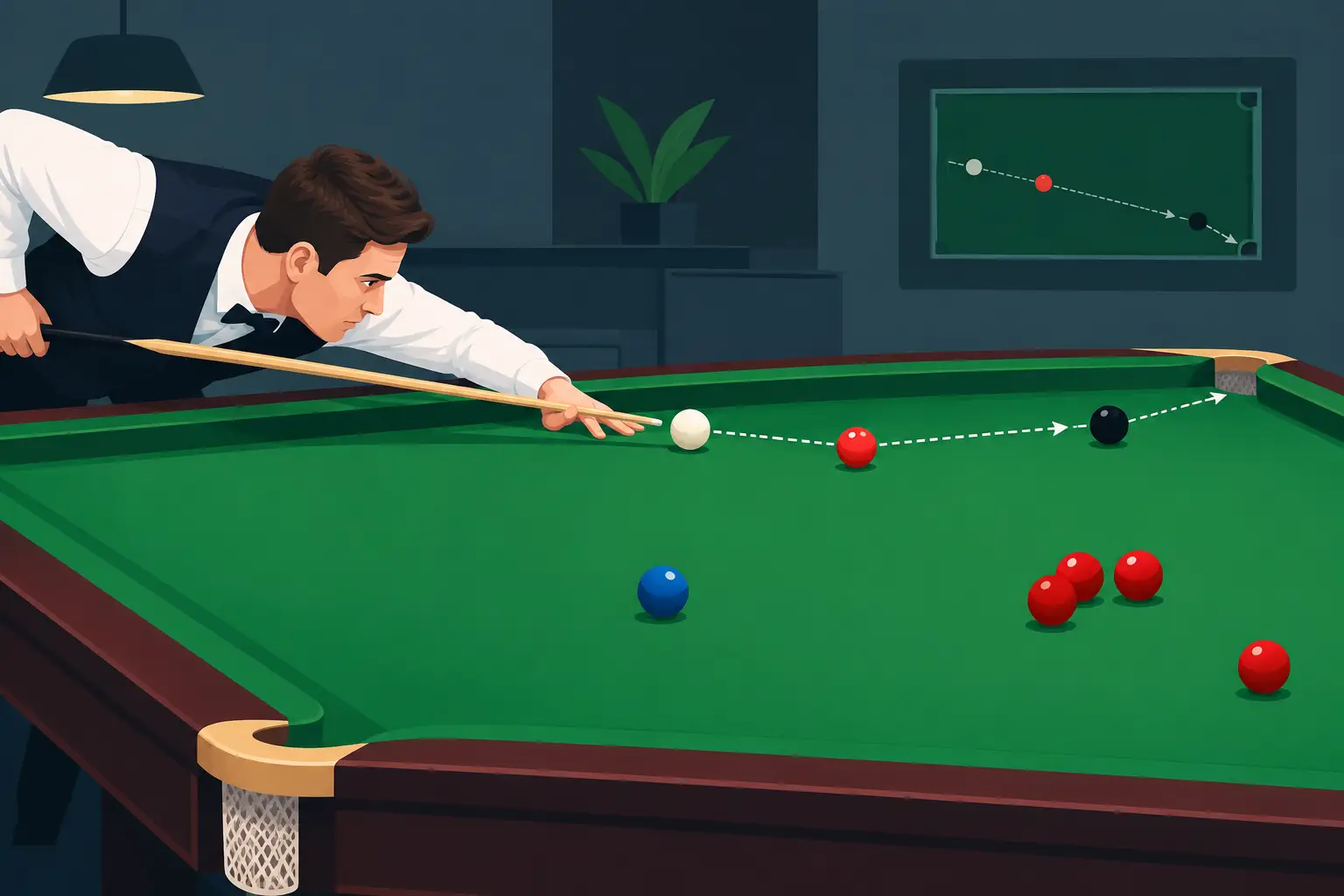
A runout is rarely won by the shot that gets applause. It is won two or three balls earlier, when you choose the right colour, leave the right angle and refuse the tempting pot that would leave you stranded. Learning how to plan snooker runouts means seeing the table as a sequence of decisions, not a collection of individual shots.
For club players, this is often the dividing line between a promising break and a score that genuinely changes a frame. Potting ability matters, of course. But once you can make routine balls, your progress depends on whether you can make the next shot easier than the last.
Start at the finish, not the first red
Before you play a scoring shot, identify the realistic finish. On a reds-and-colours break, that usually means locating the final workable red, the colour that takes you back into the pack or open reds, and the colour you want to use once the table begins to clear.
This does not mean trying to calculate a 70 break in perfect detail before your first stroke. Snooker is too variable for that. A cannon may open more than expected; a red may block a route; the cue ball may run six inches further than planned. The aim is to build a route with options.
Ask yourself three questions before committing: where is the next red, which colour offers the largest positional area, and what happens if I finish slightly short or long? If the answer to the last question is “nothing good”, the shot may be too precise for the stage of the break.
The best runout plans have breathing room. Professionals make difficult patterns look simple partly because they keep finding big landing zones. They do not demand perfect cue-ball speed unless the table gives them no alternative.
Separate the table into phases
A useful way to read a break is to divide it into three phases. First, establish scoring rhythm with accessible reds and colours. Next, develop the table by opening clusters, clearing awkward reds or improving the cue-ball route. Finally, simplify the finish by moving towards the colours and leaving the cue ball on the right side of the table.
Many amateur breaks end because the player tries to develop the table before earning control of it. If there are two open reds available, there is no urgent need to crash into a pack. Secure position first. Then choose the moment when a controlled cannon gives you a clear reward.
How to plan snooker runouts around position zones
Position is not a single point on the cloth. It is an area from which you can pot the next ball with confidence. The size and shape of that area should govern your shot choice.
For example, when coming off the blue to a red near the black end, you may have a generous zone across several feet of the table. When coming off the pink to a red tight to a cushion, you might have only a narrow line. The first route is more forgiving, even if it leaves a slightly longer pot.
This is where players often confuse ambition with quality. The route that creates a close-range pot is not automatically the best route. A slightly longer red, played from a stable angle with natural cue-ball travel to the black, can be a far better scoring proposition.
Use the colours for what they are designed to give you. The black is the highest-value scoring colour, but it is not always the best positional colour. The blue can offer a wider route through the middle of the table. The pink may keep the cue ball in the scoring zone when the black is blocked. The brown and green can be intelligent choices when they preserve a simple line rather than forcing side spin.
A strong break builder treats colour selection as a positional decision first and a points decision second. Over a long session, that discipline produces more chances to use the black anyway.
Choose routes that work at your current standard
There is a difference between the ideal professional route and the percentage route for your game. If a plan requires a thin cut, three rails and delicate left-hand side to land on a narrow red, it may be technically possible. That does not make it wise.
Build your runouts around the shots you can repeat under match pressure. Favour natural angles, simple stun, controlled screw and cue-ball paths that do not depend on excessive side. Side has its place, particularly when the natural route is unavailable, but it increases variables: contact, throw, pace and the reaction off cushions.
The same applies to opening the pack. Do not enter a cluster simply because you have seen elite players do it. Go in with a purpose. Know which red you are trying to release, where the cue ball is likely to finish, and which safety exists if the balls do not separate cleanly.
Sometimes the correct decision is to leave the pack alone and make a smaller break. That can feel conservative, but a mature player understands that a 28 followed by a good safety may win more frames than an ambitious 45 attempt that hands over an open table.
Plan your key shots before you are forced to play them
Every break contains a few shots that determine whether it continues. These might be the cannon into the reds, the recovery pot after imperfect position, or the transition from the final red to the colours. Spot them early.
When you see a key shot ahead, start preparing for it immediately. If you need to be above the blue to access a particular red, do not casually leave yourself below the blue one shot earlier. If clearing a red near the black spot will open the table, make sure you approach it from an angle that lets the cue ball escape rather than stop in traffic.
This forward thinking is especially valuable on the colours. As the reds disappear, each positional mistake becomes more expensive because there are fewer recovery options. Before potting the final red, decide which colour gives you the best route to yellow. Before taking the blue, know whether you want the cue ball on the left or right side of the table for pink.
The colours are not a formality. They are a separate runout with tighter margins. Treat them with the same planning discipline you used on the reds.
Use a decision routine, not guesswork
Good runout planning becomes faster when your thinking follows a reliable order. As you approach the table, assess the open reds, identify the available colours, notice clusters and blockers, then choose the shot that offers the best combination of potting certainty, position and table development.
Once the decision is made, stop reopening it. Indecision creates poor cueing. Commit to the line, visualise the cue-ball path and play the shot with a clear intention.
After every shot, reassess. Do not cling to the original plan when the cue ball has finished somewhere unexpected. The strongest players adapt without panic because their plan was never a rigid script. It was a framework built around priorities: stay on a red, keep the cue ball clear, preserve easy routes and avoid giving away the frame.
That is also why watching high-level snooker properly matters. Do not only admire the final pot. Watch where the player leaves the cue ball, which colour they reject, and how often they choose a larger positional area over a more spectacular route. The quiet decisions reveal the standard.
Practise runouts with a clear purpose
Random solo practice can improve your potting, but it does not always improve your break construction. Create situations that force planning. Place six reds in different scoring areas, nominate a target colour for each red, and judge the visit by whether you stayed in position rather than by the final score alone.
You can also practise one transition repeatedly: final red to a chosen colour, blue to pink, or pink to black. Start with generous angles, then narrow the positional zones as control improves. This develops the pace judgement that separates a planned route from a hopeful one.
For serious players, structured tuition can shorten the process considerably. The Rocket Method presents the game through the standards and decision-making of Ronnie O’Sullivan, helping players connect cue-ball technique with the tactical choices that make bigger breaks possible.
The next time you see an inviting red, resist the urge to ask only, “Can I pot it?” Ask what the pot gives you afterwards. That single habit turns a break from a series of chances into a runout built with intent.