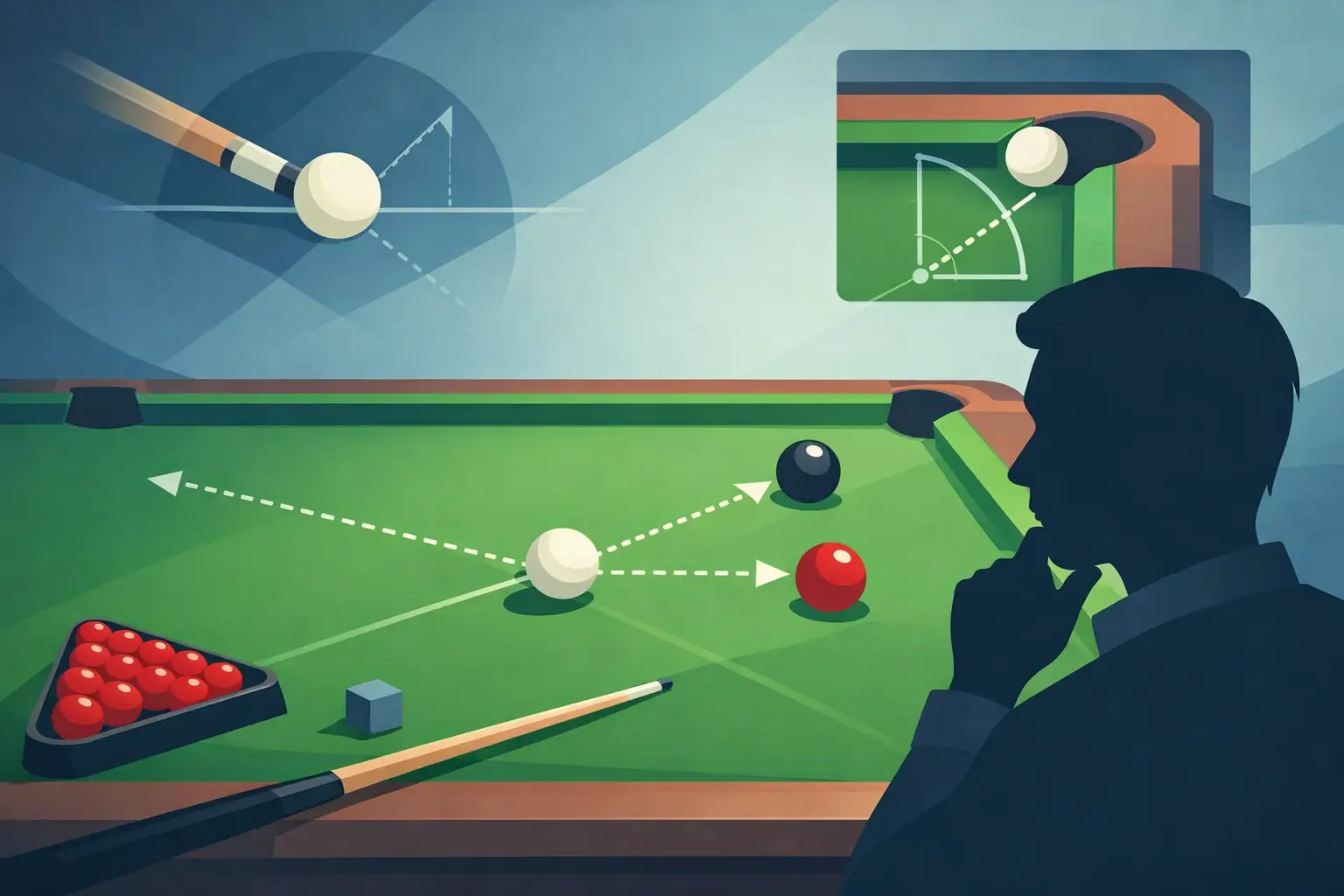
A shot can look straight, feel straightforward and still be missed by half a pocket. That is usually not a cueing problem. It is a picture problem. Learning how to judge snooker angles means seeing the true route of the object ball before you settle into the shot, then matching that picture with the right cue-ball contact and pace.
The best players do not rely on guesswork or a vague sense that a ball “looks right”. They build a reliable visual process. Once that process becomes familiar, pots become less dependent on confidence and more dependent on clear information.
How to judge snooker angles from behind the shot
Start where the shot actually begins: directly behind the line of the object ball and the target pocket. Before you think about side, screw or position, decide whether you can see a clean line from the object ball to the part of the pocket you intend to use.
For a centre-pocket pot, imagine a line running from the centre of the target pocket through the centre of the object ball. That is the object-ball line. Now ask where the centre of the cue ball needs to arrive to send the object ball down it. This is your contact point.
On a thin cut, the cue ball strikes closer to the outside edge of the object ball. On a fuller pot, it contacts nearer the middle. The principle is simple, but the table makes it deceptive: your eye can easily be drawn towards the cue ball rather than the object-ball route. Make the object ball and pocket your priority first.
A useful discipline is to stand behind the shot for an extra second. If the intended path is unclear while standing, it will not become clearer once you are down on the cue. Get up, reset your view and only address the ball when you can describe the shot to yourself in plain terms: full ball, three-quarter ball, half ball or thin cut.
Use the ghost-ball picture, but do not depend on it blindly
The classic method is to imagine a “ghost ball” resting behind the object ball, exactly where the cue ball must be at impact. Its centre sits on the line from the object ball to the pocket. Aim to send the real cue ball into that imagined position.
It is a powerful training image because it converts an abstract cut angle into a physical destination. Yet it has a limitation. You cannot see the ghost ball, and when the shot gets thin or the cue ball is travelling with side, players often start aiming at an imagined point with too much certainty.
Use the ghost ball to understand the geometry, then refine the picture through experience. On a long pot, a tiny error in the contact point is magnified over the length of the table. On a short, straightforward pot, you have more margin for error. The required precision changes with distance, pocket access, cushion conditions and cue-ball speed.
Rather than treating every shot as an exact mathematical calculation, develop reference points. Learn what a half-ball pot looks like from different positions, how a three-quarter-ball contact sends the cue ball across the table, and how a very thin cut feels when the object ball is close to a top pocket. These familiar pictures become your visual library.
Find the contact point before getting down
Many missed pots begin with a player getting into their stance too early. They see a general line, lower themselves over the cue and then try to solve the angle with small adjustments of the bridge hand or cue. That is rarely a winning process.
From upright, identify the object-ball route. Then picture the cue-ball route into the required contact point. Finally, step into the shot along that cue-ball line. Your feet, body and cue should support the decision you have already made, not search for it after the event.
If you feel yourself steering the cue at the last moment, it is usually a sign that the line was never fully committed to. A still, direct delivery is much easier when the picture was settled before the final backswing.
See the pocket, not just the pot
A pocket is not simply a hole at the end of a line. It has near jaws, far jaws and usable sections that change according to the approach angle. A ball sent too close to a near jaw can rattle even when the general line seemed correct. A ball played towards the far side may need a slightly different object-ball line, especially on a tight cut.
For routine pots, aim through the centre of the pocket. This gives you the greatest margin and keeps the decision uncomplicated. But when the cue ball is awkwardly placed, when position demands a particular route, or when a ball is close to a jaw, you may need to choose a specific part of the pocket.
That choice has consequences. Cheating the pocket can make a positional route available, but it reduces your potting margin. In a match, the correct decision depends on the score, the value of the break, the table conditions and your confidence in the shot. Championship snooker is not about forcing the most ambitious route. It is about choosing the percentage that keeps control of the visit.
Let cue-ball direction confirm the angle
The cue ball provides immediate feedback on whether you have judged a pot correctly. On a plain-ball shot, the cue ball generally travels away from the object ball on a line determined by the thickness of contact. A fuller hit sends it nearer the original line; a thinner hit sends it wider across the table.
This is why simple stun shots are so valuable for learning angles. With no excessive top, screw or side to complicate the outcome, you can see the natural cue-ball path clearly. Pot a series of balls using centre-ball stun and observe where the cue ball finishes. Over time, the connection between contact thickness and cue-ball route becomes instinctive.
Topspin, backspin and side are tools, not substitutes for accurate judgement. Top can lengthen the cue-ball path after contact, screw can pull it back, and side can alter both the cue ball’s journey and the object ball’s response off cushions. But if you are unsure of the basic potting angle, adding side often introduces another variable at exactly the wrong moment.
Build your game in the right order: see the pot, select the contact, understand the natural path, then add the minimum cue-ball action needed for position.
Train your eye with purposeful routines
Angle judgement improves fastest when practice has a clear purpose. Random potting can be enjoyable, but it gives poor feedback because every shot is different. Repetition lets you compare what you saw with what actually happened.
Place the blue on its spot and the cue ball in a fixed position below it. Pot the blue into one corner several times using centre-ball, then move the cue ball a few inches wider and repeat. Notice how the contact changes from full to thin and how the cue ball leaves the object ball. Do not rush to increase difficulty. Your goal is to make the picture accurate.
Next, use the same object-ball position and alternate between the two corner pockets. This forces you to read two distinct angles from one cue-ball location. Then introduce a simple positional target for the cue ball, such as finishing above or below the pink spot. You are now connecting potting geometry with break-building intention.
For longer pots, practise looking from behind the line, walking into the stance, delivering the cue and holding your finish. Record a few attempts if possible. Video can reveal a common fault: a player may correctly see the angle while standing, then move their head or cue off-line as they address the shot.
Make decisions that hold up under pressure
Pressure narrows attention. Players begin to stare at the pocket, jab at the cue ball or overthink the contact point. Your answer is not a more complicated routine. It is a familiar one.
When the pot matters, return to the same questions: Where is the object ball going? How full do I need to hit it? What is the natural cue-ball path? Is the positional reward worth the reduction in potting margin? Answer them before you get down, then trust the decision.
Great angle judgement is not a gift reserved for naturally gifted players. It is trained observation, reinforced until the table starts to look calmer and more legible. The Rocket Method approach is built around that standard of deliberate practice: clear fundamentals, repeatable decisions and the confidence to execute when the chance arrives.
The next time a shot appears awkward, resist the urge to manufacture a miracle. Stand behind it, find the object-ball line, choose the honest contact point and let a disciplined cue action do the rest.