
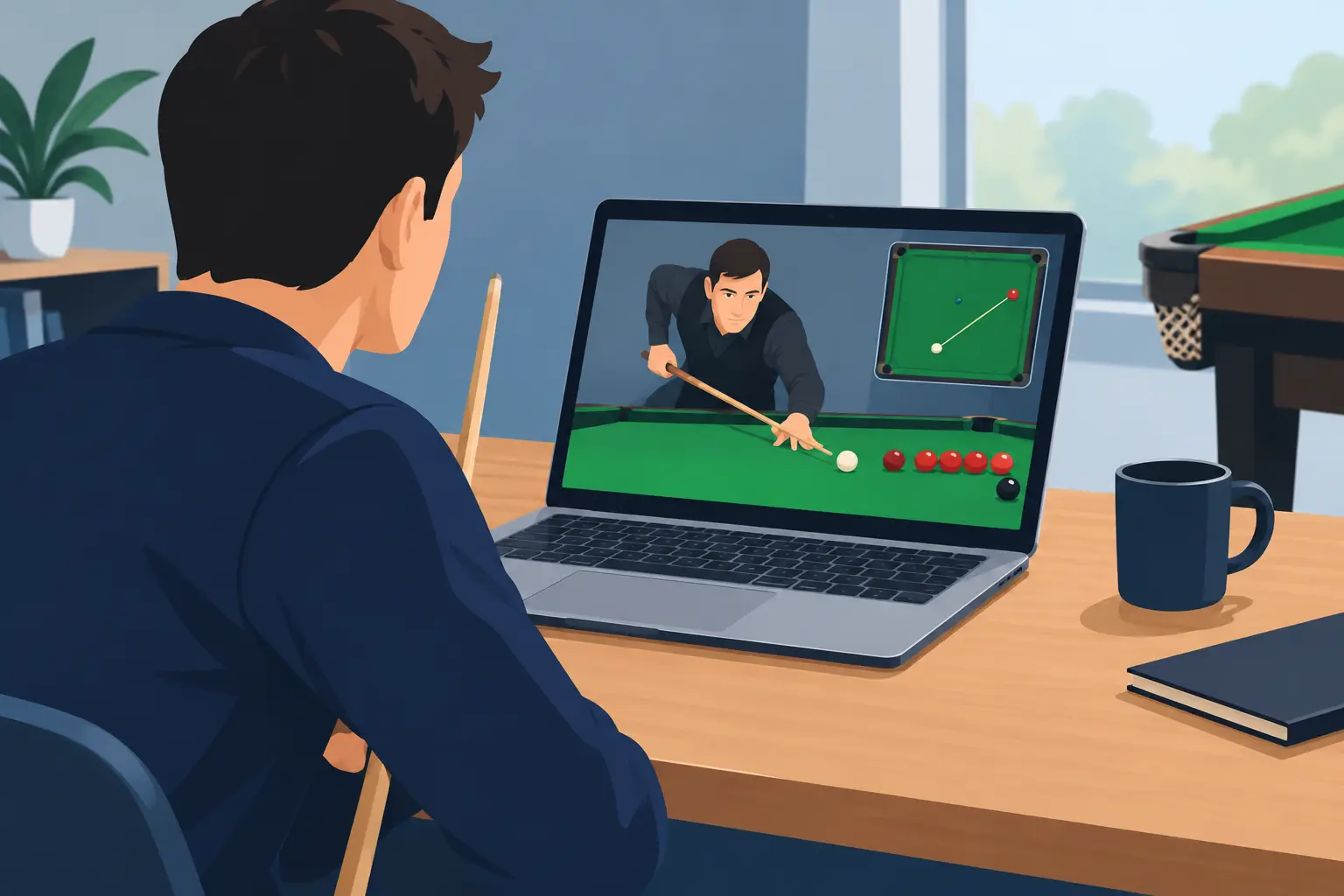
A missed black into the middle is rarely just a missed black. It may begin with a loose grip, an unstable bridge hand, poor alignment, a rushed backswing or a tactical choice made two shots earlier. That is why the real question is not simply can online snooker lessons work, but whether they can help you identify the cause of the mistake and build a repeatable response.
For the right player, the answer is yes. Online instruction can produce meaningful, measurable improvement because snooker rewards detail, repetition and decision-making. But it only works when the teaching is structured and the player is prepared to take the practice table seriously.
Can Online Snooker Lessons Work as Well as Coaching in Person?
An excellent coach standing beside the table can spot faults in real time. They can adjust your stance, watch the cue travel and stop a bad habit before it becomes ingrained. That is an advantage no honest online course should pretend does not exist.
Yet in-person coaching is not automatically better simply because it is personal. A single lesson can be expensive, difficult to arrange and easy to forget. If the instruction is not recorded or organised into a clear system, many players leave with three technical thoughts and no reliable plan for the next month.
A high-quality online course solves a different problem. It gives you access to expert demonstration whenever you need it, rather than for one hour on a particular afternoon. You can watch a key movement again, compare it with your own action, return to a lesson after a difficult match and practise one principle until it becomes natural.
That matters because snooker is learned between lessons. The player who improves is not necessarily the one who hears the most advice. It is the player who understands what to practise, why it matters and how to recognise progress.
Online teaching is particularly effective for the parts of the game that benefit from clear visual explanation: stance, cueing, bridge work, sighting, striking the cue ball, safety play, break-building patterns and match temperament. A world-class player can show not only what they do, but the decisions and standards behind it. That turns instruction from a collection of tips into a method.
What Makes Digital Snooker Coaching Effective?
The format alone is not the answer. A few short clips on social media may inspire you, but they rarely provide enough context to change a game. Serious improvement requires a sequence.
First, the teaching must start with foundations. Players often want to jump straight to long potting or heavy screw, yet those shots expose weaknesses rather than cure them. If your head position changes, your cue is not travelling straight or your delivery is tense, more advanced shots simply make inconsistency more obvious.
Second, the lessons need to explain cause and effect. Being told to keep still is not enough. You need to understand how a stable lower body, a settled head and a controlled cue delivery improve alignment and contact. Once you understand the purpose of a movement, you are more likely to retain it under pressure.
Third, digital instruction must be organised around the way players actually develop. Technical work should lead into cue-ball control. Cue-ball control should lead into better positional decisions. Better decisions should lead into stronger breaks and more composed matchplay. When these areas are taught in isolation, progress can feel fragmented. When they are connected, your game starts to make sense.
This is where elite-led instruction has real value. Great players do not merely pot difficult balls. They see the table earlier, choose simpler routes and protect their scoring chances. Learning those principles can change the way an amateur approaches every frame, even before their highest break changes.
The Limitation You Must Not Ignore
Online snooker lessons cannot physically reposition your feet or tell you, at the exact moment of delivery, that your cue has lifted. If you have a deeply ingrained technical fault, a coach in the room may help you correct it faster. Players with access to a respected local coach can benefit enormously from combining both approaches.
There is also no substitute for table time. Watching a lesson about stun and screw does not create a reliable stun and screw shot. You have to hit balls, observe the result and repeat the action with intent. A premium course can give you the blueprint; it cannot take the shot for you.
The common mistake is treating online learning as entertainment. Watching three lessons in one evening may feel productive, but it can overload your mind. A better approach is to take one technical idea to the table, work on it at a manageable pace and assess whether the cue ball is responding more consistently.
If possible, record yourself from the front and side. Your perception of your stance and cue action is often very different from reality. You do not need elaborate equipment. A phone positioned securely can reveal head movement, cue deviation, a collapsing elbow or a rushed final delivery. Compare what you see with the demonstration, then change one thing at a time.
How to Get Results From Online Snooker Lessons
The strongest players are not always those with the most natural touch. They are often the ones who practise with the clearest purpose. Build a routine around quality rather than endlessly knocking balls around.
Start each session with a simple objective. It might be delivering the cue straight on a line, holding the finishing position, controlling the cue ball through a chosen zone or playing a safety that leaves the object ball on the cushion. One focused theme gives every shot a job.
Then make the practice measurable. Instead of deciding that your long potting felt good, set up the same shot ten times and record how many you make while maintaining the intended cue-ball position. Rather than judging your safety play by instinct, ask whether your opponent has a clear pot, an easy escape or an attacking opportunity. Numbers do not tell the whole story, but they stop wishful thinking.
You should also separate technical practice from competitive practice. During technical work, slow down. Rehearse the set-up. Check your alignment. If a shot feels wrong, step away and begin again. During frame practice, trust the work and play with freedom. Trying to rebuild your stance in the middle of a tense final-frame black is rarely productive.
Finally, revisit the lessons. Your understanding changes as your game develops. A point about shot selection that seemed obvious as a beginner may become highly relevant when you are regularly making 20 or 30 breaks. The best instruction continues to offer value because it has depth beneath the first viewing.
Why Structure Beats Random Advice
Most amateur players have already consumed plenty of snooker content. They have heard conflicting opinions about grip pressure, elbow position, aiming and the perfect pause. The issue is not a shortage of information. It is a shortage of hierarchy.
Random advice encourages constant tinkering. After one poor session, a player changes their grip. After the next, they change their stance. A few days later, they are trying a new cue action from a video clip. Confidence falls because nothing has time to settle.
Structured teaching creates order. It helps you establish the basics, understand the shots that matter most and develop tactical discipline before chasing spectacular pots. That is a professional way to improve: build a standard, test it under pressure and return to the standard when your game drifts.
The Rocket Method is built on that principle, bringing Ronnie O’Sullivan’s experience into a complete, high-production learning programme rather than leaving players to piece together disconnected advice. For beginners, that means a credible starting point. For experienced players, it means a chance to examine the habits and decisions that have kept their game at the same level.
Who Benefits Most From Learning Online?
Online snooker lessons work especially well for players who have limited access to high-level coaching, irregular club hours or a desire to practise independently. They suit the beginner who wants sound habits before bad ones take hold, the club player stuck at the same break range and the serious amateur preparing to compete with greater consistency.
They can also work well for clubs and groups. A shared training resource gives members a common language for technique and tactics, while allowing each player to learn at their own pace. The key is still application. Discussion around a lesson is useful; putting the lesson onto the table is where standards rise.
They may be less suitable as the only solution for someone recovering from an injury, struggling with a very specific physical limitation or requiring immediate technical diagnosis. In those cases, combine digital learning with qualified in-person support where possible.
The value of online instruction is not that it replaces every form of coaching. It is that it places championship knowledge within reach, gives your practice direction and lets you return to the details that separate occasional good shots from dependable snooker. Choose one area of your game, give it proper attention this week and let the table tell you what has changed.