A cue can look perfectly straight in practice and still break down the moment a black is needed for the frame. Often, the problem is not aim. It is the hand on the cue tightening at exactly the wrong time. This snooker grip pressure guide shows how to hold the cue with enough control to deliver it accurately, but enough freedom to let it travel through the ball.
Grip pressure is a small detail with a large effect. It influences cue delivery, timing, cue-ball response and, crucially, your ability to repeat the same action when pressure rises. Get it right and the cue feels like an extension of the arm. Get it wrong and even a simple pot can become a fight.
What Good Snooker Grip Pressure Feels Like
There is no useful universal number. A long straight red, a delicate stun shot and a firm screw shot ask different questions of the cue action. Yet the foundation remains the same: hold the cue lightly enough that it can swing freely, while keeping enough contact to guide it reliably.
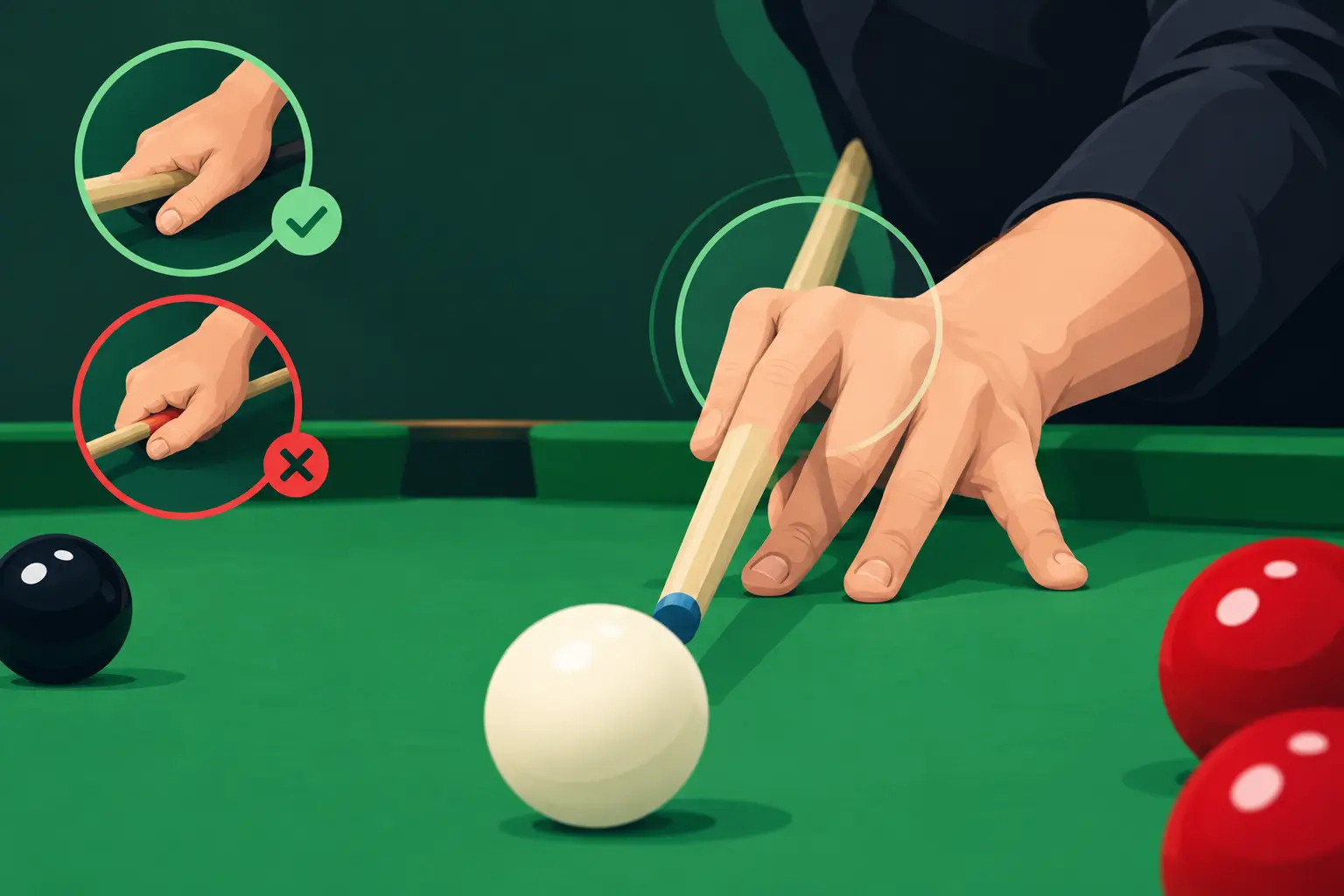
For most players, the starting point is around three or four out of ten. The cue should rest mainly in the fingers, not be clamped in the palm. Your thumb and first finger create security, while the remaining fingers support the cue without squeezing it. You should feel in command of the cue, never as though you are trying to restrain it.
A useful test is to address the cue ball, complete a few feathering strokes and notice your knuckles. If they are whitening, the hand is probably working too hard. If the cue wobbles or shifts in the hand, you may be too loose. The target is quiet, relaxed control.
The word relaxed can be misunderstood. A relaxed grip is not a careless grip. Elite cueists create a stable platform at address, then allow the cue to move with minimal interference. The hand stays connected, but it does not dominate the stroke.
Why Too Much Pressure Ruins Cue Delivery
When the grip tightens, tension travels up the wrist, forearm, elbow and shoulder. The cue no longer swings naturally. It is pushed, jabbed or dragged through the shot, often with a slight sideways movement that is difficult to see but easy to feel in the result.
This is why an over-tight grip commonly produces missed pots that look baffling. The player may be aimed correctly, but the cue has contacted the cue ball off line. On shots with side, unwanted tension makes matters worse because the cue tip must meet a very precise point on the ball.
Excess pressure also damages touch. A player who grips hard tends to hit delicate shots too firmly and struggles to judge the pace of a cue ball rolling into a tight area. Safety play becomes less exact. Positional routes become larger than intended. Under match conditions, this can turn one anxious shot into an entire difficult visit.
The trade-off is that gripping too lightly creates its own problems. If the butt lifts, rotates or slips at delivery, you have lost a dependable reference point. The answer is not to grip harder throughout the action. It is to establish better finger contact and a more balanced cue hold.
Snooker Grip Pressure Guide: From Address to Follow-Through
Your grip pressure should not be completely frozen. It should be calm and consistent, with only a subtle natural adjustment as the cue travels. Think about each phase of the shot.
At address
Settle the cue in the fingers and let the wrist hang naturally. Avoid turning the hand inward to trap the butt against the palm. The cue should be level and comfortable, with your grip hand positioned so the forearm can approach vertical at the strike on a standard shot.
Before committing, take one slow breath. This is not theatre. It gives you a direct check on tension. If the grip feels tight before you begin, reset it before you feather.
During feathering
Feathering reveals the truth about your grip. The cue should pass back and forth smoothly, without a jerky start or a sudden stop at the end of the backswing. Keep the pressure light and allow the fingers to remain soft around the butt.
Do not repeatedly squeeze and release the cue as you feather. That creates changing conditions from one practice stroke to the next. Set your hand, trust it and let the cue run.
On the final delivery
As the cue moves back, resist the urge to tense in anticipation. Many players are relaxed during their practice strokes, then grab the cue as they begin the shot that matters. That final squeeze is often the source of a rushed, inaccurate strike.
Drive the cue with a free forearm. Your grip hand may close fractionally through impact, particularly on a firmer shot, but it should never feel like a punch. The cue travels through the ball because the action is timed, not because the hand has forced it forward.
After contact
A clean follow-through is evidence, not a pose. If the cue finishes straight and your hand remains settled, the delivery has a chance to be repeatable. Do not hold the cue rigidly after impact to manufacture a finish. Let the finish happen as a consequence of a good action.
Adjusting Pressure for Different Shots
The basic feeling stays light, but the demands of the shot can change the amount of support you need. On a gentle rolling pot or a soft safety, keep the grip especially quiet. Any squeeze is magnified because the cue ball is travelling slowly and needs precise pace.
For a firm stun shot, you need a stable hand and decisive acceleration, not a tighter grip from the start. Keep the cue free during the backswing, then let the forearm deliver the speed. If you feel you need to strangle the butt to hit the ball hard, your timing and cueing rhythm need attention.
Screw shots demand commitment through the cue ball. Players often grip too tightly because they fear miscues or want to force extra backspin. Start with sound tip contact, a level cue where possible and a smooth acceleration. A controlled grip supports that action; it cannot compensate for a jab.
On shots using side, lightness is even more valuable. Side spin exposes small errors in cue delivery, so a tight hand can send the cue off line and add unintended swerve or throw. Use a shorter, more measured pre-shot routine if needed, but do not solve the difficulty by squeezing the cue.
A Practice Routine That Builds the Right Feel
Take ten minutes before a practice session and make grip pressure the only technical priority. Place the cue ball near the centre of the table and pot a succession of straight reds at a comfortable pace. Your task is not to see how many you can make. It is to observe whether the cue passes through on the same line every time.
Start with a deliberately loose hold for five shots. Then use what feels like your normal grip for five more. The contrast helps you recognise how much tension has crept into your default action. Finally, settle at a controlled three or four out of ten and repeat the drill, pausing after every shot to assess the finish.
Film the cue action from behind if possible. Look for a grip hand that twists, rises or snaps closed as the cue reaches the ball. These movements are easier to correct when you can see them, rather than relying only on the feeling of the shot.
Pressure drills are equally valuable. Create a simple consequence, such as needing three straight pots in a row before moving on, and watch what happens to your hand on the third ball. If it tightens, do not criticise yourself. Reset, breathe and rehearse the same loose, committed delivery. The goal is to make the right grip pressure available when the score matters.
Let the Cue Do Its Job
Great cue action rarely looks forced. It looks unhurried, balanced and certain because the player has removed unnecessary effort. Grip pressure is one of the clearest ways to do that. A lighter, better-supported hold gives your technique room to work and gives your natural timing a chance to emerge.
Build this feeling patiently. A few minutes of purposeful practice can change the way the cue leaves your hand, and that change can travel through every part of your game. For players who want championship-level detail presented in a structured way, The Rocket Method brings that standard of thinking to every element of the table.