
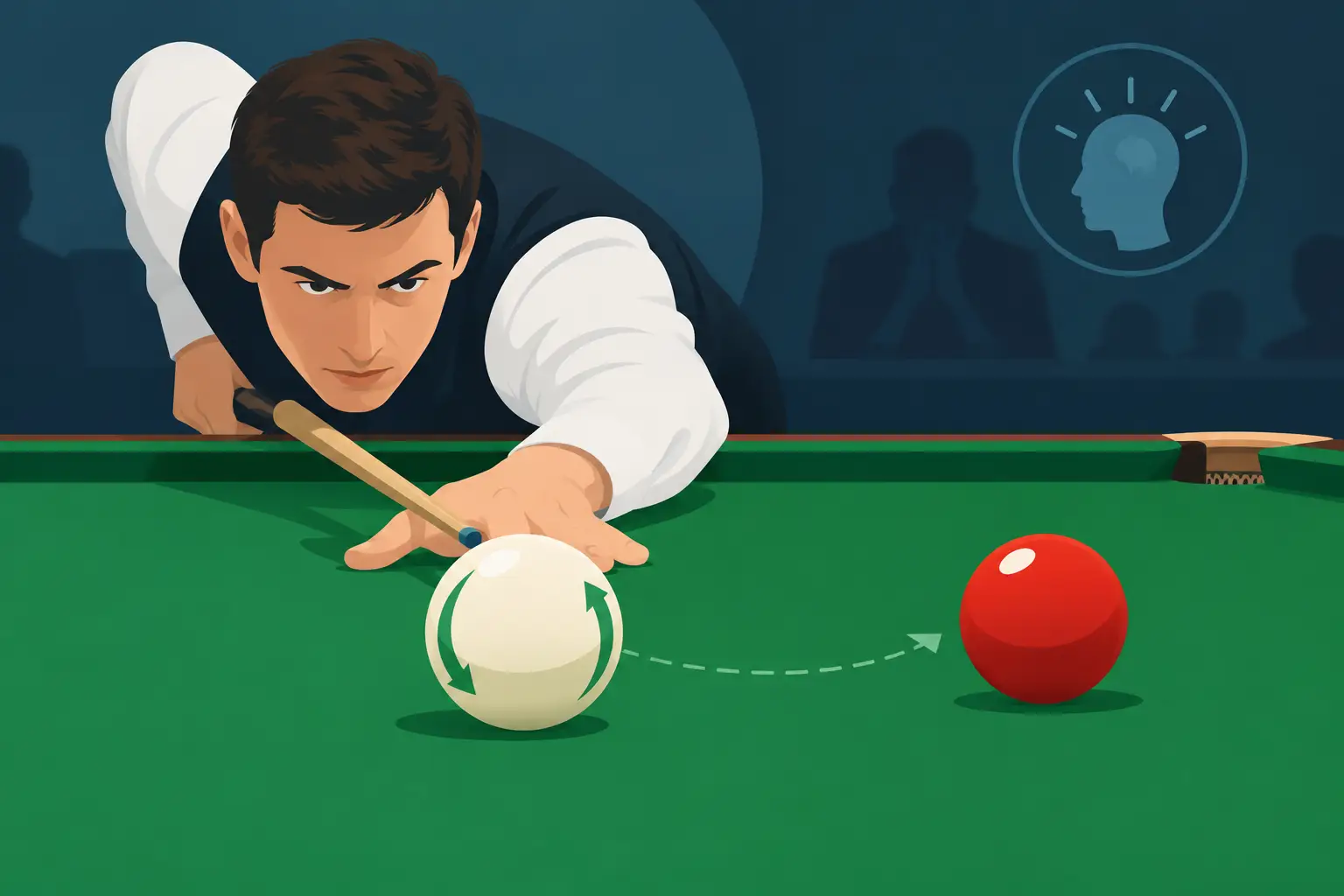
A centre-ball shot can look simple because the cue ball behaves as expected. Add snooker side spin, however, and the table starts asking more of you: a cleaner cue action, sharper judgement and a genuine understanding of what happens after contact. Used well, side gives you routes that centre ball cannot. Used carelessly, it turns a routine pot into a miss and a promising break into an apology.
The difference is not talent. It is control. The best players do not apply side because it looks clever. They apply it for a clear positional or tactical reason, then deliver the cue accurately enough to make the shot repeatable.
What side spin really changes
Side spin is created by striking the cue ball to the left or right of its vertical centre line. Left-hand side makes the cue ball rotate anticlockwise from above; right-hand side makes it rotate clockwise. That rotation affects the cue ball at three key moments: when it contacts the object ball, when it reaches a cushion and when it travels across the cloth.
Before object-ball contact, side can cause swerve. The cue ball curves slightly, particularly when the cue is elevated or the shot is played slowly. At the moment of contact, it can create throw, where friction between the balls pushes the object ball a fraction off its natural line. After contact, side becomes most visible at the cushions, changing the cue ball’s rebound angle.
This is why side spin is not simply a positioning tool. It alters the potting equation as well. On a straight, firm shot, the effect may be minimal. On a slow cut shot to a tight pocket, or a shot with a raised cue, it can be decisive.
When snooker side spin earns its place
The first question before applying side is not, “Which side will bring me round?” It is, “Can I achieve this position with centre ball, stun, screw or follow?” If the answer is yes, choose the simpler option. Centre-ball cueing gives you the largest margin for error and protects potting accuracy.
Side earns its place when it gives you a superior route into position. Perhaps you need the cue ball to widen off two cushions, hold its line after the first cushion, avoid a middle pocket, or come around an angle that natural running would not provide. In safety play, side can help the cue ball check off a cushion and finish short of danger, or take a path that leaves the object ball in a less forgiving position.
There is a trade-off. The more side you add, the more precisely you must strike the cue ball, judge the contact point and account for the cloth. Heavy side on a difficult pot is often a low-percentage decision unless the situation demands it. Championship snooker is built on choosing the highest-percentage shot available, not the most spectacular route.
Running side and check side
Running side is the side that encourages the cue ball to travel onwards around a cushion. If the cue ball is approaching a cushion and you apply the side that matches its natural roll along that rail, it tends to rebound more open and travel further around the table.
Check side does the opposite. It resists the natural path, making the cue ball rebound shorter or sharper. This can be extremely useful when natural running would send the cue ball too far, but it requires better judgement because check side magnifies small errors in pace and contact.
Do not try to memorise every possible angle at once. Start by recognising the simple question: do you want the cue ball to run on from the cushion or check back? Then learn how strongly your own table responds.
Build the cue action before adding more spin
Side spin exposes flaws that centre-ball striking can hide. If your cue drifts across the line, if your grip tightens at delivery, or if your head moves as you play the shot, the cue tip will not finish where you intended. What feels like a half-tip of right side can become unwanted side, or a complete miss-hit.
Set up as you would for a straight pot. Keep your bridge hand firm and stable, and make sure the cue has room to travel through the cue ball without brushing your body or clothing. Your grip should remain relaxed enough for the cue to swing freely. A tense hand is one of the fastest ways to twist the cue at impact.
Aim the cue tip at the chosen point on the cue ball during your practice swings. Then deliver straight through that point. Do not steer the cue sideways in an attempt to “put spin on it”. The spin comes from the tip position, not from a curling action of the arm or wrist.
A level cue is also valuable. Sometimes elevation is unavoidable, especially when bridging over a ball, but a raised cue increases swerve. If you are trying to learn the effect of side, practise with the cue as level as the situation allows. You will see a truer response and develop a more reliable reference point.
The contact point: begin with less than you think
Many players use too much side because they are chasing a dramatic reaction from the cushions. That makes potting harder and makes the result less predictable. Begin at around one tip from centre, rather than aiming near the edge of the cue ball. This is enough to see a clear effect without turning every shot into a technical gamble.
On a typical two-cushion positional shot, play the same route first with centre ball. Notice the cue ball’s path and finishing area. Then repeat with a small amount of running side at the same pace. Finally, repeat with check side. The contrast teaches more than theory alone because you can see how pace and spin work together.
As a general rule, slower shots allow side to grip the cushions more noticeably, while firmer shots reduce some of the effect. But speed is not a simple dial. A very soft shot can pick up more swerve before it reaches the object ball, while an overly hard shot can make touch position difficult. The right pace is the pace that gets the cue ball to the intended area with enough margin to play the next shot.
Common side-spin mistakes and their fixes
The most common error is blaming the side when the real issue is poor alignment. If you miss a routine pot with side, return to centre ball and check whether your cue is travelling straight. Side should be added to a sound action, not used as a substitute for one.
Another mistake is failing to allow for throw. On slow, thick cut shots, side can push the object ball away from the expected line. The exact adjustment depends on cut angle, speed, cloth conditions and how much side you use, so there is no magic formula. Start with modest side, watch the result honestly and make small adjustments. Trying to compensate wildly after one miss creates confusion rather than knowledge.
Players also misread cushions by assuming every table plays alike. New cloth, worn cloth, lively cushions, cold rooms and table humidity all change the response. Give yourself a few minutes before a match or practice session to play simple side-spin routes. That information is not wasted time. It is part of preparing to score.
Finally, avoid forcing side into shots where cue-ball control is already difficult. If the cue ball is tight to a cushion, you may have limited room to cue accurately. If you are stretching, bridging over a ball or playing at an awkward height, the sensible shot may be a simpler safety or a less ambitious positional route.
Three drills that make side spin dependable
Start with the cue ball near the centre spot and an object ball on its spot, leaving a comfortable pot to a corner. Pot the ball with centre ball and send the cue ball to a chosen side cushion. Repeat until you can land within a cue’s length of your target area. Then use one tip of running side and observe the altered rebound. The goal is not power. It is a repeatable finishing zone.
For the second drill, place the cue ball in the baulk area and use a simple object ball to send it around two cushions into a marked area near the black spot. Play ten attempts with running side, then ten with check side. Keep the same cue-ball contact point and alter only the pace once you understand the route. Record which misses run long, short, wide or narrow.
The third drill is for potting accuracy. Set up a gentle cut to a corner and play it first with centre ball, then with small left and right side. Use a slow-medium pace. You are training your eye to see throw and your cue action to remain straight. If your pot success collapses as soon as side is added, reduce the amount of side and rebuild from there.
Make side spin part of intelligent break-building
The finest positional players use side quietly. The audience may notice a cue ball floating perfectly into the next line, but the decision was made before the player addressed the table: which route leaves the easiest angle, which cushion response is most reliable, and how much side is genuinely required?
That is the standard to pursue. Learn the mechanics, practise the routes and respect the variables, but keep the objective simple: make the next shot easier. The Rocket Method approach is built around this kind of purposeful decision-making – technique that holds up when a break matters, not isolated trick shots.
Next time you practise, choose one familiar positional route and play it with less side than usual. Watch the cue ball closely, judge the result, and add only what the shot needs. Control begins when side spin becomes a deliberate choice rather than a hopeful correction.